People’s Movement Assembly in Atlanta draws hundreds to create collective vision of transformed public safety
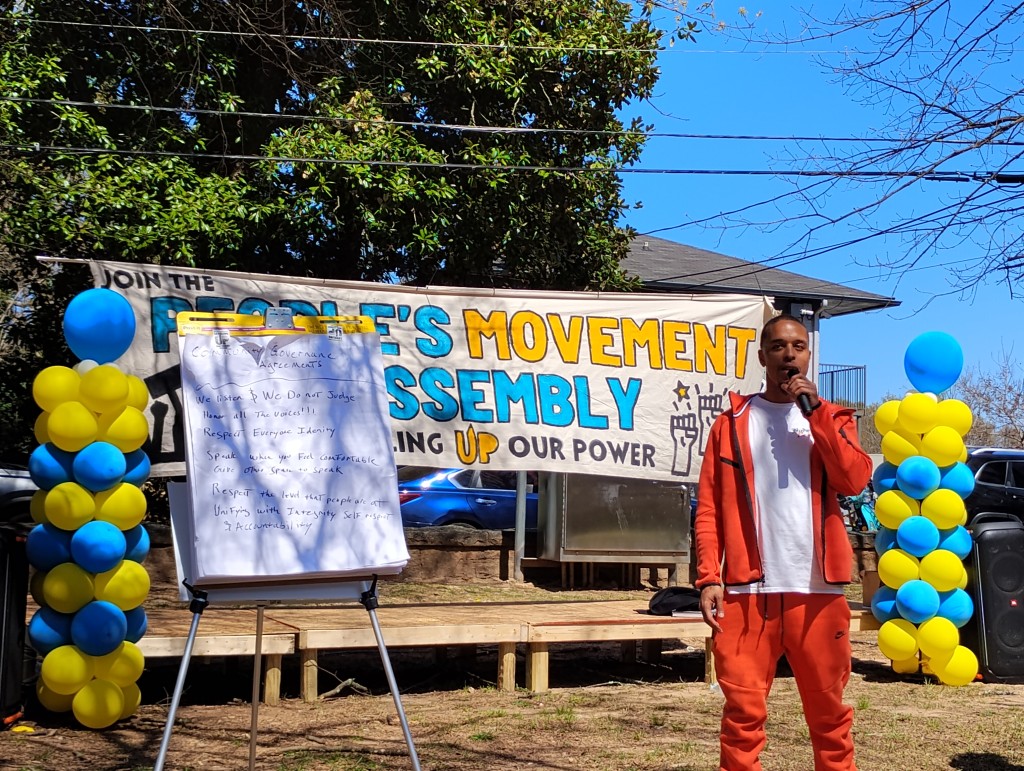
Participants agreed on protecting one another and meeting everyone’s basic needs, among key elements of how Atlanta residents redefined public safety.
Community members discussed and partially lived out a collective visualization of what they want public safety to look like as hundreds of Atlantans convened Saturday afternoon at Howell Park in the West End to brainstorm and vote on critical aspects of a holistic view of public safety in a People’s Movement Assembly (PMA).
“We have to figure out exactly how we harness this people’s power,” said Steph Guilloud, Project South movement organizing senior strategist and editor of the People’s Movement Assembly Organizing Handbook. “We’ve got multiple spaces where we can take some power back, but we have to have a platform. We have to have agreements about what we want, what we’re going to build and what we’re going to fight.”
As a group of locals active in their communities, they agreed through a series of conversations and activities that public safety in Atlanta would entail:
- Meeting fundamental necessities such as food and child care.
- Establishing accessible community solutions in times of crisis.
- Organizing neighborhood systems for accountability, education and harnessing existing infrastructure.
- Understanding how history, relationships, biases, norms, challenges and de-escalation have all manifested in Atlanta.
The event itself provided all of this, which excited many participants to the point of clamoring for more PMAs. In addition to calling for the next citywide PMA in August, Atlanta People’s Campaign organizer Chris Bufford encouraged attendees to build PMAs in their neighborhoods, extending these discussions to family, friends and even the city government’s neighborhood planning unit meetings.
“We want to make this process as inclusive as possible,” Bufford said. “We are all active participants in the work to bring the public safety that we envision, that we talked about today, to life.”
Breakout discussions shape safety priorities
The large group used paddles marked “Yes” and “No” on each side to respond to event organizers’ prompts. These ranged from true-false questions about the recent history of public safety in Atlanta to broad statements that formed a basis for the in-depth breakout group discussions that came next.
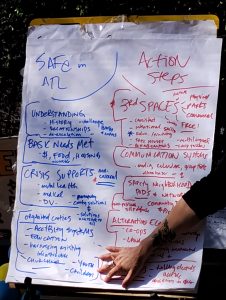
“We need to expand public transportation and improve it,” Albert, a local resident, said in one breakout group. “Expand its scope and make it free to residents—that would cut down on all the terrible traffic on our highways.”
Other thoughts included greater accessibility and funding for skill-sharing and community services, sustainable localized union careers in public works programs and implementing the actual preferences of each neighborhood from surveys and workshops, like the ones city government teams host around the city but often go ignored. The group concluded with a pledge from each member as an action step toward building the collective vision.
“Whenever we talk about organizing locally, I always feel intimidated because I am not an extrovert at all,” group participant Lindsey said. “At the same time, though, I’m also a project manager. I think I can use that skill set to organize things. I know how to set up budgets and schedules. I can bring that skill set to something and let someone else be the voice. I wonder how much people are feeling that same way—‘I’m not someone that people would want to follow’—that kind of mentality blocks people from getting involved.”
This inspired the group to ponder how to encourage others to get involved in their pledges. One said making flyers to help draw awareness; another spoke of a concerted effort to engage and involve neighbors in meetings like this; and multiple group members said simply showing up consistently and filling gaps, from child care to setup and cleanup. Although some were experienced organizers, others explained this PMA was their first engagement in community organizing and had attended at the invitation of a neighbor or friend.
How grassroots movements build power from local to global
Those simple steps are the building blocks for people’s movements to change their communities first, then their cities, states and countries, as featured speaker Geovani Serrano of the Georgia Latino Alliance for Human Rights elaborated.
“We need to transform everything that’s taking place in local elected office, so that we don’t have to worry about the city council in Atlanta anymore, because we know that they are going to do the work,” Serrano said. “Then we continue showing other communities that change is possible. And that’s really important when I think about the full transformation in Mexico that just last year led to the first woman in North America to be elected [president].”
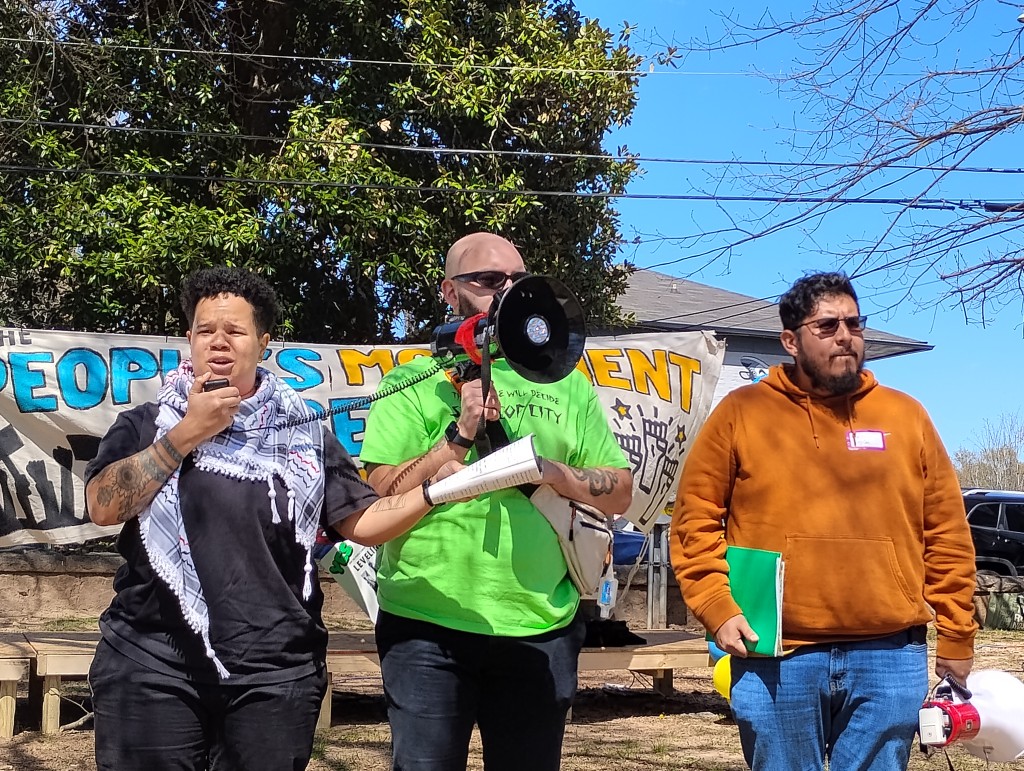
Serrano explained how extensive grassroots organizing with trainings every weekend was integral to that change in Mexico, continuing into the term of President Claudia Sheinbaum, not just in Mexico, but among Mexicans abroad, too.
Fellow featured speaker Rehana Lerandeau, an Atlanta-based national membership organizer at Critical Resistance, underscored how local and international militarized policing continue to affect one another, just as people’s movements at home and abroad affect each other.
“We’re facing a common enemy across so many different movements: immigration movements, labor movements, education movements, environmental justice movements,” Lerandeau said. “We are all under attack right now. That’s daunting, but that’s also the stuff of good coalition building. We can rally behind this together in a really strong formation, build our power and mobilize that power to bring in everyone.”
No paywall. No corporate sponsors. No corporate ownership.
Help keep it that way by becoming a monthly donor today.
Free news isn't cheap to make.
Related Articles
2026 Midterms: Metro Atlanta’s local races to watch
These are the competitive downballot races ACPC is watching in the 2026 election.
‘It seemed like every town in America had something going on’: Week of Action against Flock and ALPRs gets people engaged
As protests spread nationwide, Atlanta-based Flock Safety grapples with backlash over surveillance technology and growing privacy concerns.