‘Communities are watching’: Atlanta metro area residents increasingly concerned about Flock
From city halls to campus organizing and public records battles, Metro Atlanta residents are joining a growing national movement pushing back against Flock Safety cameras and mass surveillance.
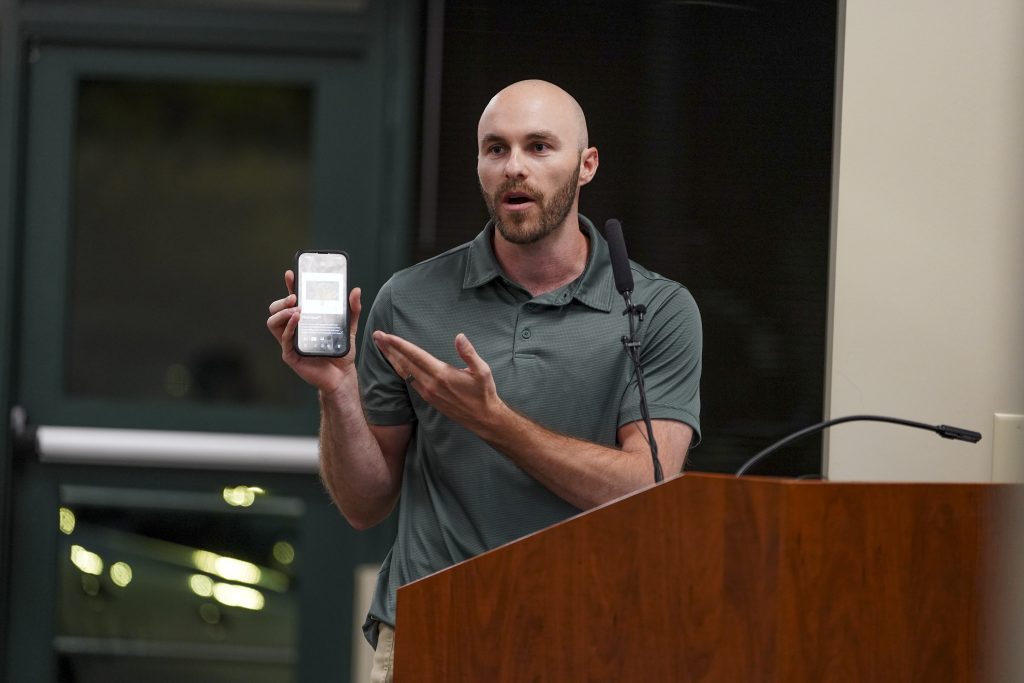
Jason Hunyar was chagrined, but resolute.
After attending six Dunwoody city council meetings over several months and discovering, through dozens of public records requests, an increasingly worrying litany of issues with Flock Safety, he had just witnessed his elected representatives approve a contract with the Atlanta-based surveillance tech company.
“It’s baffling to me,” said Hunyar, who sells software to pharmaceutical manufacturers. “Less than a week after we find out that Flock employees are watching children at a pool, they decide to continue to do business,” he said—referring to his discovery that the company’s executives were logged into cameras at Dunwoody’s Marcus Jewish Community Center.
A Flock spokesperson said via a written statement to ACPC that the company disagrees with Hunyar’s allegations and that Dunwoody was a demonstration partner and had authorized “select Flock employees to demonstrate new products and features.”
Nonetheless, on Tuesday, the morning after the council voted unanimously to approve several Flock-related contracts, the Dunwoody resident started his day by sending public records requests seeking all communications between each of the city council’s eight members and the company.
It was a shift in strategy. After sharing findings from what he estimated were 60 previous records requests with members of the city council, he was now focusing on the elected officials themselves. “They’ve shown no interest…they’re trying to push issues aside, instead of addressing them head on,” he said.
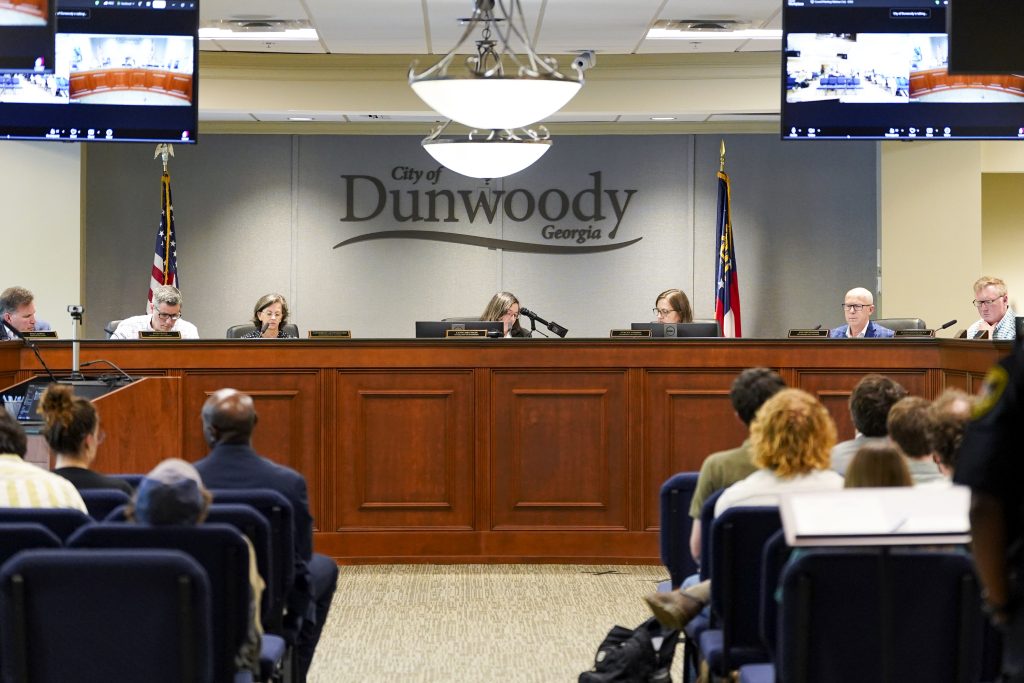
Turns out he’s not the only resident of the Atlanta metro area concerned about Flock, whose tech—license plate readers, cameras, “gunshot detection” microphones, 911 software, among others—is rapidly expanding across municipalities nationwide.
Also this week, in Marietta, product manager Taylor Arnold attended a Cobb County Board of Commissioners meeting to express her concerns about the county’s contracts with Flock.
And late last week, a coalition of undergrad and graduate students, professors and employees at Emory University delivered a petition to school administrators signed by more than a thousand people to remove all license plate readers from campus, terminate the school’s contract with the company and “initiate a transparent community-led review of campus surveillance practices.”
So it is that people in the surveillance tech company’s own backyard appear to be joining a growing chorus of communities across the U.S.—a nationwide, decentralized and politically pluralistic campaign that, while not universally effective, has led to at least 50 contracts being cancelled or rejected, or Flock cameras being deactivated, in the last year-plus, according to DeFlock, a project focusing on license plate readers.
We need to raise $65,000 from readers like you this year to keep publishing stories like this one! Historically, readers like you have accounted for ~5% of our annual revenue. For sustainability, we need it to be closer to 25%. That’s the number we need to hit so we can continue to cover ICE, protests, surveillance, DEI, Cop City, policing and the City Council.
To that end, we’re attaching a cost of goods to each of our stories so to be transparent about how much this work costs to produce.
This story is 1249 words. We pay $.66/word for freelance work ($824.34 for this story). There were an additional two hours of editing time ($27/hour).
The total cost of this story is $878.34.
Will you chip in $25 to help cover the cost of the story and to continue critical election coverage like this?
Unlikely organizers push back as Flock’s footprint grows
Hunyar’s concerns include “security, auditability and transparency. These three things should be present at a high level in a system of mass surveillance.” Then there’s privacy—as demonstrated in his discovery of Flock staff looking at footage of children in a local community center, an incident the Dunwoody Mayor Lynn Deutsch explained as being part of a “demonstration” to another municipality.
The Dunwoody resident became aware of Flock’s presence in his community when he saw surveillance researcher Benn Jordan’s December YouTube video calling a Flock vulnerability that the company says has since been fixed, “Netflix for stalkers.” The video, which has been seen more than 1.2 million times, includes footage from Peachtree Creek Greenway—where Hunyar and his wife go on walks.
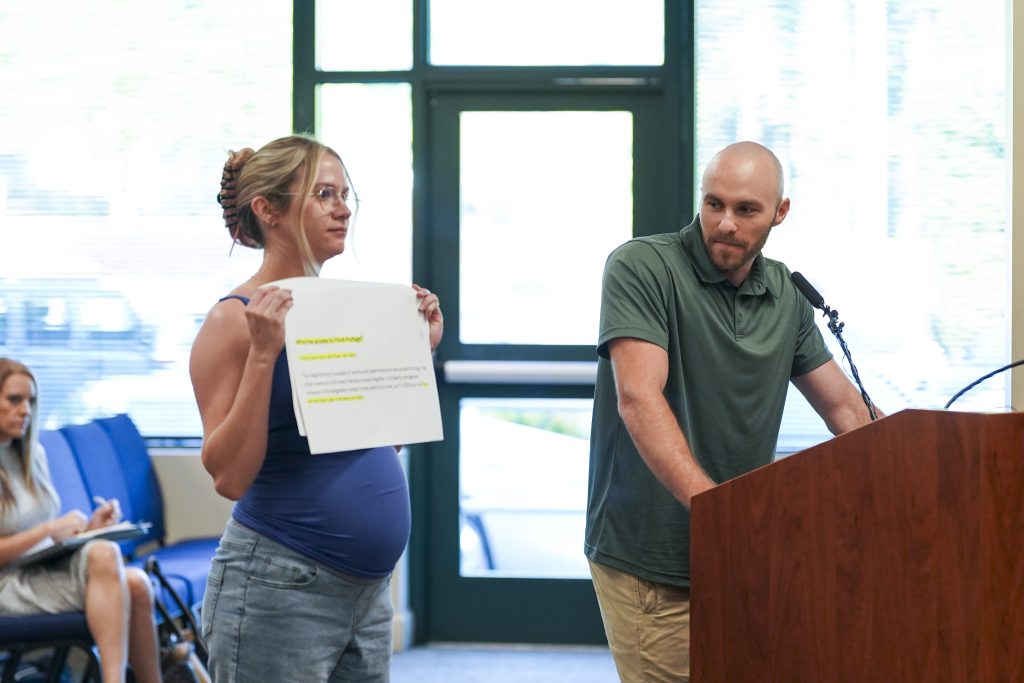
“That was an unsettling feeling,” Hunyar said. His wife is pregnant; their son is due in June. “I thought about my son, about to be born—and how he’s going to be tracked in an insecure database from the moment he’s born to the moment he dies.”
He started learning about the company and local politics.
Arnold, meanwhile, is concerned about ICE using the information gathered by Flock’s cameras. Between the two of them, the same issues they’re raising also come up in the dozens of cities and counties where residents are opposing surveillance tech.
Both Hunyar and Arnold have begun attending meetings of local elected officials due to their concerns.. In Dunwoody, Hunyar went from being the only person speaking about the issue during public comment to one of several dozen. Arnold is just getting started and still finds herself alone.
The issue also motivated them to learn about seeking public records and the challenges involved. In Hunyar’s case, that has included learning the stark realities of how public officials respond to such requests, after the city of Dunwoody said reviewing one year of Flock audit logs would cost him $5.4 million.
Emory campus activists take aim at surveillance infrastructure
At Emory, Maya, a sophomore studying environmental science and American studies, had been doing community safety organizing around ICE and the federal government’s mass deportation push when she began seeing connections to Flock’s ubiquitous cameras.
She and other organizers found that at least seven police departments have access to Emory’s feeds, including the Cobb County Police Department. If any of those departments share information with ICE, she said, it means that Emory is indirectly collaborating with the agency.



Right: Emory University sophomore Maya delivers a speech discussing her concerns over Flock Safety use at Emory during a protest and press conference on campus on April 10, 2026. (Matt Scott)
At the same time, she said there are multiple concerns among those who have signed the petition, including privacy and oversight—like what happens when those who have access to the license plate readers stalk former spouses?
“Everyone is tied up in this fight,” she said.
Emory spokesperson Laura Diamond did not answer an ACPC query about the petition and instead sent a statement which included the phrases, “[m]ore than 300 colleges across the country have [license plate readers]” and “only sworn [Emory Police] officers have access to the university’s account.”
ACPC could not independently verify which agencies, if any, can search the cameras on Emory’s network.
Atlanta’s surveillance decisions made in little-watched venue
In the Atlanta metro area, the outsized role of the Atlanta Police Foundation adds a layer of complexity for local residents concerned about surveillance tech in their communities.
This week, the board of Invest Atlanta—the city’s economic development authority—unanimously approved $536,000 in matching funds at the foundation’s request for a “Citywide Security Camera Expansion Program,” which will pay for 33 new cameras. The foundation will add $1.2 million for 75 cameras and Invest Atlanta will later vote on $682,000 for 42 cameras on the Beltline.
These cameras will be installed in five special tax districts, located in different Atlanta neighborhoods; the funding comes from property taxes. The cameras will come from Flock or NetPlanner, another tech company, according to Kyle Kessler, a member of two advisory committees on the funding.
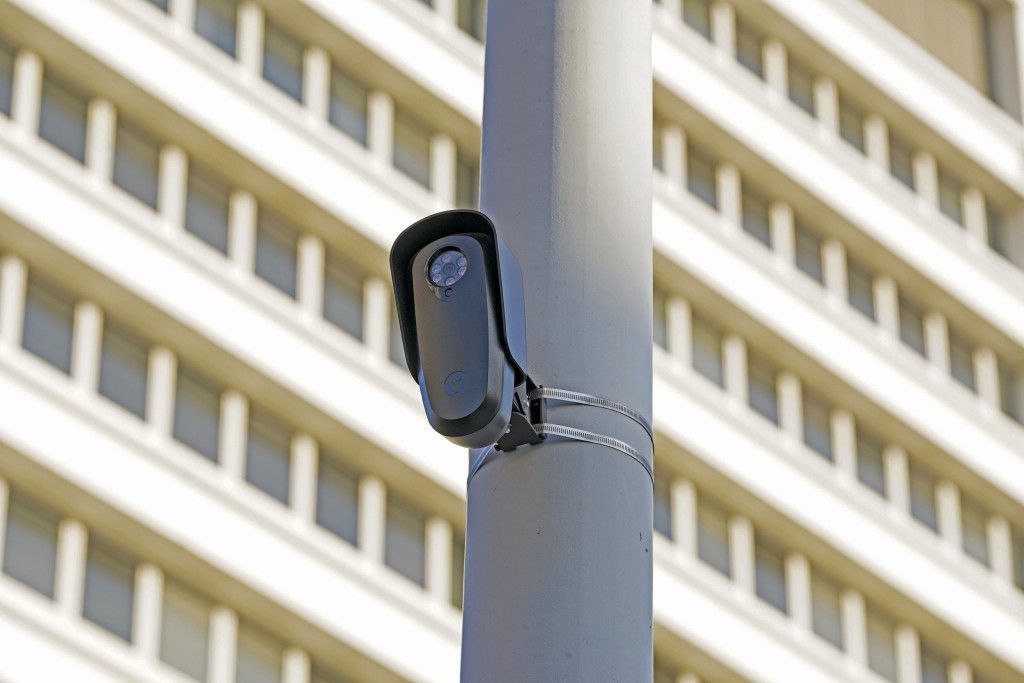
This week’s green light for more surveillance cameras from Invest Atlanta in partnership with the Atlanta Police Foundation was not the first such request. Invest Atlanta,, ostensibly focused on economic development, has granted $3.7 million for such tech in the last decade, said Jennifer Fine, vice president for planning and strategic initiatives.
The mechanism—the Atlanta Police Foundation seeks matching funds; advisory committees representing special tax districts make recommendations on the request; the board of Invest Atlanta makes decisions on the funding—is almost completely devoid of broad-based, public input.
“The public will become involved when a press release on the funding comes out,” said Kessler. “But folks are not invited to participate in the conversation. There’s not a robust communications strategy or invitation to the public, when millions are being spent.”
Meanwhile, Arnold plans to end her week by attending her first political rally on Friday outside Flock headquarters in Atlanta’s West Midtown Neighborhood. She said Dunwoody’s decision left her “battling between hope and fear. I think, ‘Is this the world we want to live in? Or is there a small but growing population hearing these stories?’”
Even as Flock’s cameras are increasingly found in communities everywhere, she said, “communities are watching them.”
No paywall. No corporate sponsors. No corporate ownership.
Help keep it that way by becoming a monthly donor today.
Free news isn't cheap to make.
Author

Comments (2)
Comments are closed.
Related Articles

AI, Flock cameras and data centers dominate debates for Georgia’s statewide races
AI was a hot topic in every Atlanta Press Club debate, from Attorney General to Agriculture Commissioner
Approximately 500 participate in hunger strike at Folkston immigration detention center
Government recently awarded massive contract to expand GEO Group facility to 3,000 beds to become largest permanent ICE site in United States.


Looks like it’s time to start removing Council Members as they apparently no longer represent those who put them in the Office
Another concern is voting. My polling place is covered up in flock and so is our early voting location; that’s just great!