
‘Everybody’s stuff surrounding me’: Lolita Griffeth moves into her own place after years on Old Wheat St
A year after the death of Cornelius Taylor brought national attention to an Atlanta homeless camp, Lolita Griffeth now sits in a quiet Buckhead apartment she calls her own—the first home she’s ever had.
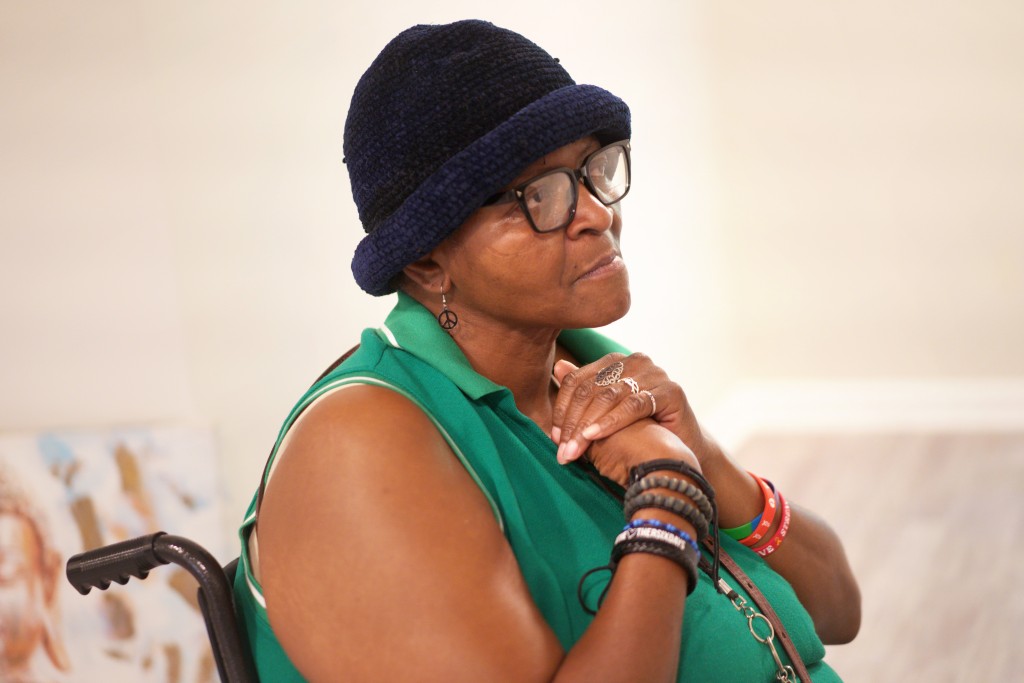
Lolita Griffeth sat in her wheelchair, looking over the living room and kitchen of her new apartment. At 57, it’s the first time she’s had her own place to live.
She circled the space with her eyes, taking in various stages of unpacking.
“It’s everybody’s stuff surrounding me,” she said. “I feel it.” She was talking about a painting of Buddha leaning against the wall, a coffee maker on the counter, some mugs that belonged to someone who used to live in the same homeless camp she did.
Everything came from someone else, supporters of Griffeth on her journey from a tent on Atlanta’s Old Wheat St. homeless camp to her new apartment in Buckhead.
They hadn’t just given her art for the walls and utensils for the kitchen, though. Before her recent move-in, she had gotten help with everything from dentures to sobriety.
Griffeth’s arrival at a new apartment came a year after a coalition of caring people began working with the city of Atlanta and a handful of organizations to get her and dozens of others off the street after decades of on and off homelessness.
She was perhaps the most high-profile member of a camp that had persisted for years in historic Sweet Auburn, being the former fiancé of Cornelius Taylor, who was killed by a city worker driving a front-loader truck into the tent where he was sleeping last year, days before the MLK holiday weekend.
In the wake of Taylor’s death, a group formed calling itself the Justice for Cornelius Taylor Coalition.
There were six months of activity surrounding the camp, including a city council resolution, the city of Atlanta issuing two reports and finally, the city announcing another sweep of the Old Wheat St. camp. Weeks of contentious negotiations and political theater surrounding the search for housing for nearly all the camp’s inhabitants followed.
ACPC wrote about this in September.
The camp’s former residents landed in various transitional housing programs. Twenty-two people, including Griffeth, received a room and a key at Welcome House—apartments “for some of Atlanta’s most vulnerable residents,” according to 3Keys, which owns the property.
With most of Welcome House’s 202 apartments inhabited by others getting off the streets, there are important differences between the arrangement and Griffeth’s new apartment.


Right: Lolita Griffeth packs frozen food to bring to her new apartment in Buckhead, Atlanta. (ACPC/Jesse Pratt López)
First, there’s the fact that she chose the apartment in Buckhead. The apartment is larger than the room she has at Welcome House, and there are no rules regarding what she can and can’t do spelled out on fliers at the front entrance. Also, importantly, her new neighbors are from the larger Atlanta community.
Housing First is a method developed by psychologist Sam Tsemberis in the early 1990s that has repeatedly resulted in higher rates of formerly homeless people remaining in housing.
In its original and intended form, the housing offered by the model is what’s known as “scattered site,” meaning unsheltered people get to choose where they want to live in the wider community, most commonly with rental assistance through federal or state-funded vouchers.
This is the situation Griffeth is now able to enjoy.
On the other hand, over time, many organizations––like Welcome House––have opted for “congregate” housing models, where formerly unhoused people live together in one building or several, and usually have access to supportive services on-site or nearby.
The congregate model makes it “easier to provide services,” Tsemberis told ACPC in September. However, missing from this approach is “the issue of dignity,” he said. “Is this the kind of place you would invite your grandchildren for dinner?”
From survival to stability
Alena Johnson, a case manager at Welcome House, told ACPC that Griffeth received what’s known as a federally funded “Housing Choice” voucher.
Under this arrangement, she pays $346 a month in rent, which she affords with money she receives via the Social Security Disability Insurance program. Griffeth had a stroke several years ago and mostly gets around in a wheelchair.
Both Johnson and Lorice Jean, a mental health counselor, were hired by the city of Atlanta to help the group of people that left Old Wheat St. and wound up at Welcome House.
Jean began visiting Old Wheat St. as a volunteer in May of last year, several months before Griffeth and others left the camp. Members of the coalition helped obtain a three-month contract for her to lead two weekly workshops at Welcome House—one on health and wellness, another on trauma.
Griffeth took advantage of the latter, as well as one-on-one sessions with Jean. She draws a direct relationship between being sexually abused by family members as a young child and decades of drug use, mostly smoking crack.
“She expressed to me that she hadn’t worked much on childhood trauma so much before,” Jean said. “It was an opportunity to heal.”
Griffeth also began attending AA meetings and is now 10 months sober. Meanwhile, the coalition raised money from the larger community to get her dentures.
Through all this healing work, Griffeth has begun seeing herself more clearly, she said.
For example, she no longer cares to be known only in relation to the tragedy of Cornelius Taylor’s death, as “the girlfriend.”
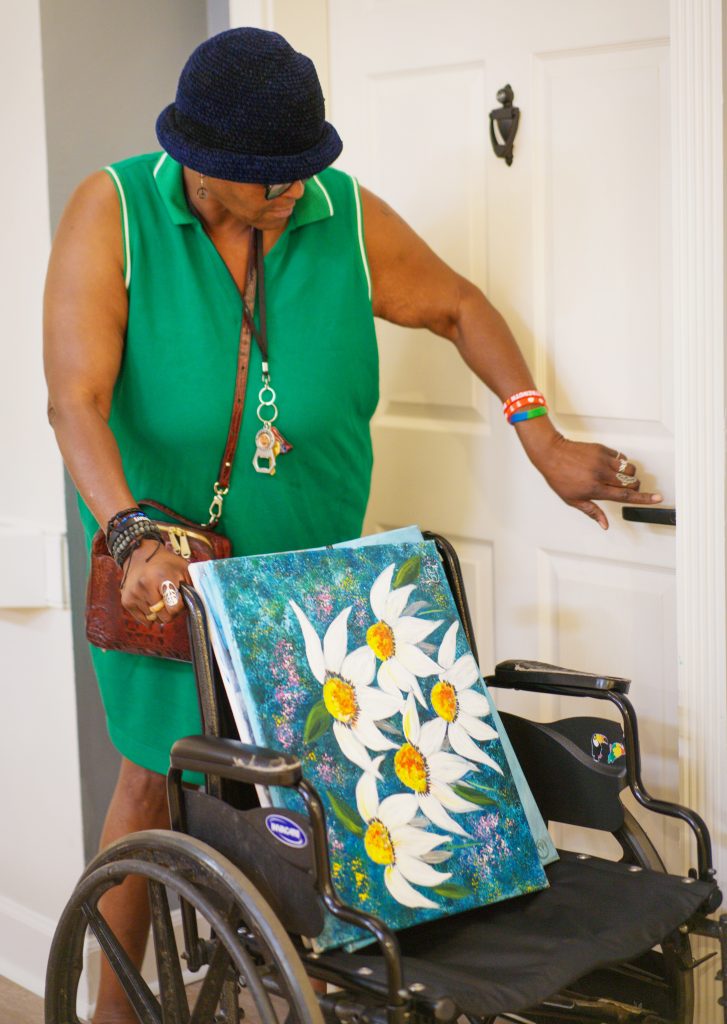
Reclaiming her story beyond the headlines
Johnson and Jean both described Griffeth as focused and driven. “She’s self-motivated,” Johnson said.
In part because of this and in part because of all the help she received, Griffeth’s journey is unique. “Most people would not be able to get as far,” said Jean.
“She latched on,” Jean added, meaning she pursued help wherever it was available, including with the counselor. “She would say, ‘Lorice, I know you give me your undivided attention.’”
This in turn helped build trust, Jean said. “Trust is a very hard thing. You go from one place to another and don’t build many trusting relationships. With trust comes the rebuilding of hope.”
At the same time, Jean’s contract was only for three months–a period of time “very challenging for someone working with trauma.”
The counselor decided to continue visiting Griffeth and others without payment. “No contract can just boot me out of her life,” she said.
As a measure of her commitment, Jean pulled up during a recent visit to Griffeth’s new apartment, bearing silverware, cooking spoons and some sheets. She hadn’t seen the place before. Stepping into the airy space, a tall tree bringing green into the living room from outside, she said, “I’m gonna cry.”
The two embraced.
Griffeth pointed to her ears and said, “Listen. You hear that? It’s quiet. Y’all just don’t know…”
“This what it looks like to fight for you. And there’s more to come,” said Jean.
“I cannot do this by myself,” Griffeth said.
“You weren’t meant to,” Jean replied.
No paywall. No corporate sponsors. No corporate ownership.
Help keep it that way by becoming a monthly donor today.
Free news isn't cheap to make.
Author

Related Articles

AI, Flock cameras and data centers dominate debates for Georgia’s statewide races
AI was a hot topic in every Atlanta Press Club debate, from Attorney General to Agriculture Commissioner

Approximately 500 participate in hunger strike at Folkston immigration detention center
Government recently awarded massive contract to expand GEO Group facility to 3,000 beds to become largest permanent ICE site in United States.

