
Popsicles and the FBI: Organizers launching week of action against Flock and ALPRs
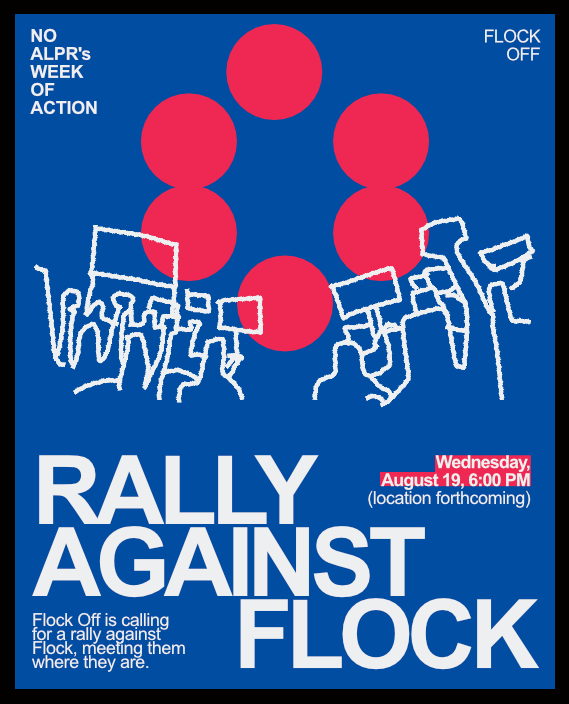
From Aug. 16 to Aug. 22 organizers, both new and experienced, are holding events across the country for the National Week of Action Against Automated License Plate Readers.
At the beginning of a recent national organizing meeting held on Zoom, host Ed Vogel mentioned a particular group of attendees he thought might be listening.
“If anybody from the FBI is on the call, we want them to put in some work,” he said. “We’re not listing events, just groups and locations.”‘
He was referring to events planned for the first national Week of Action against ALPRs, or automated license plate readers, scheduled for Aug. 16-22.
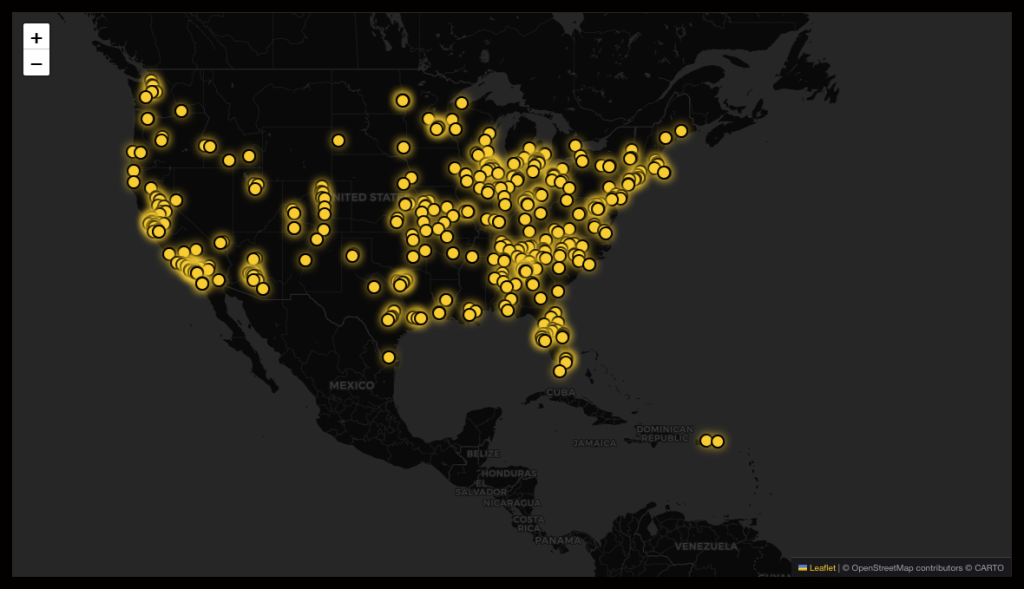
A map on the event’s website shows more than 400 events planned by groups and individuals in nearly every U.S. state, as of Aug. 13. Twenty of those events are in Georgia. About 22,000 people across the country have registered with the event, according to organizers.
Participants on the Aug. 2 Zoom call hailed from Anne Arundel, Maryland; St. Louis, Missouri; Florence, South Carolina; Mississippi; Texas and several dozen other locations.
“We know we are being watched,” Vogel told them, referring again to the FBI. “It’s time to show the movement is growing.”
The “movement,” in his words, has a message: “surveillance isn’t safety, and we want the cameras to come down.”
If the FBI was on the call, one thing motivating the agency was likely the recent spate of people across the country literally taking down or destroying cameras in their communities, attracting a flurry of national media attention. Recent reporting from 404 Media reveals that government surveillance is aimed at the upcoming week and conflates it with ongoing incidents of camera destruction.
Those incidents have centered on license-plate readers made by Flock Safety, the Atlanta-based company and biggest player in the field. Although the upcoming week of action is organized by a national group called DeFlock, of which Vogel is a member, the event’s organizers are concerned with police surveillance writ large and automated license plate readers as a part of that surveillance.
As for the tactics drawing some of the recent media coverage, “DeFlock doesn’t advocate or organize around smashing or taking down cameras,” Vogel said. “At the same time, people who are smashing cameras are people who feel like they have been failed by democratic processes,” he added.
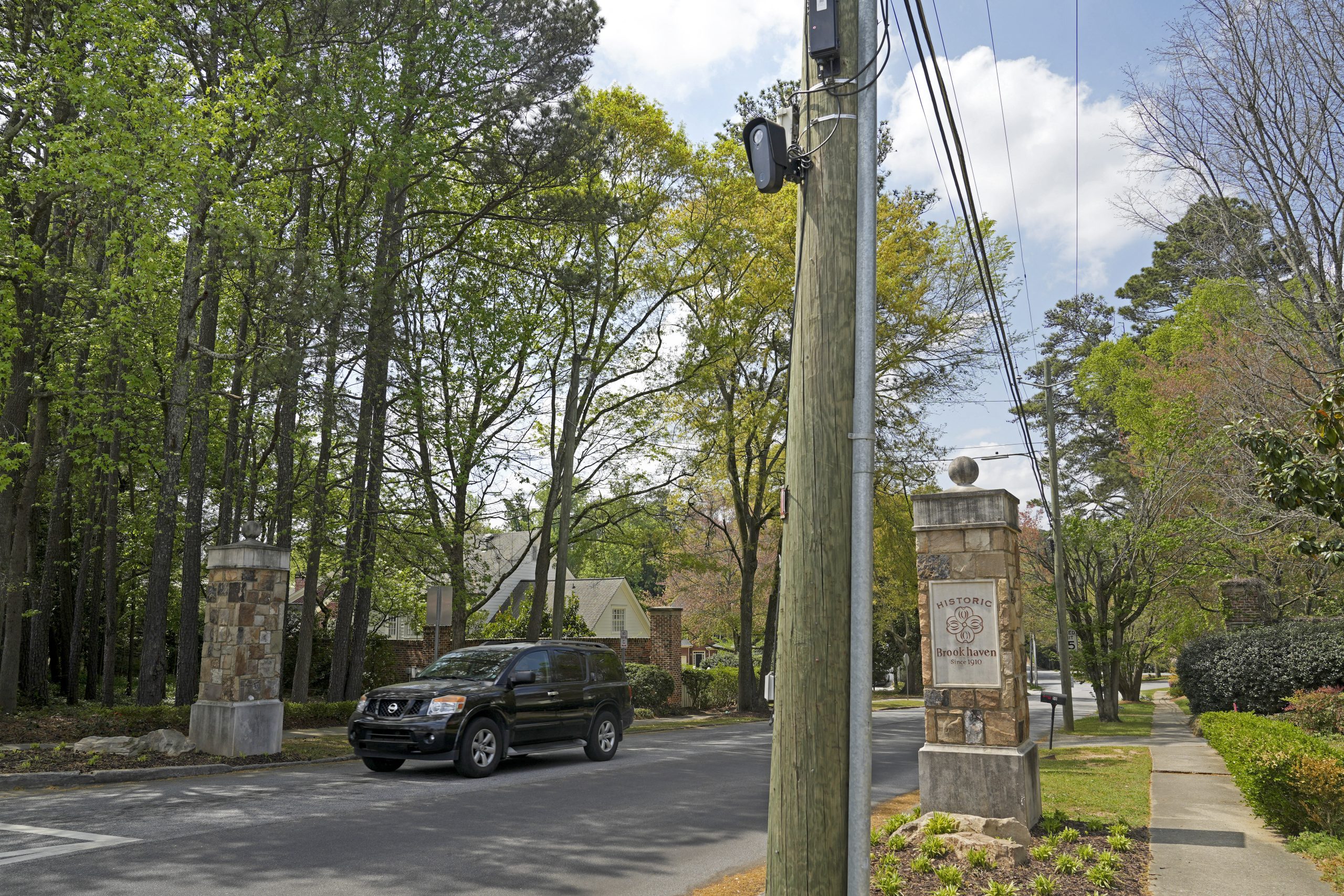
Participants in the week have concerns ranging from Fourth Amendment and invasion-of-privacy issues to lack of transparency in local government contracts to abuses of the technology such as stalking exes and sharing data with ICE.
Notably, despite the recent media attention, most of the several organizing calls ahead of the upcoming week that ACPC attended centered on prosaic organizing tactics for engaging in local democracy, including shared experiences by callers from Santa Cruz, California, and South Portland, Maine, where attendees have joined with neighbors at city council meetings in recent months and gotten elected officials to cut contracts with surveillance companies.

“Even if one person stands on a corner with a sign, that’s an event,” said Vogel on a July 26 call, regarding the upcoming week of action.
Vogel also told ACPC that participants in the week who he had communicated with occupy different points along the political spectrum. “They’re making sense of how to demand something at the local level,” he said, listing first-time experiences people across the country have had in pursuit of addressing their concerns about surveillance: filing open records requests, attending community gatherings and local government meetings.
“These are basic things we should all know how to do to practice democracy,” Vogel said.
One person who’s been learning how to do these things is Mary Gibson, a 32-year-old shepherd in Madison County, North Carolina, a rural area of about 20,000 people.
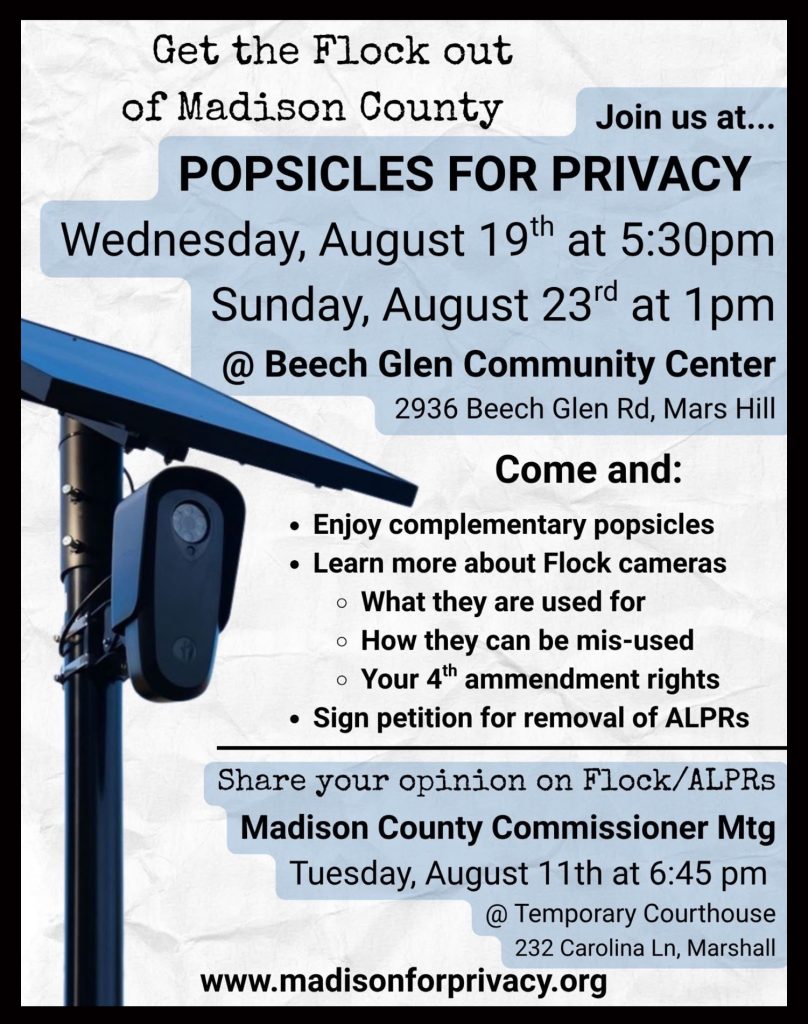
Gibson is helping organize an event during the week of action called “Popsicles for Privacy.” She’s four months into attending monthly county commission meetings for the first time, after moving to the area with her husband and son nearly a decade ago.
She and several dozen of her neighbors went to a recent county commission meeting to speak about their concerns surrounding a contract with Flock Safety announced by the local sheriff earlier this year. The head of the Board of Commissioners pointed to a rule that requires large groups wishing to speak about an issue to name a spokesperson to summarize their concerns, instead of giving each person a turn.
“It felt anti-democratic,” she said. It also had the effect of discouraging future attendance, Gibson added—she was the only one who showed up at the following meeting. She hopes to get the Flock contract issue on a future commission meeting agenda. “There should be a way we can have a voice,” she said.
Meanwhile, she’s planning on hosting an “information session, going through commonly asked questions” about APLRs. “I’m wanting to give the impression of having a friendly discussion about why you should care about this,” she said–including popsicles to ward off the late-summer heat.
Reporter and author John Washington has spent years observing these sorts of dynamics in communities nationwide that organize against immigration detention, culminating in his recently-published book, “How To Close a Camp: Dispatches From The Fight Against Immigration Detention.”

He sees local struggles against immigration camps, data centers and ALPRs as related. “There’s so much overlap–people are starting to recognize that these things…don’t provide a public good.”
Washington pointed to the range of tactics people have embraced in their communities in opposition to immigration detention in their backyards, from “community meetings and letters to Congress …[to] civil disobedience. It’s people taking radical stands, along with almost hokey community gatherings.”
“I keep coming across even small efforts that make a difference,” he added. “People aren’t happy with the status quo, and once you start pushing, you almost immediately inspire others and gain some ground.”
Vogel hopes the first week of action against ALPRs is “a starting point” for people organizing the hundreds of events nationwide. “We could take out Flock, but the gap would be filled,” he said. “We want people to understand the power structures behind the tool.”
No paywall. No corporate sponsors. No corporate ownership.
Help keep it that way by becoming a monthly donor today.
Free news isn't cheap to make.
Author

Related Articles

AI, Flock cameras and data centers dominate debates for Georgia’s statewide races
AI was a hot topic in every Atlanta Press Club debate, from Attorney General to Agriculture Commissioner
Approximately 500 participate in hunger strike at Folkston immigration detention center
Government recently awarded massive contract to expand GEO Group facility to 3,000 beds to become largest permanent ICE site in United States.

