Organizer Bentley Hudgins takes second crack at Georgia House District 90 seat
Veteran organizer Bentley Hudgins seeks a second chance at Georgia House District 90, pitching neighborhood investment and alternative approaches to public safety in a crowded Democratic primary.
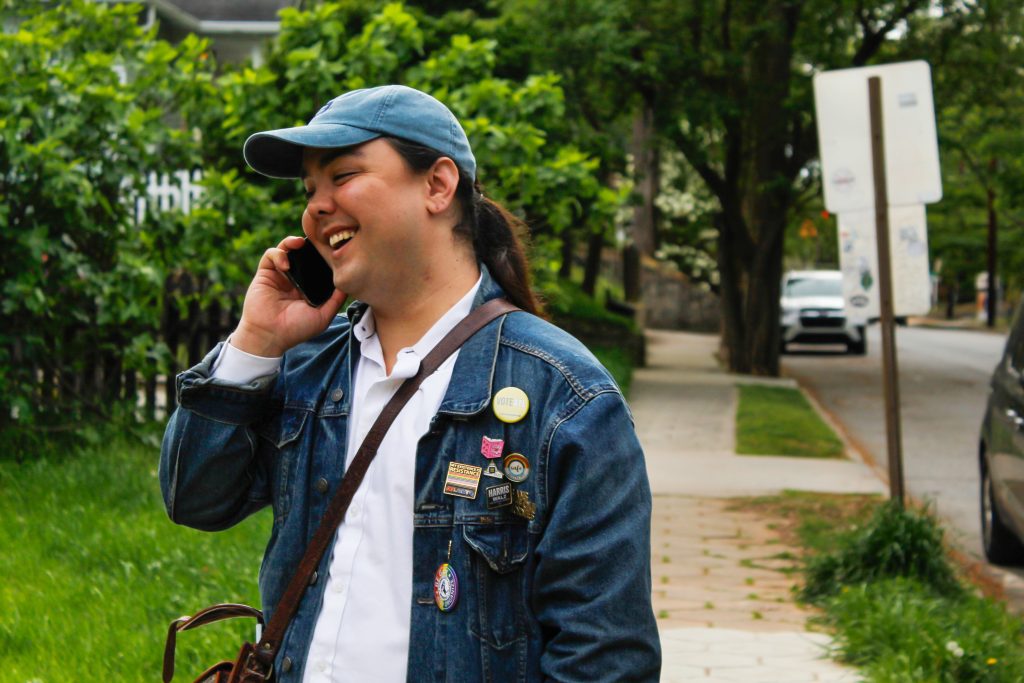
Bentley Hudgins walks up and down the streets of Candler Park, knocking doors and checking off houses on their phone to track which homes have already been covered.
In a solidly Democratic district, the primary race for House District 90 is a contest over priorities rather than party. Hudgins, a former organizer and past candidate for the seat, is running on a platform focused on neighborhood investment, expanded transit access and alternative approaches to public safety.
Hudgins is one of three Democratic candidates remaining in the primary, alongside Nicole Horn and Leisa Strafford.
One Republican candidate, Samantha Nichole Boston, qualified for this cycle.
If they win the Democratic primary, Hudgins will likely become the first openly non-binary and trans state representative in the Deep South. Aaron Baker, a House District 61 candidate, would also share of that distinction if she wins her primary against incumbent Esther Panitch.
“I don’t necessarily care about being the first. I care about us being represented,” Hudgins says while walking to the next house on their list.
On March 5, state Rep. Saira Draper announced she was running for an open Georgia Senate seat, giving way to Hudgins and four other candidates to file for the House seat. Two have since dropped out of the race, leaving Hudgins, Nicole Horn and Leisa Stafford to compete in the May 19 primary.
Hudgins ran for the seat in 2022, coming in third in the primary. Draper won the primary in a runoff.
We need to raise $65,000 by June to keep publishing stories like this one! Historically, readers like you have accounted for ~5% of our annual revenue. For sustainability, we need it to be closer to 25%. We’ve run fundraisers before, but not at this scale. That’s the number we need to hit so we can continue to cover ICE, protests, surveillance, DEI, Cop City, policing and the City Council.
To that end, we’ll start attaching a cost of goods to each of our stories so you can see part of what it costs to do this work.
This story is 1211 words. We pay $.66/word for freelance work, for a total of $799.26. There was an additional hour of editing time. A livable wage in Atlanta is $27/hr.
The total cost of this story is $826.26.
Will you chip in $25 to help cover the cost of the story and to continue critical election coverage like this?
Learning politics from the ground up
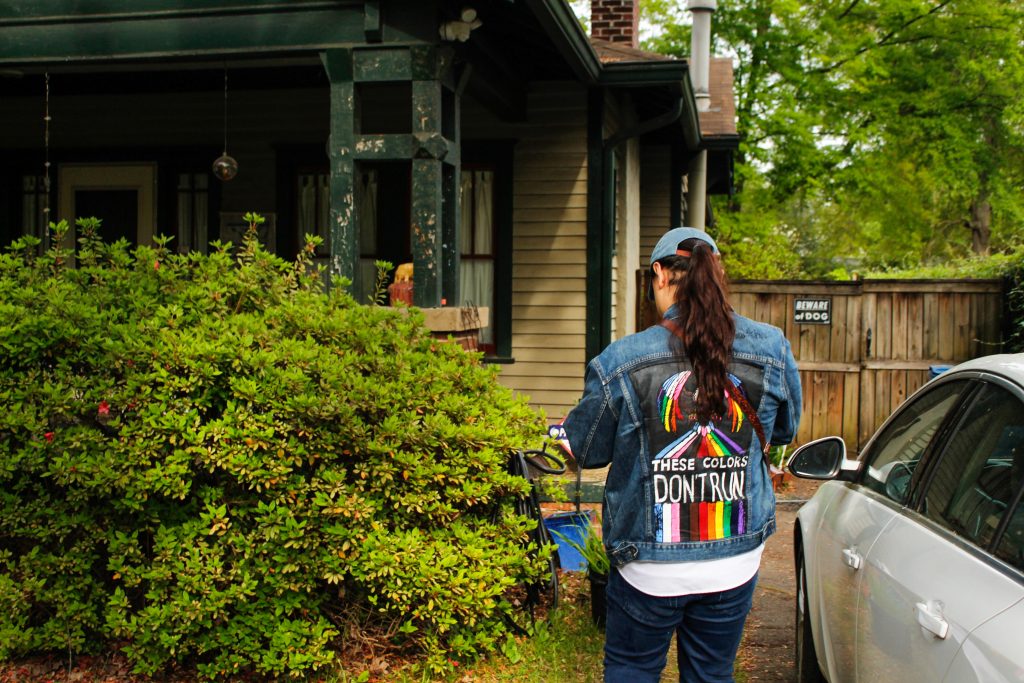
“One of my favorite parts of campaigns is knocking doors. You see a lot of dogs and a lot of gardens,” Hudgins says. They occasionally pause on the route to point out various native plants they like.
Their campaign goal is to knock 18,000 doors before the primary.
Hudgins is no stranger to canvassing. They’ve been knocking doors in Atlanta since 2017, when they moved to the city to escape an unsafe living situation with their parents.
“They didn’t agree with me being young and queer and having friends do drag,” Hudgins says. “So I made a choice, I could either risk my safety or live in my car.”
That’s when they started working as a canvasser for Bee Nguyen’s first campaign. After work, Hudgins would either sleep in their car or on a friend’s couch. “Or his front porch sometimes, if I would come home too late,” Hudgins adds before taking a pause to drop off a pamphlet on the porch of a neighbor smiling through a glass door and mouthing that she was on a phone call.
Hudgins said this period of homelessness was one of many life experiences that would shape their policy approach.
The first major turning point occurred about a year earlier. Hudgins was 21 and managing a gay bar in Macon, Georgia, that closed down a short time before the shooting at the Pulse Nightclub in Orlando, Florida.
“When the massacre at Pulse happened, it really just felt like the last thing that I had going for me was taken away. Life was already hard enough, and I couldn’t even go get a drink without being afraid of getting shot,” Hudgins says softly.
They organized a vigil that attracted a wide range of attendees from drag queens to faith leaders and labor organizers. That coalition launched an organizing campaign that landed an amendment to Macon-Bibb County’s charter protecting public-sector LGBTQ people from job discrimination.
From the streets to statewide organizing
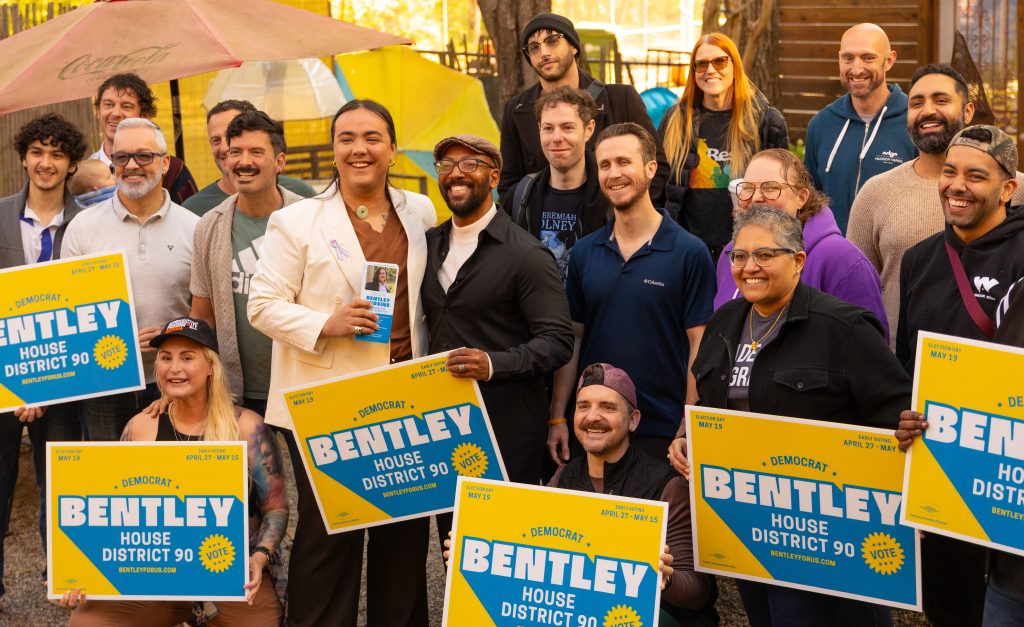
From the Nguyen campaign, Hudgins took their first paid organizing position at the ACLU before moving to the Georgia Budget and Policy Institute in 2019, where they launched a budget justice campaign. During that campaign, they spent their time with working Georgians, breaking down how the state’s budget works and “all the different ways that we can introduce family-centered policies and working-person policies.”
After their unsuccessful bid for HD90 in 2022, Hudgins took a break from political life, or so they thought. They got a job working at the Laotian pop-up restaurant So-So Fed, which started a couple of blocks away from where Hudgins was canvassing.
Hudgins, who is Japanese-American, grew up in a community that was more “keep your head down,” and hadn’t expected the project and its Asian American staff to be deeply politically engaged.
“It was political in a different way. I’m used to doing big P—I call it big P—political work,” Hudgins says. “What [chef Molli Voraotsady] was doing was creating food from the most bombed country on the planet in a country that bombed it, teaching people to love her culture and her food and bringing a lot of Asian people along with it.”
So-So Fed gave Hudgins the space to land back on their feet and reenter the big P political world. They were offered a job as the Georgia state director for the Human Rights Campaign (HRC), where they worked until stepping away from the organization to campaign.
Hudgins points to the defeat of 47 anti-LGBTQ bills in the Georgia General Assembly during their tenure at HRC—including 15 in this legislative session—as one of their achievements with the organization.
Policy priorities and rethinking public safety
Hudgins’ general policy priorities align with their organizing and professional history: voting rights, financial relief for working families and protecting LGBTQ and immigrant communities. They also hear concern from district residents over data centers, transit and school closings and housing affordability.
But most of the policy discussion during the Candler Park canvasing involved alternative approaches to public safety.
Locally, Hudgins wants to push investment into underserved neighborhoods in the district, which include portions of unincorporated DeKalb County. They talked about creating a pedestrian corridor on Flat Shoals Road between Gresham Road and Fayetteville Road—something that would likely take a partnership between the state and county to develop.
The corridor is flanked by a Walmart on one end and three gas stations and a liquor store on the other. In between sit hundreds of units of apartments and condos, as well as the entrance to the Longdale Park neighborhood where Hudgins lives with their fiancé.
“All of this is tied up in what people think safety is,” Hudgins said. “I think it’s prioritizing community safety for someone to have a sidewalk to walk on to their bus stop and while they’re waiting for a bus they feel cared for and aren’t in the sun or in the rain or things like that.”
Outside of their professional organizing role, Hudgins has worked hard to develop this sort of community safety for the neighborhood. Longdale Park, Hudgins said, had been neglected and became a location for gun sales and gunfire. They created a Google form for neighbors to use as a tracker to record when and where gunfire happened along the corridor. They brought that data to DeKalb County Commissioners Ted Terry and Larry Johnson. That resulted in $200,000 in American Rescue Plan funds to revitalize the park through clearing out invasive plant life, recutting trails and cleaning up nearby Sugar Creek.
The County invested an additional $300,000 to create a new master plan for the park designed, Hudgins said, “to get people in there more often, so it’s not an empty park where bad behavior can happen.”
“We can get better public safety outcomes by just making better choices that doesn’t have anything to do with incarcerating people or making up more crimes.”
No paywall. No corporate sponsors. No corporate ownership.
Help keep it that way by becoming a monthly donor today.
Free news isn't cheap to make.
Author

Related Articles
‘It seemed like every town in America had something going on’: Week of Action against Flock and ALPRs gets people engaged
As protests spread nationwide, Atlanta-based Flock Safety grapples with backlash over surveillance technology and growing privacy concerns.
Popsicles and the FBI: Organizers launching week of action against Flock and ALPRs
From Aug. 16 to Aug. 22 organizers, both new and experienced, are holding events across the country for the National Week of Action Against Automated License Plate Readers.

