
Georgia’s young men swung 63 points toward Democrats. That doesn’t mean they’ve become liberals.
Economic frustration, broken promises and changing expectations of masculinity helped reshape the 2026 electorate. Whether Democrats can hold on to these voters is another question.

Daniel Wodkins spent part of the 2026 election season struggling to persuade his conservative friends to vote.
Wodkins, 20, is a University of Georgia student who worked on Republican Rick Jackson’s campaign for governor. Two years after young men helped propel President Donald Trump back to the White House, many of the young conservatives Wodkins knew had lost their enthusiasm for Republican politics. Some didn’t vote at all.
“I think it was more so the Republicans losing young men’s votes more so than Democrats winning them,” Wodkins said.
The election results suggest that disillusionment extended far beyond his circle of friends.
Georgia men ages 18 to 29 swung a remarkable 63 percentage points toward Democrats in their partisan voting margin between the 2024 presidential election and the 2026 midterms, according to estimates from The New York Times’ Voter Trends project.
In Georgia’s U.S. Senate race, 75% of young male voters backed Democratic Sen. Jon Ossoff, compared with 25% for Republican Mike Collins, according to Voter Trends models. That same demographic favored Trump and the GOP by 56% to 43% just two years ago. Young Georgia women also shifted back toward Democrats by 40 points after a rightward shift in 2024.
Nationally, the overall U.S. House vote shifted 13 points toward Democrats compared with the 2024 presidential vote. But among men ages 18 to 29, the swing was 40 points. In Texas, the shift among young men reached 68 points, while Michigan saw a 47-point shift.
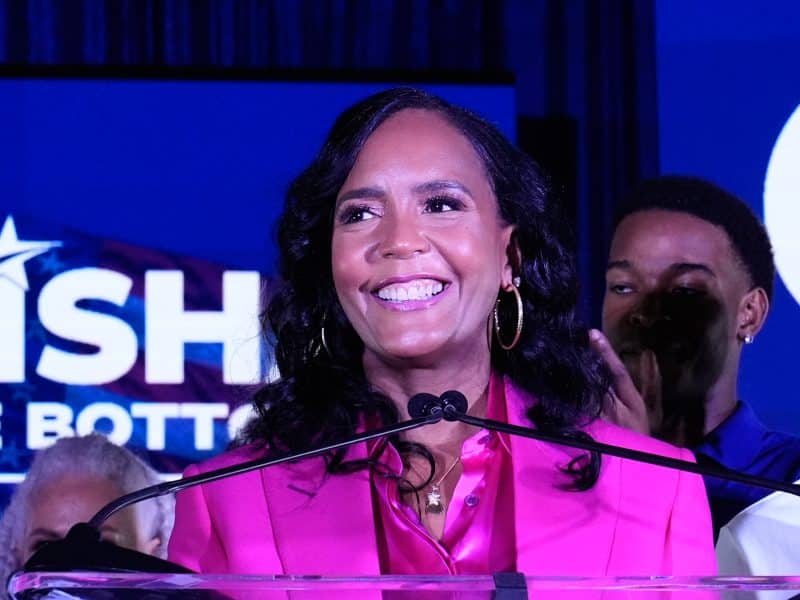
The massive leftward shift of young voters helped reshape the electorate in an election that saw Ossoff win reelection by about 18 points and Democrat Keisha Lance Bottoms defeat Jackson by roughly 9 points in the governor’s race.
But the numbers raise a more complicated question: Have young men genuinely embraced progressive politics, or are they simply rejecting the Republicans they supported two years ago?
Interviews with voters, political scientists, elected officials, a clinical psychologist specializing in men and masculinity, and a young Republican campaign worker suggest the latter explanation may be more accurate.
A vote against broken promises
Melissa Deckman, CEO of the nonpartisan Public Religion Research Institute and author of the book “The Politics of Gen Z,” said the movement toward Trump among young men in 2024 was driven substantially by economic frustrations rather than a wholesale embrace of conservative ideology.
Trump’s outreach to male-focused podcasters and influencers helped him reach young voters who felt ignored by Democrats during the 2024 election cycle. But his promises to improve affordability and keep the United States out of new wars may have been more decisive than the cultural messaging surrounding his campaign.

Two years later, Deckman said, voters faced continued economic pressures alongside a war in Iran that contradicted Trump’s earlier promises.
Deckman said the institute’s research has consistently found that young men have remained more ideologically moderate than young women, who have increasingly identified as liberal.
Alan Abramowitz, a political scientist at Emory University who studies voting behavior, offered an additional explanation: Young voters tend to have weaker attachments to political parties than older Americans.
“They are fickle,” he said.
That makes them more responsive to changing economic conditions, presidential approval and other short-term political developments. Abramowitz said young men may have experienced greater disappointment with Trump precisely because more of them had supported him in 2024.
Charlie Bailey, chair of the Democratic Party of Georgia, similarly attributed the shift to what he described as a sense of betrayal over Trump’s economic promises.
“Young folks have been hit hardest by the betrayal of this Republican economy,” he said.
Bailey pointed to the rising cost of establishing an independent life, housing affordability, health care costs and the economic uncertainty confronting younger workers set against the backdrop of an administration that appeared increasingly old, corrupt and out of touch.
“They were a ticket of yesterday, protecting the profits of the very few,” Bailey said. “So no wonder that young men who had given a shot to some of these Republicans are just like, ‘yeah, f-ck that. I’m gonna go with the people that look like they have a vision for the future, that are actually talking about how to build a better life, and not stumbling over themselves to protect the stature of a corrupt old fool.’”
Georgia state Rep. Akbar Ali, a 22-year-old Democrat from Gwinnett County and the youngest member of the Georgia General Assembly, said young men were not fundamentally different from other voters in wanting stable jobs, affordable housing and an opportunity to build a life. But their disappointment with both parties, he argued, had made their political loyalties unusually fragile.
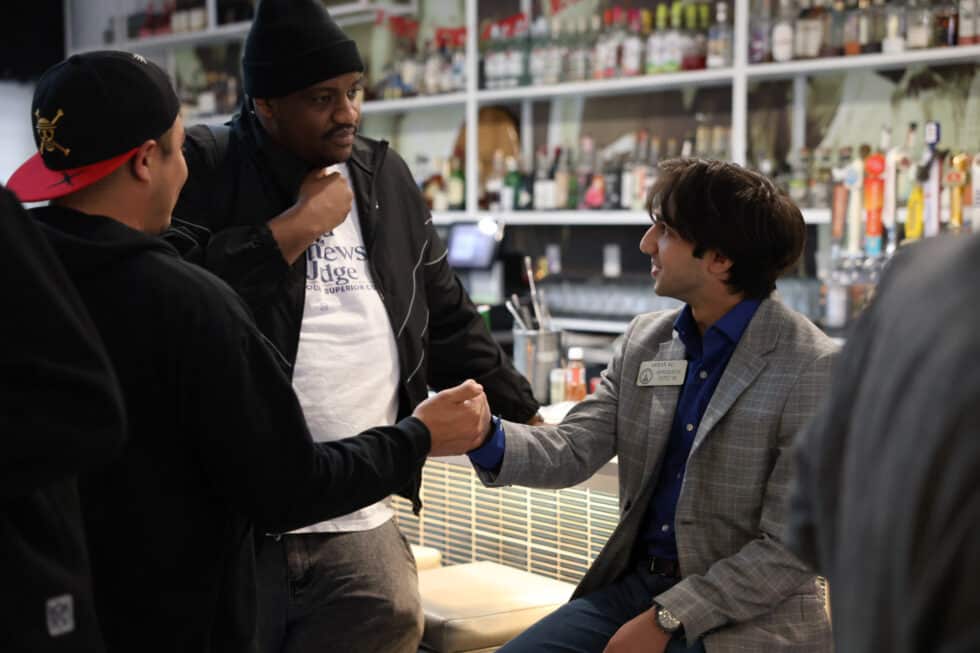
“You don’t get rewarded for a wasted opportunity,” Ali said, noting that was as true of former President Joe Biden and his Democratic trifecta after the 2020 election as it was for Trump and the GOP trifecta in 2024.
Even Wodkins, the young Republican campaign staffer, agreed that his party had failed to address the concerns motivating young men. The Iran war, he said, was “probably the biggest factor that alienated young men.”
“It’s just a failure of the promises that were made. He (Trump) ran on no new foreign wars. Then we got into one,” he said, adding that “I think a lot of young men — all they feel is gas prices, all they feel is tax dollars going to other places.”
But that frustration did not necessarily make those voters more liberal.
Where young conservative men overlap with the left
Wodkins said young men in his circles remained skeptical of progressive positions on a range of social and economic issues, but were increasingly receptive to arguments about corporate power, economic competition and affordability — even when those arguments came from Democrats.
Wodkins singled out Michigan Sen.-elect, Democrat Abdul El-Sayed’s criticism of monopolies and oligopolies on “60 Minutes,” saying the candidate’s argument for breaking up concentrated corporate power appealed to his own conservative beliefs.

“It’s bad for the consumer. It’s bad for business owners. It’s bad for everybody. And we need to go in and break them up. I just 100% agree,” Wodkins said.
He disagrees with Democrats over government spending but sees tougher antitrust enforcement as consistent with a conservative tradition associated with President Theodore Roosevelt.
He suggested the war also made some young men on the far right more receptive to candidates promising domestic spending instead of military involvement overseas.
This combination of cultural conservatism and economic populism was reflected in findings from a survey of 1,661 Generation Z adults shared with Atlanta Community Press Collective by Duncan Gans and Tresa Undem, nonpartisan researchers at the public opinion firm PerryUndem.
In previously unpublished survey comparisons, 53% of Gen Z men who voted for Trump in 2024 favored taxing the rich at much higher rates, compared with 34% of Trump-supporting men ages 30 and older. Similarly, 51% of younger Trump-voting men supported increasing funding for safety net programs such as foot stamps, compared with 32% of their older counterparts.
The generational differences were far smaller on cultural issues. Both groups were equally supportive of eliminating diversity, equity and inclusion programs, at 84%, while 39% of each said abortion should be legal in all or most cases.
One of the starkest differences concerned their underlying economic philosophy. Some 55% of Gen Z Trump men say they prefer a society based on competition, individual effort and hard work over one emphasizing shared resources and community. By comparison, 83% of older Trump men made that choice.
The younger group was also more likely to strongly favor holding people in the Epstein files accountable, 79% compared with 57% among older Trump men.
Gans said those findings point to an anti-establishment outlook that does not fit neatly into traditional left-right political categories. Younger Trump supporters may share their older counterparts’ social conservatism while embracing economic policies more frequently associated with the left.
That doesn’t mean they have become Democrats, he cautioned. Nor does the polling establish that individual voters changed their preferences between elections.
What do young men want?
Gans and Undem also shared preliminary findings on Nov. 9 showing that just 17% of Gen Z men said they liked “Trump’s version of masculinity,” while 69% disagreed.
The data also shows that young men, regardless of political affiliation, still feel pressure from conventional social expectations. Some 92% of Gen Z men said society expects men to be providers, and 88% said society expects them to make a lot of money.
Asked what they would most like to change about their lives, 68% of Gen Z men selected having more money. At the same time, 69% of young men say they feel the American dream is out of reach for them, according to Gans and Undem’s findings.
For Gans, that tension helps explain why economic disappointments can resonate so deeply among young men. In focus groups, he said, financial pressure frequently surfaces not simply as a question of purchasing power, but as a measure of personal success — shaping how young men think about dating, family formation and their ability to live up to the expectations of previous generations.
“They moved in particular on economics because they are young men,” Gans said.
Ronald F. Levant, professor emeritus of psychology at the University of Akron and a former president of the American Psychological Association, has spent decades studying the psychology of men and masculinity.
Levant said young men face changing educational, economic and social circumstances without a comparable change in the expectations imposed on them. That disparity explains the vote shift more than a change in political ideology, he said.
“I don’t think the ideology factor is as salient as the fact that young men are doing more poorly than young women on nearly every educational, health and social indicator there is,” he said.
“I think for this specific demographic, just based on sex alone, this is why the unmet expectation stung so bad because there was a lot of hope that went into what Trump said he would do, and it didn’t happen,” he added.
Levant also rejected the notion that young men’s electoral behavior is fundamentally driven by masculine aggression or some uniquely male response to betrayal.
Levant argued that the appeal of things like the manosphere has often rested on recognizing genuine economic and social insecurities before offering rigid, sometimes resentful prescriptions for masculinity. “I think the manosphere was incredibly overhyped, and I don’t think it had that much staying power with men in general,” he said.
Instead, he said the takeaway should be to rethink what society expects of men, especially given the rising importance of traditionally “feminine” traits like emotional intelligence in the workplace.
“We need a new blueprint,” Levant said. “It can’t be as rigid as the old one.”
A different approach to boys and men
Virginia Delegate Josh Thomas, a Democrat originally from the Atlanta area, has been attempting to address some of those problems through legislation.
Thomas introduced the legislation establishing Virginia’s Boys and Men Advisory Commission, a bipartisan body tasked with studying educational disparities, economic opportunities, health outcomes, family life and social media’s effects on boys and men.
Established in 2026, the commission has examined challenges from boys’ literacy and educational attainment to barriers facing young men entering the workforce.
Thomas said the effort began with his first campaign in 2023, when he repeatedly encountered young men who felt they had no clear career opportunities or direction.

Democrats in 2024 emphasized reproductive rights and strong economic indicators, like the strong stock market, which doesn’t reflect the material conditions young voters face. On the other hand, Thomas said, Trump was speaking directly to the economic frustrations of young men who felt the opportunities promised to them were out of reach.
Thomas argued that the resulting support for Republicans was especially vulnerable to disappointment when promised improvements failed to materialize.
“This was primarily a punishment of being lied to and of failed policies from the current administration,” Thomas said of the 2026 shift.
He also described a broader cultural problem: Young women have benefited from recent generations of encouragement to pursue education, careers and leadership, while young men have been left with an older conception of masculinity centered on being the primary breadwinner.
Thomas, a former Marine, said his own marriage demonstrates how that model can evolve. Although his wife now earns considerably more than he does, he continues to contribute through household management, financial planning and other responsibilities.
That adjustment, he said, has not diminished his sense of masculine identity.
For Thomas, the answer is not to abandon efforts to improve opportunities for women, but to recognize that boys and men face challenges requiring attention of their own.
He said the commission’s bipartisan work demonstrates that those goals need not be in conflict.
A coalition, or a temporary revolt?
There are limits to what the election results can establish.
The Times’ Voter Trends figures used in this story are estimates derived from polling, voter records, census data and election returns rather than a direct accounting of how each individual voted. The comparison also involves different electorates: the voters who turned out for a presidential election in 2024 were not necessarily the same people who participated in the 2026 midterms.
Abramowitz said young voters’ weaker partisan attachments make it difficult to assume the shift will endure.
Quinn Rigney, a 26-year-old insurance underwriter in Atlanta, said he had voted for Biden in 2020, then Trump in 2024, but in 2026 he voted straight Democratic ticket. Reflecting on his shifts, he said he didn’t vote for Trump out of any ideological conviction, just that the economy had seemed better during Trump’s first term. That, combined with Biden’s failure to deliver on student loan debt relief, pushed him to vote red. “It was an ineptitude.”
“It sounds crazy to say now, but there was a sense the Republicans seemed like a more common-sense party,” he said.
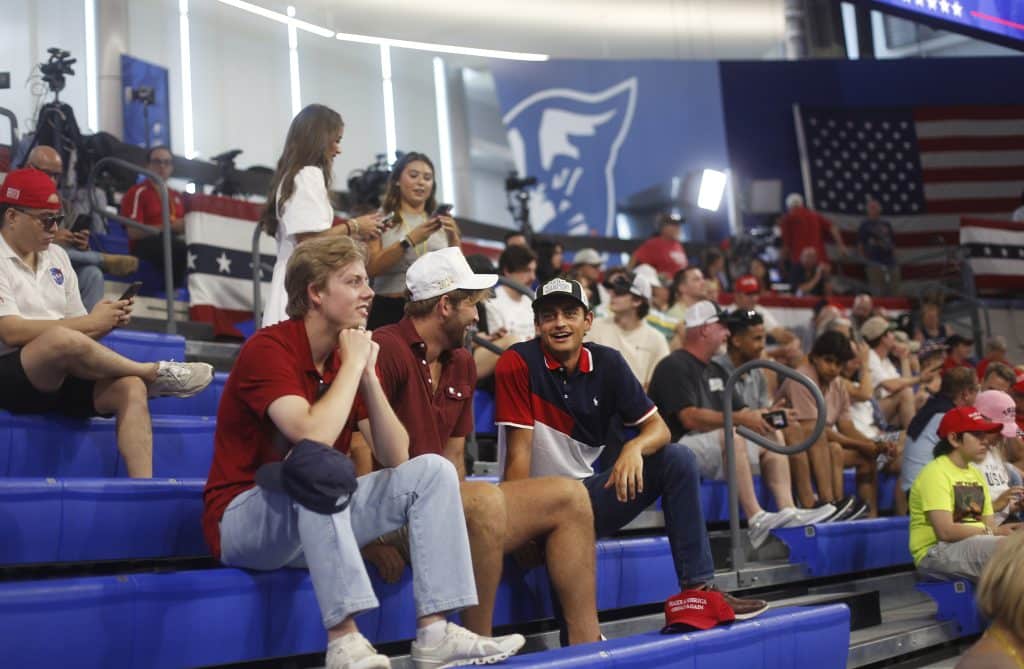
Broken promises, again on the economy and cost of living, pushed him back over to the Democrats this year. “Nobody wants what’s happening, the tariffs were a f-ing disaster, nothing’s worked.”
Rigney also said he was also repulsed by Trump’s military interventions in Venezuela and Iran, as well as the brutality of Immigration and Customs Enforcement raids in U.S. cities, comparing the conduct of federal officers to the Nazi SS. “It’s un-American,” he said.
Now, Rigney said, he’d just like to see the Democrats “be effective and get something done.”
“Like universal health care, they’ve been talking about it for years, but it never happens,” he said. While Rigney enjoys good health insurance through his company, he sees it as an indicator of Democrats’ ability to deliver. “I care about them doing something that is their main goal.”
Ali, the young Georgia legislator, agreed. “My own party has to not waste this opportunity and focus very heavily on real affordability, real delivery,” he said.
Ali also warned fellow Democrats against believing they have a lasting endorsement from voters.
“I would encourage members of my party that this isn’t some ultimate victory right now,” Ali said.
“Despite the numbers, we are here on rent. We are here on lease.”
Note: The Times’ Voter Trends data is subject to update as more data from the elections is processed. The figures cited in this article are accurate as of Nov. 14, 2026.
No paywall. No corporate sponsors. No corporate ownership.
Help keep it that way by becoming a monthly donor today.
Free news isn't cheap to make.
Author

Related Articles
“They Cannot Break Us”: Lawmakers make history as a blue wave crashes over Georgia
Fueled by anger over ICE, gas prices, and war – immigrant voters came out, and immigrant candidates win

Election Day liveblog: 2026 Midterm in Georgia
Atlanta Community Press Collective is partnering with 285 South to provide live coverage of the 2026 Midterm Election in Georgia.

