
Statewide project promises to reduce wildlife deaths on Georgia roads
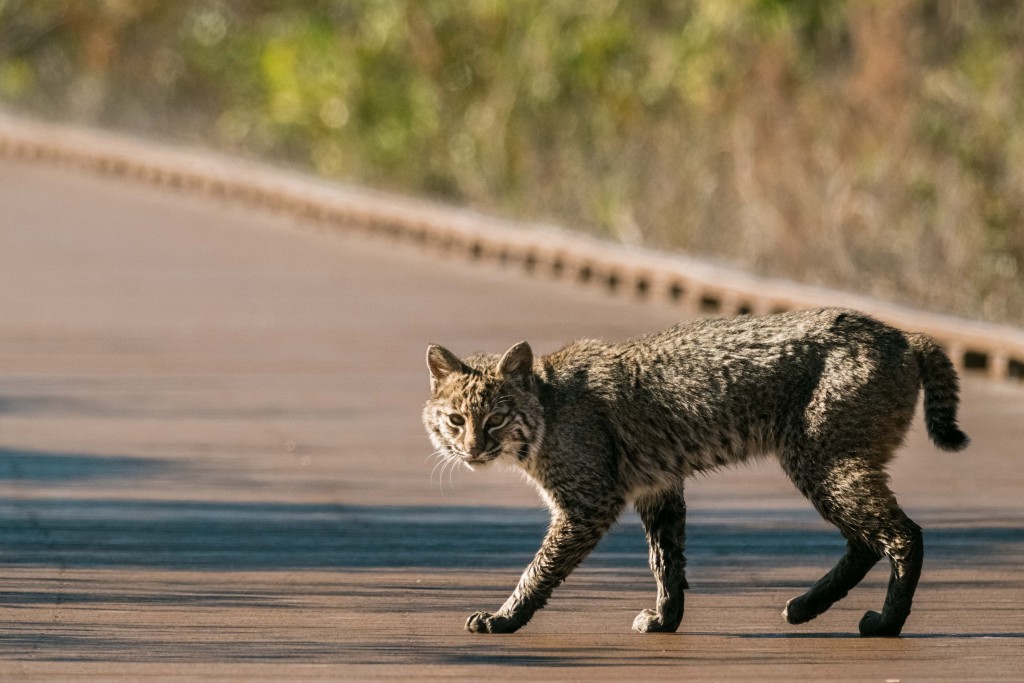
Thanks to a state-led wildlife crossings project currently underway, wildlife traffic collisions in Georgia could be less common by 2030—but it’s still a long road ahead, and the project won’t be a comprehensive solution.
In December 2024, the U.S. Department of Transportation awarded the Georgia Department of Transportation (GDOT) a $2.2 million grant for a pilot program to decrease the number of wildlife collisions on state roads. The funded project is a collaboration between GDOT, the Georgia Department of Natural Resources (GADNR) and the Institute for Resilient Infrastructure Systems (IRIS) at University of Georgia. Its ultimate goal is to create wildlife crossings intended to keep as many animals as possible off the roads.
When roads are constructed through a natural area, they segment wild animals’ habitat in a way that forces them to cross roads to access things they need, such as vegetation that may change seasonally, water, mates or social groups. They may also need to cross roads to escape a predator or an interspecific competitor in their area. Sometimes, new construction decreases the space and resources available in their area, so they must relocate to a more suitable habitat. But moving is risky. According to GDOT crash report data, drivers reported 18,189 wildlife collisions on state roads in 2024. Collisions with smaller animals are usually not reported to GDOT, so the total number of wild animals hit on Georgia state roads is likely much higher. But in those cases of a collision with a large animal, like a deer, it’s not only the animals who are harmed: 1,810 of the 2024 wildlife collisions resulted in injuries to people, and 15 of them were fatal.
Doug Chamblin, assistant state environmental administrator at GDOT and one of the project leads, says reported collisions typically involve large mammals such as deer, because they are most likely to cause injuries or damage vehicles. GDOT does not record the consequences for the animals involved in crashes, but mortality is likely high: A Federal Highway Administration study found that in another region of the country, around 90% of deer died after being struck by a vehicle.
“If you drive in Georgia, you see dead animals on the road all the time,” says Katrina Morris, program manager for Wildlife Conservation with GADNR. “So for any biologist, it’s a big issue, and we’d like to figure out how we can make a difference.”
Georgia plans unique and affordable wildlife crossing solutions
In some parts of the western United States, such as California and Colorado, large land bridges have recently been built to protect species like elk that go through seasonal mass migrations. But Georgia’s large mammals do not migrate like this, so expensive land bridges would not be an appropriate solution in this region, Chamblin says.
Instead, GDOT plans to incorporate certain accommodations for wild animals in newly constructed bridges and culverts. Animals already try to use these kinds of structures, Morris says, but they are not always successful. New bridges can be wider, or include a grassy margin in the underpass that deer can easily traverse, rather than standard boulders alone. Culverts can be constructed with a shelf for smaller animals like raccoons or foxes to use, preventing them from having to walk through the water inside, which can sometimes be a foot deep.
These updates are relatively low-cost. According to Chamblin, the average cost to replace an old bridge is $1.5 million to $2 million, but for $15,000 extra, it can be made wildlife-friendly.
Just over a year after the grant was awarded, its anticipated outcomes are still a ways off. GDOT and IRIS are analyzing wildlife collision data to identify the areas where crossings would be the most useful. Then they’ll build a tool that pulls together data on how animals move, what they use nearby landscapes for, how waterways connect, how climate change may affect habitats, and where crashes happen now, to figure out which locations need wildlife crossings most. After all of this analytical work, IRIS will design the crossings, the team will develop monitoring plans, they’ll publish a report and then GDOT’s actual construction work can begin—expected in around four years. Project members do not currently know how many crossings will ultimately result.
No paywall. No corporate sponsors. No corporate ownership.
Help keep it that way by becoming a monthly donor today.
Free news isn’t cheap to make.
Atlanta and other urban areas will be a more challenging fix
This pilot project will most likely result in crossings in the state’s more rural regions—but not in its capital.
“You’re going to be more limited in what you can do in that built environment,” Morris says. “You can’t change things as easily as you can in a more rural area where there’s not a structure in the way.”
There is also a higher density of roadways in the city, which fragments animal habitats and makes it harder to guide them to specific crossing points, says Brian Bledsoe, a professor at IRIS and UGA’s principal investigator for the project. And city roads are wider on average—more lanes for more vehicles—which means those crossings need to be longer, presenting additional challenges.
“If, for example, a deer looks into the opening of a crossing and sees that the other end is far away, they’re less likely to enter it,” Bledsoe says. “So then you need to put breaks in where they can emerge and not feel like they’re trapped in a tunnel. But if you give them a place to emerge, you still need to keep them contained, so that they continue on.”
Rural areas are a priority because that’s where most large animals get hit. Some of the areas with the most reported wildlife collisions in 2024 were unincorporated Hall County, with 476 collisions on state roads, unincorporated Fayette County, with 376, and unincorporated Cherokee County, with 341. Compared with Atlanta’s 80 reported wildlife collisions in 2024, these areas and several others are more likely to be selected for crossing projects.
Many other underreported species—such as coyotes, turtles, opossums, raccoons, and snakes—live in Atlanta and try to cross urban roads, often being struck in their attempts. But no department has sufficient data on the extent of the problem for these smaller animals, and without data, departments like GDOT do not take action.
“For us in DNR, it’s really one of the things that we have trouble measuring—those small animals that get hit on the road and never get noticed,” Morris says.
Mark Mandica, co-founder and executive director of the Amphibian Foundation, a research and education nonprofit based in Decatur, has had similar challenges studying local amphibians. They’re small, and they hide, so it’s difficult to track their numbers and causes of death with a high degree of confidence. But roadways do seem to be an issue for them. Some amphibian species live on land but must migrate to specific ponds seasonally to breed. They require unobstructed migration routes, so roads and structures become a “predictable catastrophe” for them, Mandica says. With many of their ponds disappearing, roads becoming barriers and vehicles often squashing the ones who try to cross, their numbers have dwindled dramatically.
“Very few species are doing well in Atlanta, and it’s mostly the ones that don’t require moving much,” Mandica says.
Small updates in urban neighborhoods could make a big difference for smaller animals, Morris says, and a high density of residents who interact with wildlife in their neighborhoods could provide grounds for public buy-in. She hopes future projects will directly address the issue in Atlanta as well.
In the meantime, state transportation officials see the pilot project as a first step toward bringing scalable wildlife-crossing strategies to Georgia.
“We’ve been hearing about what other states have been doing for a number of years,” Chamblin says, “and we’re really excited to bring some of those success stories to Georgia.”
Author
Related Articles
Organizer Bentley Hudgins takes second crack at Georgia House District 90 seat
Veteran organizer Bentley Hudgins seeks a second chance at Georgia House District 90, pitching neighborhood investment and alternative approaches to public safety in a crowded Democratic primary.
Melting ICE and other chilly topics for families: The People’s Puppet Show
A local organizer uses scenarios of colorful animal friends in conversation to help families break the ice on ICE every Saturday afternoon in Grant Park.