
Flock, Ring and Atlanta’s network of more than 28,000 integrated cameras haven’t improved city’s crime clearance rates
Despite an eightfold increase in the number of cameras integrated into the city’s Connect Atlanta surveillance program, crime clearance rates have not meaningfully increased, according to data collected by the FBI.
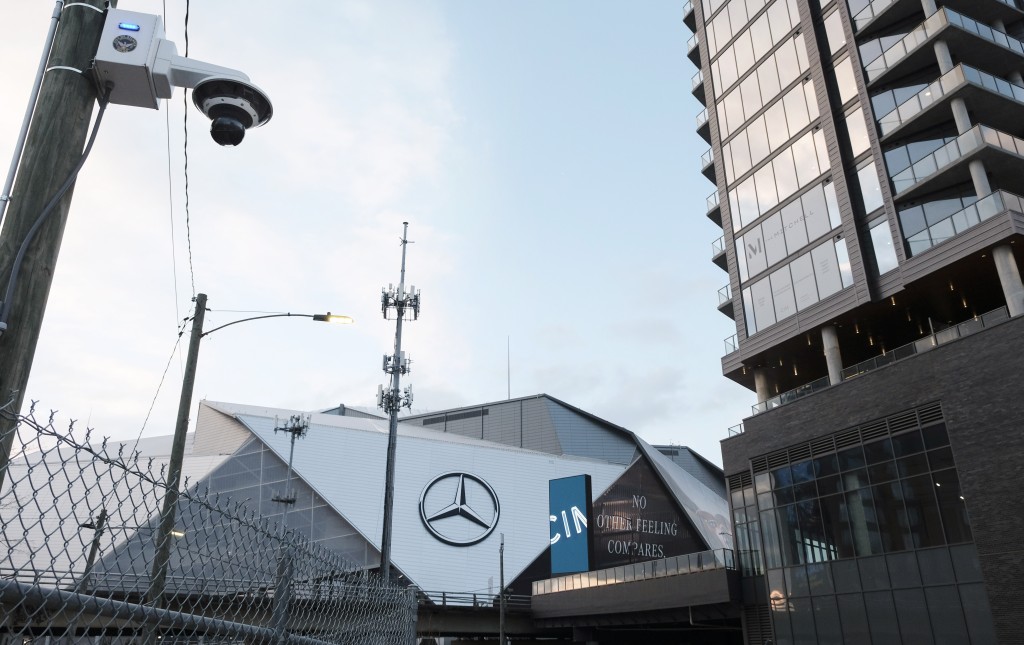
When Georgia Attorney General Chris Carr wrote an opinion piece on the importance of police surveillance technology like license plate readers, he included an entire section under the heading, “How LPRs have helped law enforcement solve crimes.”
But does the vast network of surveillance equipment really help solve crimes? An in-depth review of FBI data across a range of crime types suggests that this infrastructure has not corresponded with an increase in the Atlanta Police Department’s (APD) clearance rates.
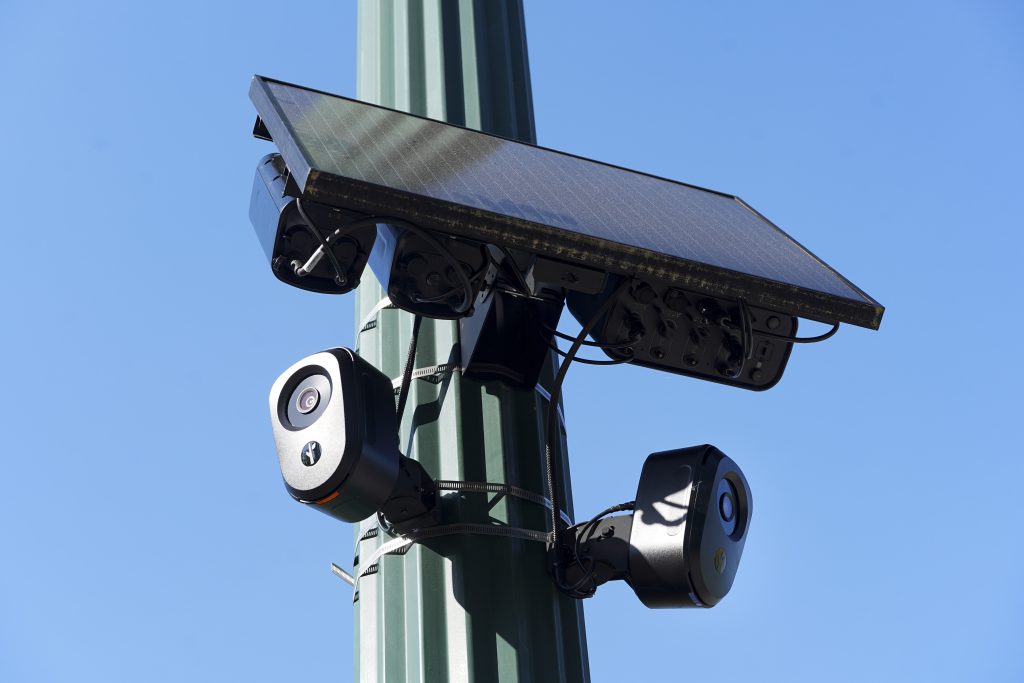
Since Flock Safety’s launch in 2017, its black-boxed license plate reader cameras on black poles with a solar panel atop have become ubiquitous across the country, including here in Atlanta, where the company is headquartered. Flock’s software platform boasts a nationwide lookup feature, allowing police officers to search over 80,000 cameras—both license plate readers and traditional cameras—with the click of a few buttons.
Increased scrutiny over Flock cameras arose in May 2025, when 404 Media revealed the nationwide lookup feature had been repeatedly used to search for immigration enforcement. Locally, ACPC found evidence that APD also conducted immigration-related searches in the months following President Donald Trump’s second inauguration. The department denies the assertion.

These cameras, surveillance technology officials and policy makers say, play a vital role in solving crime. In 2024, Flock claimed that “one additional Flock Safety License Plate Recognition (LPR) camera per sworn officer correlates with a 9.1% increase in clearance rate,” and that “20 additional Flock customers within 50 kilometers of the original agency leads to a 1% increase in clearance rates.”
According to the FBI, an offense is cleared by arrest or solved for crime reporting purposes. Police can also clear cases by exceptional means, including the identified alleged offender’s death, a victim refusing to cooperate or prosecutors declining to pursue the case. The clearance data was pulled from the FBI’s Crime Data Explorer, a tool, the bureau says is intended to increase police accountability by providing greater access to law enforcement data. The clearance numbers in this story are based on the quantity of reported crimes and clearances. Clearances in this data set do not necessarily happen in the same month or year as the underlying reported offense.
The company and APD have both been silent on the exact number of Flock cameras in Metro Atlanta; however, DeFlock.org, which has a crowdsourced map of surveillance cameras, shows over 5,000 Flock cameras in the area. APD has an authorized strength of 2,000 sworn officers, though it currently employs around 1,800.
Despite the growth of the Flock network, APD’s clearance rates have not increased markedly between 2021 and 2025, the first and last full years for which comparable clearance data are available.
| Category | 2021 | 2025 | Difference | Highest Year | Lowest Year | Variation |
| Criminal Homicide | 53.4% | 48.0% | -5.4% | 61.9% | 48.0% | 13.9% |
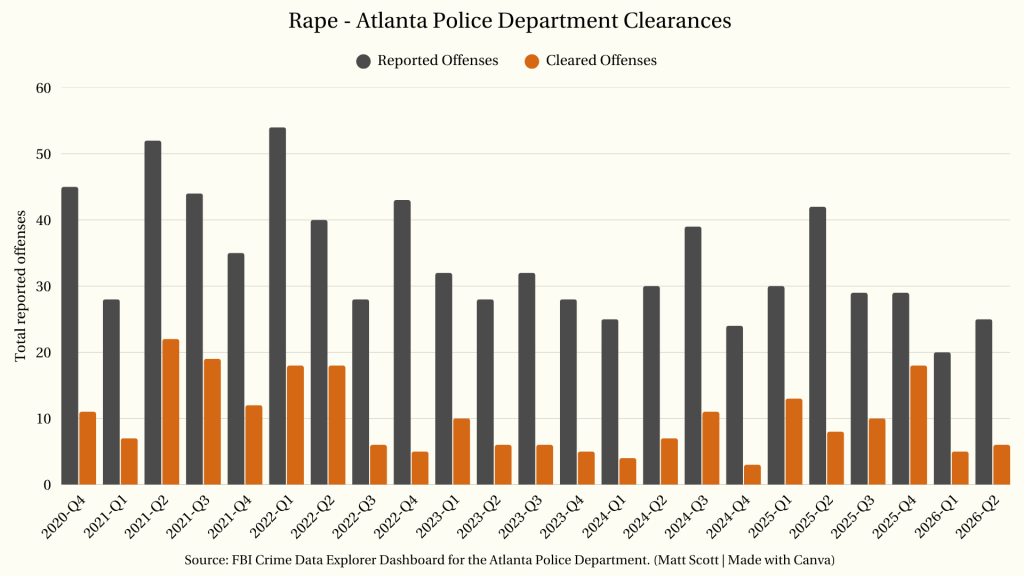
| Rape | 37.7% | 37.7% | -0.0% | 37.7% | 21.2% | 16.5% |
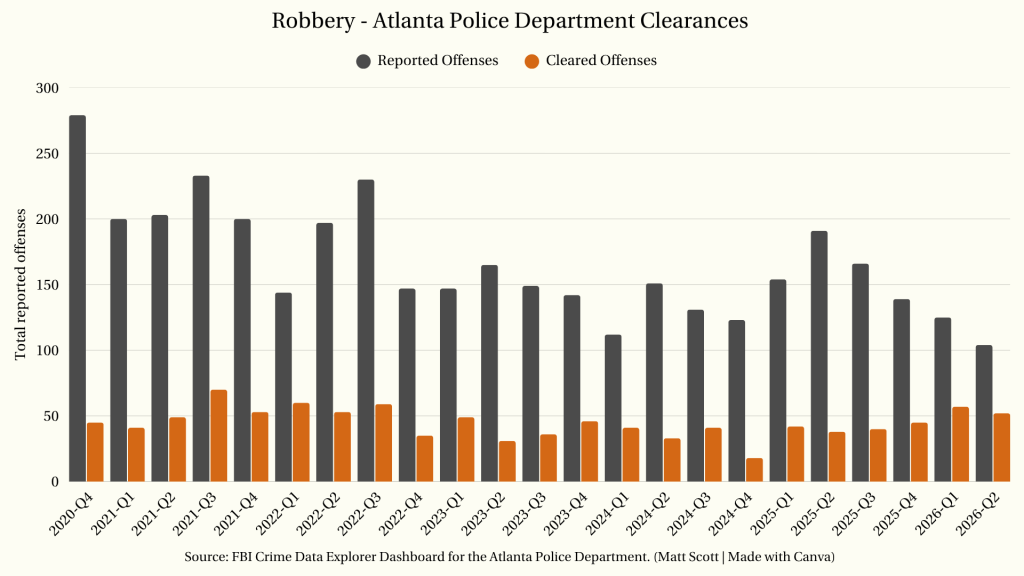
| Robbery | 25.5% | 25.4% | -0.1% | 28.8% | 25.4% | 3.4% |
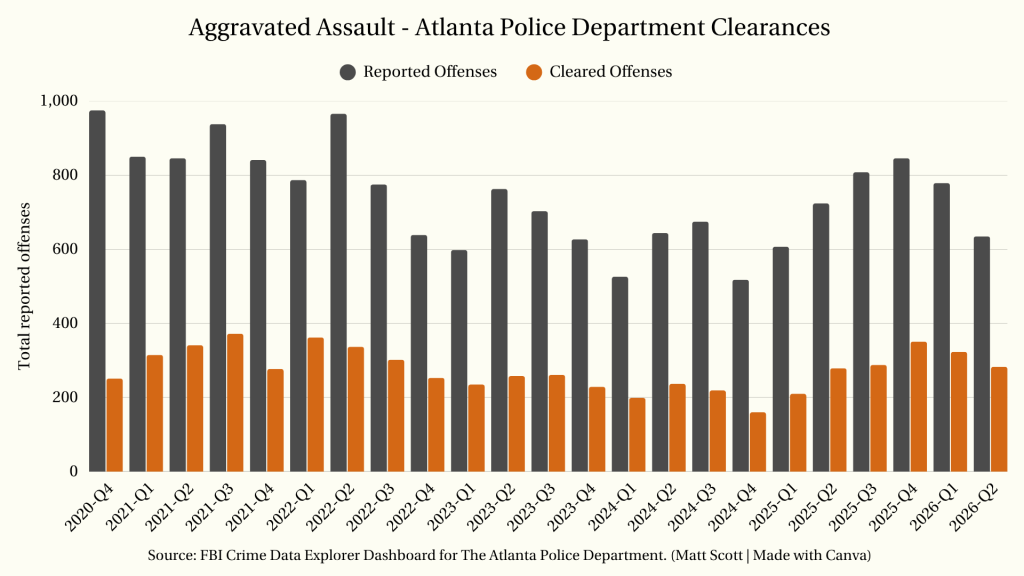
| Aggravated Assault | 37.6% | 37.8% | 0.2% | 39.6% | 34.5% | 5.1% |
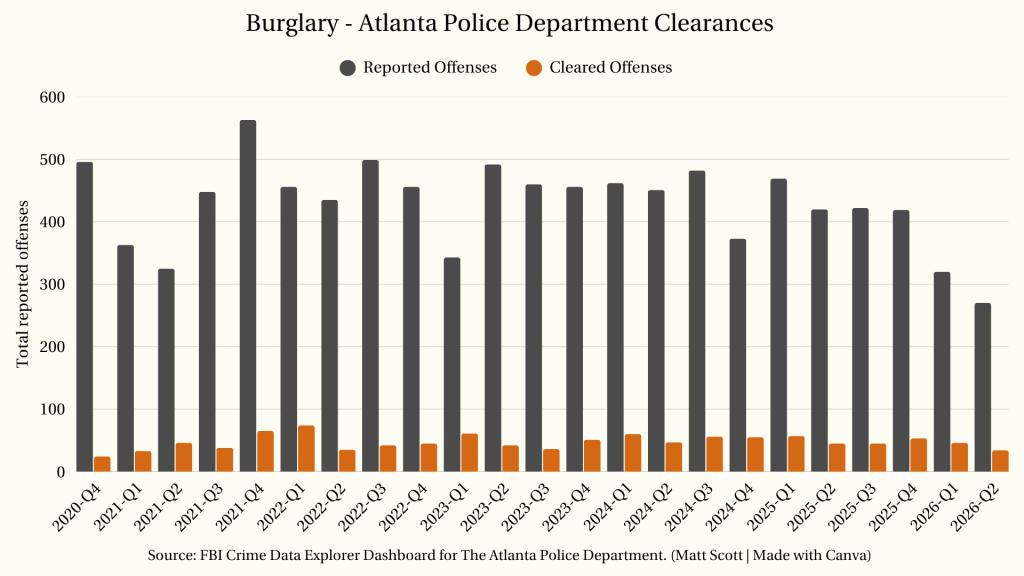
| Burglary | 10.7% | 11.6% | 0.9% | 12.3% | 10.6% | 1.7% |
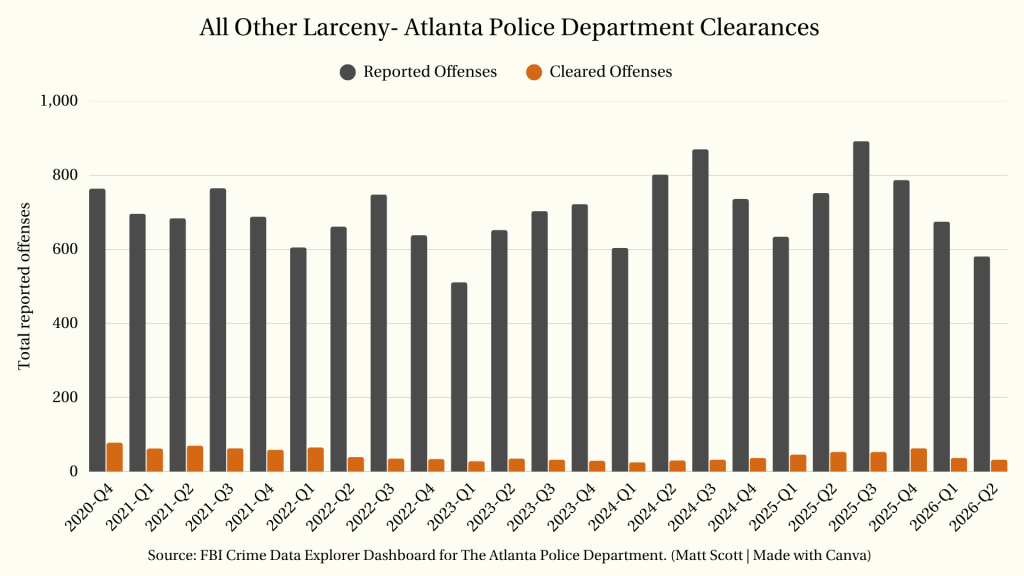
| All Other Larceny | 9.0% | 7.0% | -2.0% | 9.0% | 4.1% | 4.8% |
| Motor Vehicle Theft | 9.9% | 10.2% | 0.3% | 10.2% | 3.9% | 6.3% |
| Theft From Motor Vehicle | 1.4% | 2.8% | 1.4% | 2.8% | 1.4% | 1.4% |
| Shoplifting | 38.8% | 37.6% | -1.2% | 38.9% | 34.4% | 4.5% |
Connect Atlanta
Flock is one of the two main arms of the city’s growing police surveillance infrastructure.
Fusus-connected cameras have also proliferated throughout the city of Atlanta over the past six years, largely thanks to the efforts of the Atlanta Police Foundation (APF) and APD. Axon, makers of the taser and body cameras, purchased Fusus in 2024. Fusus software allows for the integration of surveillance devices from different manufacturers onto a single platform.
In March, APD posted on social media, encouraging residents to add their doorbell cameras to the city’s camera network program, Connect Atlanta, which is jointly operated by the APF and the APD. “Did you know your home 🏡security and doorbell cameras could play a key role in solving crimes in your neighborhood❓,” the post said.
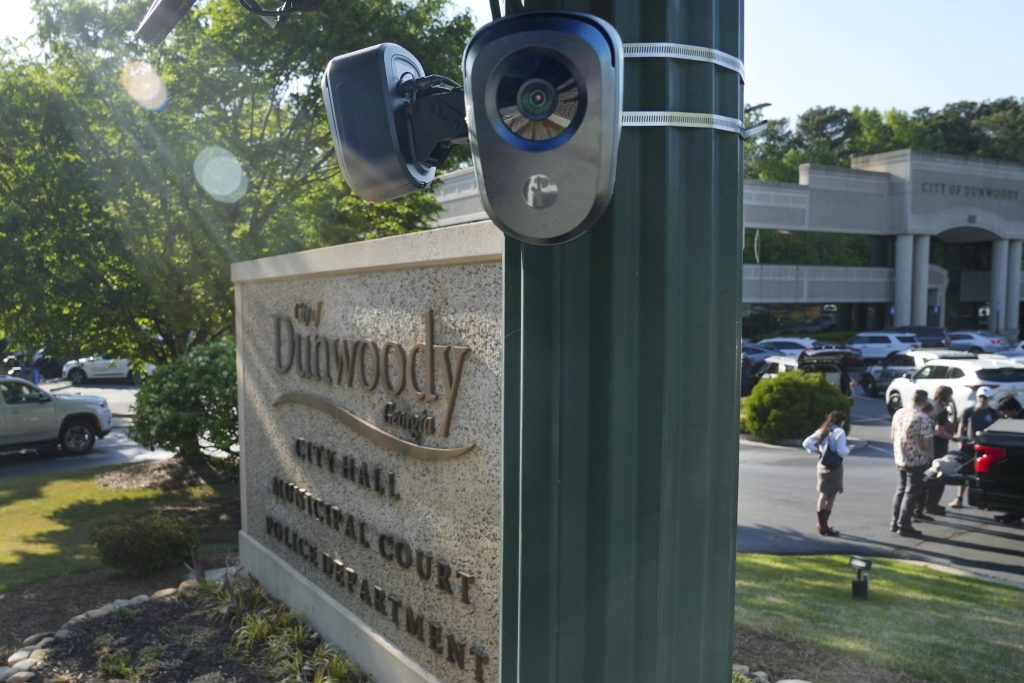
APD has reported 34 cases of human trafficking since October 2020. In the same time frame, the department has cleared seven cases. The most recent clearance was reported in the first quarter of 2024. Since then, an additional 12 human trafficking incidents have been reported by APD with no clearances.
Connect Atlanta runs on Axon-Fusus software and comprises two types of participation. The first, registered cameras, allow officers to know where cameras are and request footage from camera owners, but do not allow direct access. The second, integrated cameras, allow APD officers to view live streams or recordings—if the owner has the setting enabled—on demand.
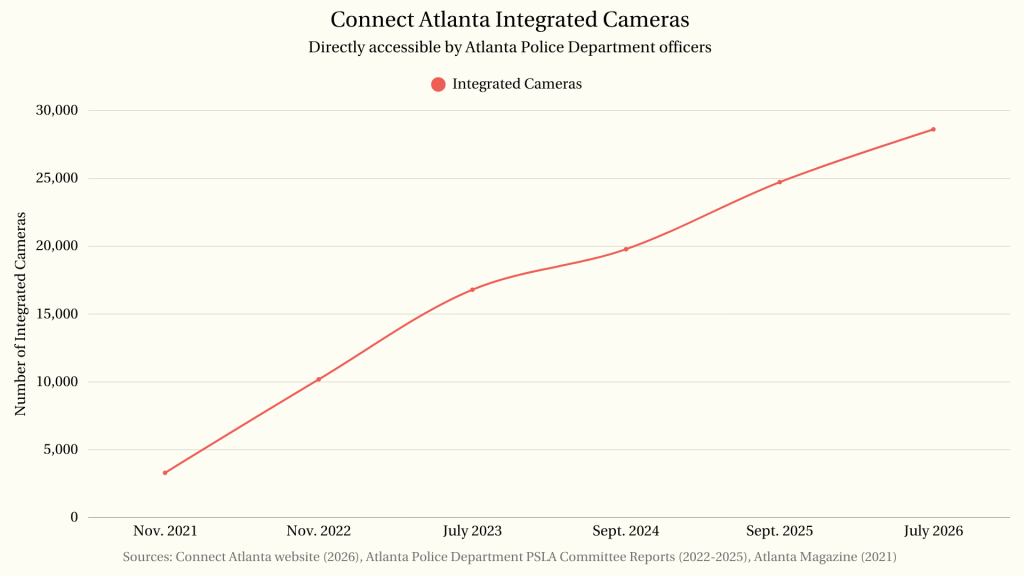
Despite the eightfold growth of the integrated camera network between 2021 and 2026, APD’s clearance rate across eight major crime categories has remained relatively unchanged.
In November 2021, Atlanta Magazine reported that Connect Atlanta had 3,300 integrated cameras. That number grew to 10,188 by December 2022, according to an APD presentation to the Public Safety and Legal Administration (PSLA) Committee. Since 2022, APD has included an update on the number of cameras in its quarterly report to the committee. On July 23, 2026, Connect Atlanta’s website reported 28,626 integrated and 17,314 registered cameras.
Surveillance cameras not the crime-solving panacea they are sold as
For Atlanta City Council Member Kelsea Bond, the city’s growing surveillance network merits a deeper examination.
“Atlanta is the most surveilled city in the country, and even in the last several years, usage of security cameras and surveillance technology in our city has continued to explode,” Bond told ACPC. “The swift expansion of surveillance in our city raises serious concerns about civil liberties, discrimination and bias, and privacy and transparency surrounding how the data collected is used.”
These surveillance cameras are said to play a key role in solving major crimes. Even news articles critical of Flock Safety contain statements like, “Flock Safety cameras help solve crimes.”
Murder, or homicide, is a frequently touted crime that cameras are alleged to help solve.
On Feb. 26, 2026, Flock CEO Garett Langley wrote on X, “Just spoke to an Atlanta PD detective who solved 35 homicides last year using Flock.”
APF CEO Dave Wilkinson spoke to his belief in the importance of these cameras during an Atlanta City Council Community Development and Human Services Committee meeting on May 18. “The murders—the major homicide cases in our city—are mostly all solved through the camera network,” Wilkinson said.
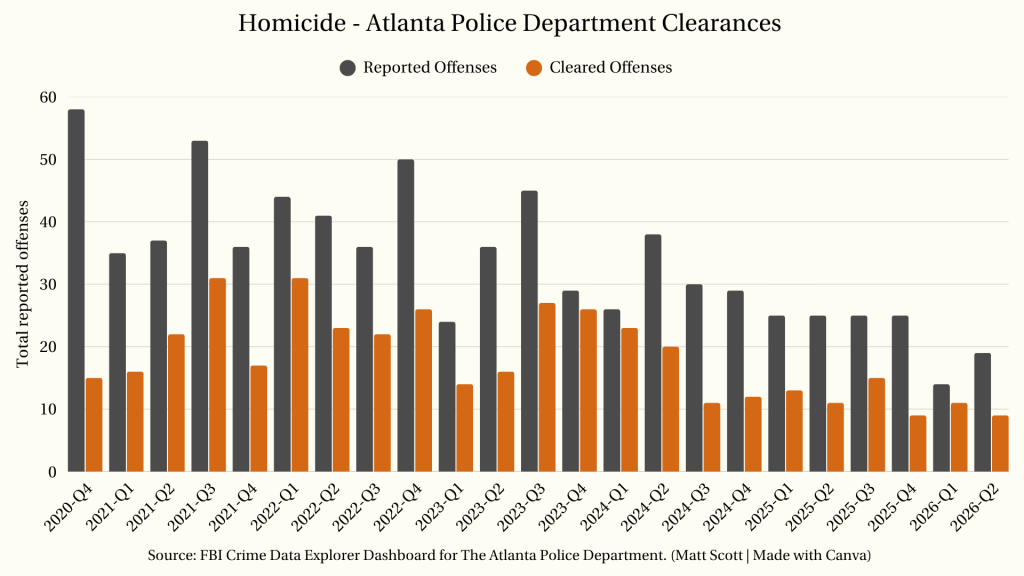
In 2021, APD had a 53.4% homicide clearance rate. In 2025, the department had a 48% clearance rate—its lowest homicide clearance rate between 2021 and 2025.
The department’s best year was 2023, when it hit a 61.9% clearance rate. Across the entire timeframe, APD had a 53.8% clearance rate.
Contrary to these findings, on Jan. 20, 2026, Atlanta Police Chief Darin Schierbaum held a press conference saying the department had reached a 77.55% homicide clearance rate for 2025.
APD did not respond to an opportunity to comment on the findings of this story or the discrepancy between the 77.55% homicide clearance rate claimed by the department and the 48% clearance rate in the FBI’s data, which is derived from agency reports to the bureau.
Flock airport contract renewed after Council member cited human trafficking issues
It’s not just homicide. Policymakers say these cameras help solve many types of crime.
When Bond tried to send a proposed Flock Safety camera contract renewal for Hartsfield-Jackson International Airport back to committee during the June 15 regular meeting of the Atlanta City Council, Council member Jason Dozier pushed back, saying, “I do have deep concerns about some of the challenges that we experience at the airport, particularly around human trafficking.”
Again, the data tells a different story. More cameras have not resulted in a greater percentage of human trafficking cases cleared.
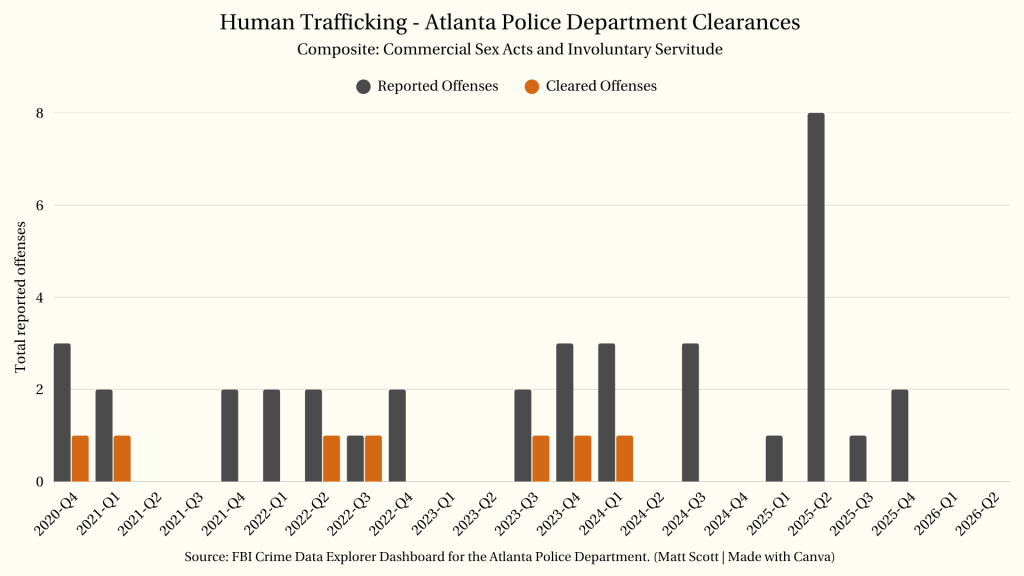
APD has reported 37 cases of human trafficking since October 2020. In the same time frame, the department has cleared seven cases. The most recent clearance happened in May 2024 for an incident reported on March 12, 2024. Since then, an additional 12 human trafficking incidents have been reported by APD with no clearances.
“This data regarding the human trafficking cases is really interesting, since both that and car theft were used by certain Council members to justify renewing the airport Flock contract that I tried to send back to committee at a recent City Council meeting,” Bond said. “If our city is going to be spending tens of millions of dollars a year on surveillance technology, the least we can do is investigate whether this technology is even effective at solving cases.”
Clearance rates around APD’s commonly tracked crimes
To have a more complete understanding of APD’s clearance rates, ACPC surveyed the data for nine crime categories: homicide, rape, aggravated assault, robbery, burglary, motor vehicle theft, theft from motor vehicle, shoplifting and all other larceny—a composite category of larcenies except shoplifting and motor vehicle thefts, which are tracked separately.
These are the categories APD presents in its crime statistics regular report to the Public Safety Committee. In these reports, the department shows how often these crimes occur, but not how often they are cleared.
“Those who seek to justify the City of Atlanta’s increased reliance on such invasive technology, such as Flock cameras, often fearmonger about crime, but that fear-mongering begs the question—does increased surveillance actually correlate with increased rates of solved crimes?” Bond said.
With the prevalence of tools like Flock license plate readers, it would stand to reason that more motor vehicle thefts are solved now than ever before. However, the data does not show a strong correlation.
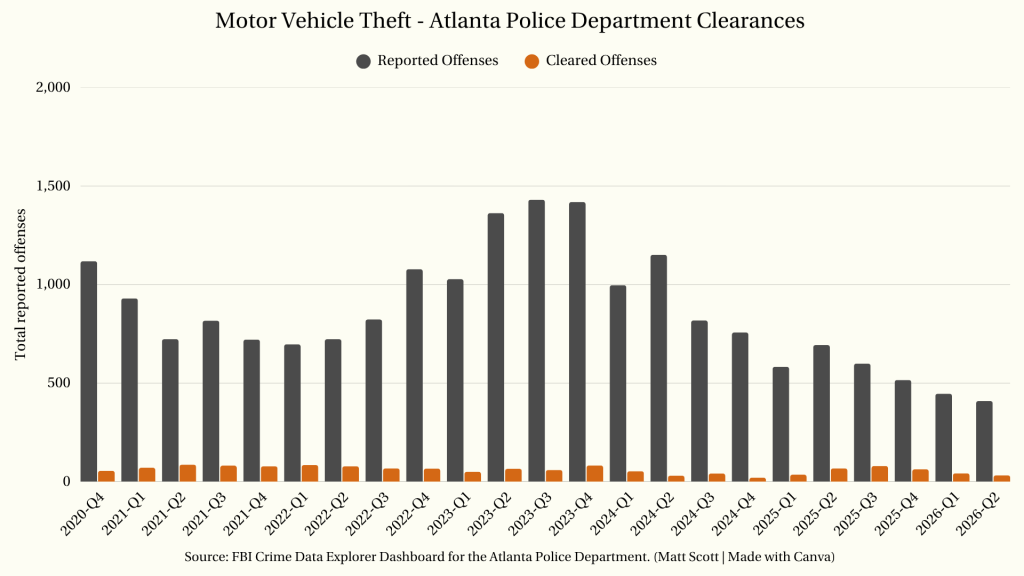
In 2021, APD had a 9.9% clearance rate for motor vehicle thefts. Clearance rates dropped to 4.9% in 2023 and 3.9% in 2024 during a steep rise in motor vehicle thefts linked to the Kia vulnerability. The department rose back to a 10.2% clearance rate in 2025, amid an overall decrease in motor vehicle thefts—a trend seen throughout the county, according to the National Insurance Crime Bureau. Overall, between the fourth quarter of 2020 and the second quarter of 2026, the Crime Data Explorer shows 19,841 reported motor vehicle thefts and 1382 clearances, a 7% clearance rate.
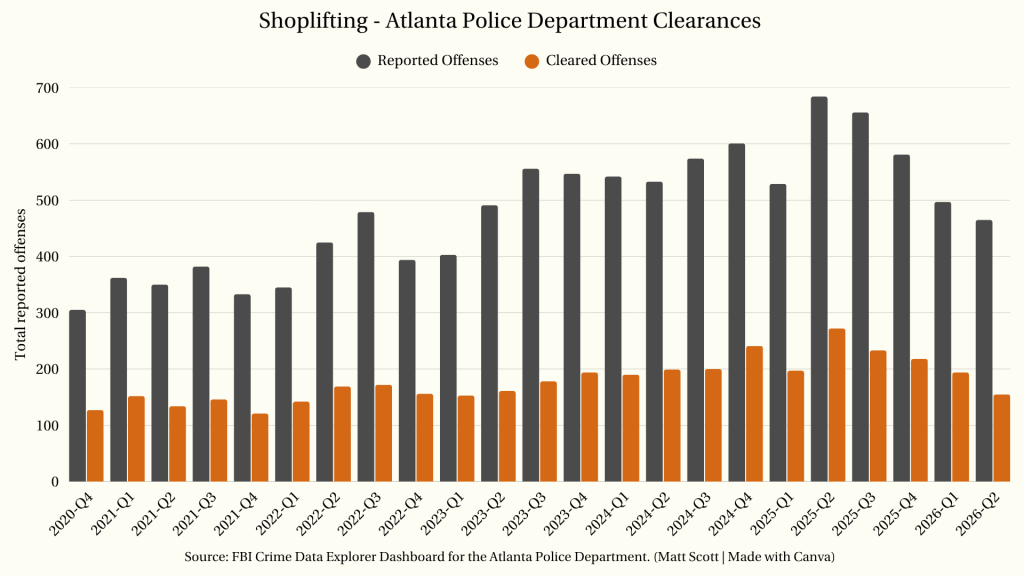
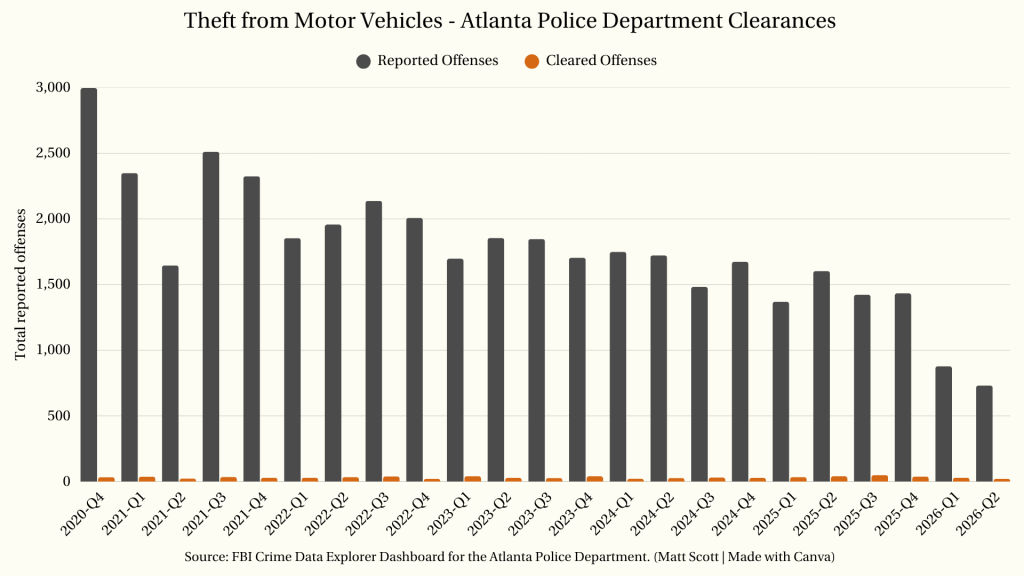
So-called property crimes like theft from motor vehicles, shoplifting or other types of larceny also do not exhibit strong increases in clearance rates.
Thefts from motor vehicles are the most commonly reported offense type and the department’s least cleared among the nine categories, though its clearance rate has doubled, from 1.4% in 2021 to 2.8% in 2025.
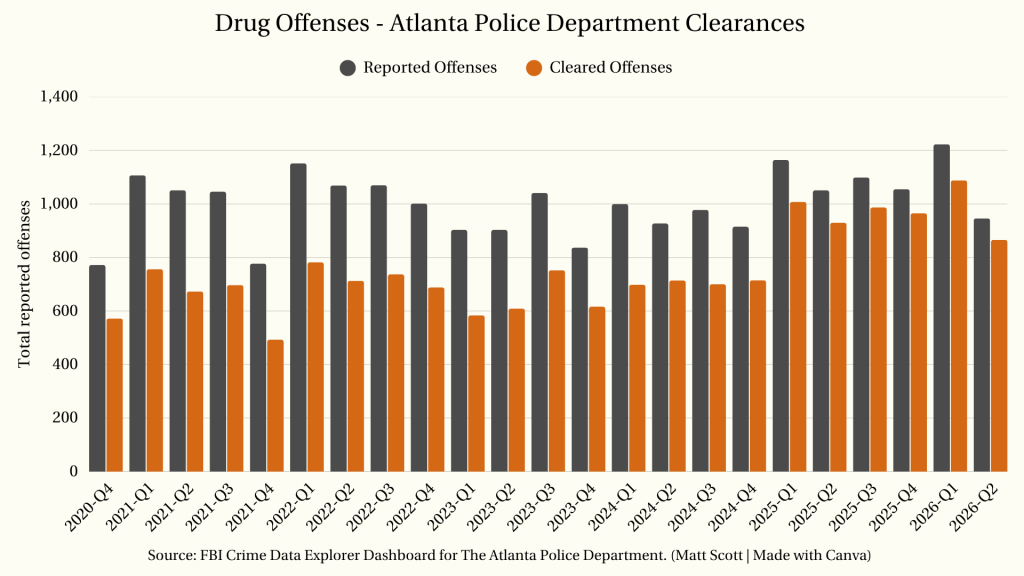
There is one category of crime APD showed a marked improvement in clearing: drug crimes. The department reported a 65.8% clearance rate in 2021. That figure has grown steadily, hitting 90.1% over the first six months of 2026.
Local pushback against growing surveillance infrastructure
Cities and counties across the country have been canceling or pausing their contracts with Flock over privacy and security concerns with the company itself. DeFlock has found 91 such municipalities. But Flock, for many agencies, including Atlanta, is just one piece of surveillance infrastructure. DeFlock’s website also shows the crowd-sourced geolocations of other automated license plate readers beyond Flock.
For Len Phillips of DeFlock Atlanta, the question is why local governments continue to spend tax dollars on surveillance that hasn’t produced meaningful outcomes.
“The public has been asked to accept a significant expansion of surveillance based on the promise that it would dramatically improve public safety,” Phillips told ACPC.
Instead of improving crime-solving, public dollars have been spent on surveillance infrastructure that has caused more harm, Phillips said. “We’ve seen cases of abuse by police officers,” he continued. “We’ve seen cases of faulty plate reads leading to felony traffic stops being conducted on innocent people. We’ve seen people who are not only accused of crimes they had nothing to do with, but who then have to prove their own innocence.”
The tradeoff between public safety and privacy, Phillips said, “was just a one-way transaction.”
About the data
The FBI collects data from local police departments nationwide to track crime details through the National Incident-Based Reporting System.
National crime data is published on an ongoing basis in the FBI’s Crime Data Explorer, which can be filtered by individual departments. ACPC downloaded APD’s data from October 2020—when the department began reporting under the current NIBRS schema—through June 2026.
Data from each month includes the number of reported offenses and the number of clearances. The clearances in any given month are not necessarily for offenses reported that month. For example, a clearance in May 2026 for an offense in May 2025 would be included in the 2026 totals.
Additional clearance rate graphs
No paywall. No corporate sponsors. No corporate ownership.
Help keep it that way by becoming a monthly donor today.
Free news isn't cheap to make.
Author

Related Articles
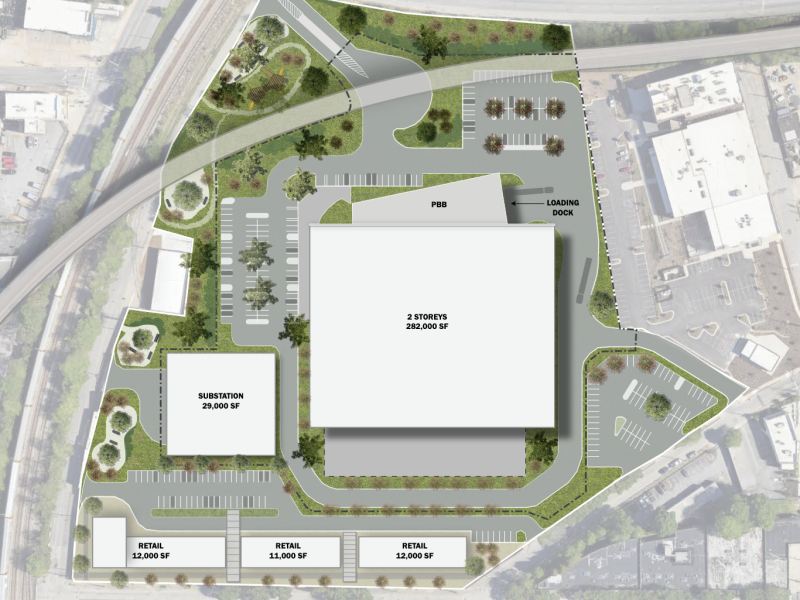
Atlantans organize ahead of Zoning Committee vote on West End data center
Advocates continue to demand that their voices are heard ahead of the Aug. 10 Zoning Committee meeting to determine the future of the proposed West End data center in Atlanta.

Marietta City Council tables approval of new data center
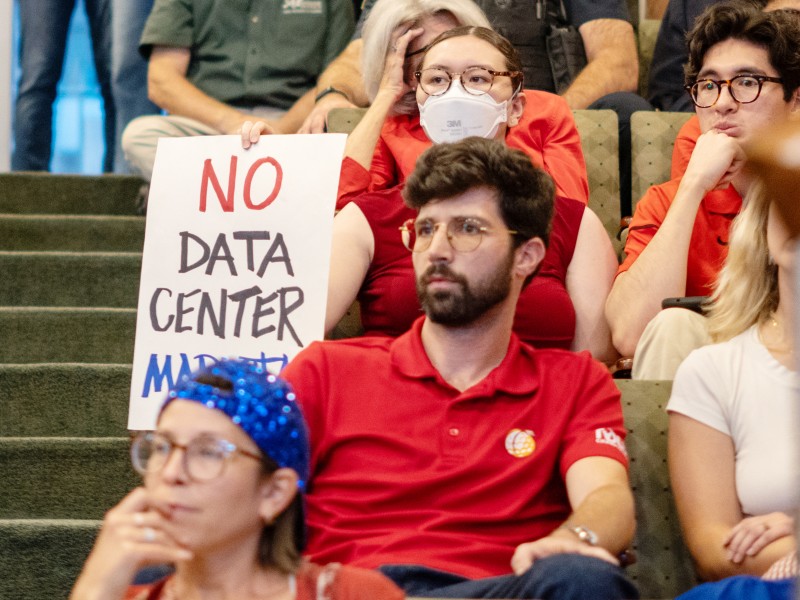
Inside and outside the walls of Marietta City Hall, residents and advocates confronted Marietta City Council members during Wednesday’s meeting with signs and chants to protest a proposed data center at 1155 Powers Ferry Place.

