
Flock Safety: The billion-dollar company at the forefront of AI-powered surveillance

When Georgia Tech graduate and Atlanta Mayor Andre Dickens trumpets his efforts to make the city a “Tech Hub” and incubator, fellow Georgia Tech alum and Flock Safety founder Garrett Langley is often by his side.
Flock Safety—an Atlanta-based AI-powered surveillance company that tracks license plate and vehicle data—made national headlines recently, after researchers discovered a Texas police officer used the company’s surveillance database to track a person who allegedly had an abortion.
Flock is one of Atlanta’s tech “unicorns”—the industry term for a privately held startup with a valuation of a billion dollars or more. Flock’s latest round of capital injections in March valued the company at $7.5 billion. In April, Georgia’s Department of Economic Development lauded Flock’s opening of a new 97,000 square-foot drone and surveillance technology manufacturing facility in Cobb County.
Langley began the police surveillance startup around 2017, after his neighbor experienced a non-violent vehicle theft. Through the experience, Langley learned that police solve only one in five crimes of this type.
In the eight years since, Langley has built a massive, integrated national video surveillance network whose stated mission is to “eliminate crime.” Langley claims Flock helps solve roughly 10% of all crime in the U.S. and plays a role in 1% of all daily arrests in the country.
Flock’s surveillance tech backed by investors with anti-democratic views
Flock’s initial venture capital came largely from members of the so-called “PayPal Mafia”: Former PayPal CEO Peter Thiel’s Founder’s Fund and several other Thiel-associated firms, including Bedrock Capital, Y-Combinator and Initialized Capital.
Critics termed members of this Silicon Valley-based capital formation the “Broligarchy” and have accused them of ushering in “technofascism” through a sweeping, cross-jurisdictional, AI-powered police state.
Thiel and the cadre of other early Flock investors envisioned surveillance technology as a “dual-use” product. Their idea is that governments, private businesses and even neighborhood organizations can buy and utilize surveillance technology as a “force multiplier”.
Some of Flock’s funders, including Thiel, have expressed anti-democratic views.
No paywall. No corporate sponsors. No corporate ownership.
Help keep it that way by becoming a monthly donor today.
Free news isn’t cheap to make.
In 2009, Thiel wrote, “I no longer believe freedom and democracy are compatible.”
Marc Andreessen—whose venture capital firm Andreessen Horowitz is another Flock funder—previously called one of the early 20th century architects of fascism a “saint.” Andreessen has publicly espoused a political theory known as the Iron Law of Oligarchy, which holds that all organizations inevitably move toward oligarchy.
“Democracy is fake,” Andreessen said on the Lex Friedman podcast. “There is always a ruling class. There is always a ruling elite, structurally… the masses can’t organize. The majority can’t organize. Only the minority can organize.”
From ALPRs to drones: Flock’s growing police tech empire
Today, Flock claims to have cameras in “over 5,000 communities across the country,” more than double the 2,000 contracts it reportedly had in 2023. Its offerings combine solar-powered automated license-plate reader (ALPR) technology with integrated, AI-powered networking across departments and jurisdictions. “In ten years, Flock will have eliminated crime in the United States,” Langley claimed on the Logan Bartlett Show in 2024.
Flock recently fell into bitter competition with one of its early partners, Axon Enterprises. Axon markets taser devices, body cameras and real-time video integration centers. The two companies launched a partnership in 2020, which lasted until Axon severed ties with Flock earlier this year. Rick Smith, Axon’s CEO, accused Flock of “coercive behavior” and told the press he was “embarrassed” to have recommended the company to police chiefs.
In February, Flock released Flock Nova, a unified police intelligence platform that enables data sharing between law enforcement agencies. Flock Nova is a direct competitor to Axon’s Fusus platform. In April, Axon announced the launch of a competing ALPR offering. Both companies are investing in police surveillance drones as the next frontier for their revenue models. Flock intends to deploy and market Aerodome, while Axon is launching its Drone-as-First-Responder programs.
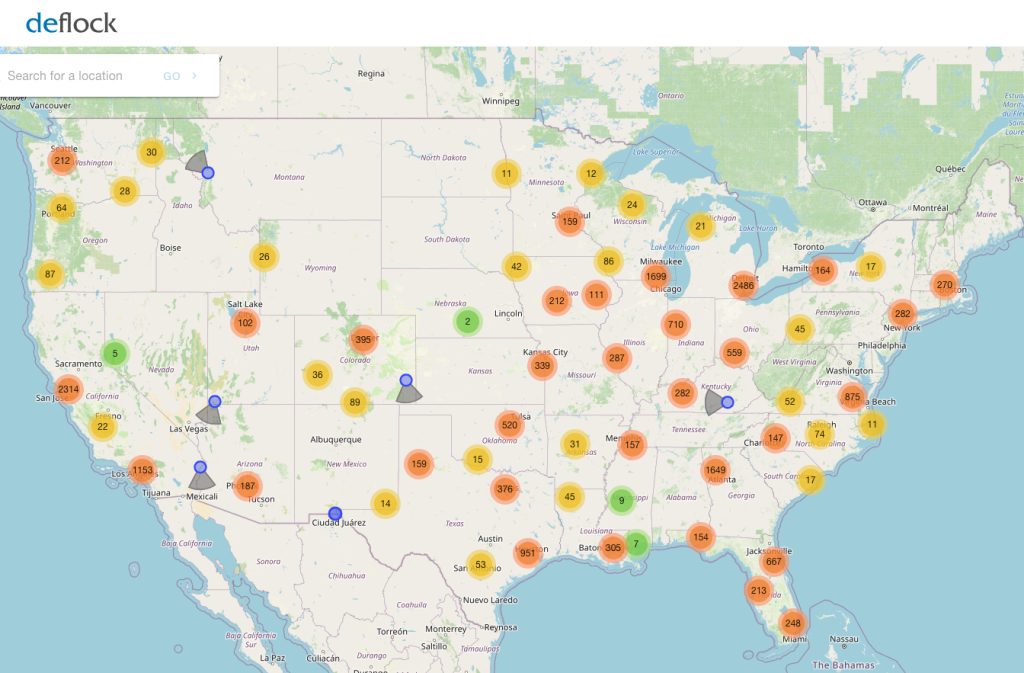
Communities around the country have mobilized to oppose new Flock contracts. The Denver City Council recently declined to reauthorize its agreement with Flock after advocates raised privacy concerns and cited potential violations of a Colorado state law limiting local police collaboration with ICE. Towns in Oklahoma, Washington, and North Carolina have also cancelled or sought to regulate Flock’s agreements with law enforcement. In response to growing pushback, Flock recently sent a cease-and-desist letter to the operators of Deflock.me, a community-powered mapping tool that shows the locations of its cameras.
Related Articles

A Rohingya man in New York died under mysterious circumstances— his relatives in Georgia are grappling with the loss
Federal immigration officers left Nurul Amin Shah Alam outside a closed coffee shop in harsh winter weather— days later he was found dead. He was getting ready to move to Georgia, says his niece in Stone Mountain.