Imaginary Crimes Tour: Stop Cop City movement seeks to build national solidarity against police militarization
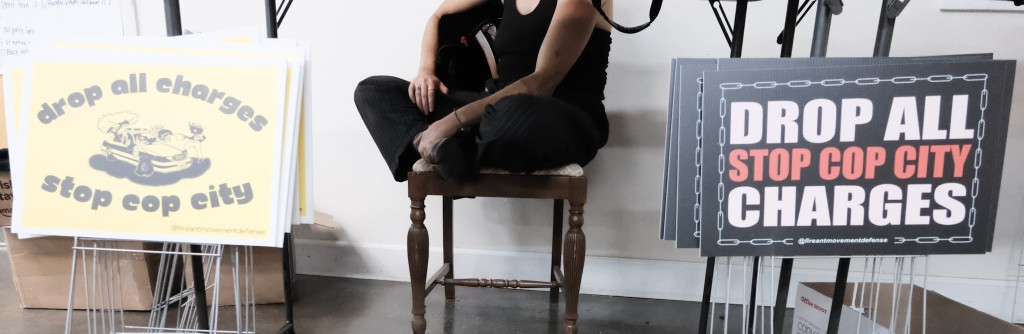
A thorough presentation of Stop Cop City’s history in the broader context of RICO, state repression and anti-repression accompanies community panels on these issues in cities across the nation.
On Friday, April 4, a group of Atlanta organizers welcomed community members to the Multi-Use Radical People’s Hall for the kickoff of their Stop Cop City Imaginary Crimes Tour, a nationwide slate of more than 60 educational convenings featuring panel discussions, anti-repression resources and fundraisers for alleged Stop Cop City protesters charged under Georgia’s Racketeering Influenced and Corrupt Organizations (RICO) Act.
“The tour seeks to educate the public on the broader implications of criminalizing political movements using RICO charges and the need to defend dissent and support the activists under attack,” the group said in a prepared statement. “The cross-country tour will educate the public on the history of the Atlanta forest and resistance to Cop City, how racketeering law has been used as a means of political repression and the ongoing legal battle. The tour will also facilitate discussions on resisting the repression of social movements—and how to adapt to evolving forms of repression by using solidarity, mutual aid and collective action.”
From Keene, New Hampshire, to Seattle and New Orleans to Riverside, California, a group spokesperson who requested anonymity for personal safety said part of the hope is that more and more people across the country will recognize this is not merely a localized struggle for Atlantans, but rather a coordinated national crackdown against the people’s will and popular uprisings in response to the nationwide summer 2020 protests sparked by the murder of George Floyd. More than 80 facilities similar to Cop City, officially known as the Atlanta Public Safety Training Center, are in various phases from proposal to operation, covering every state except Wyoming.
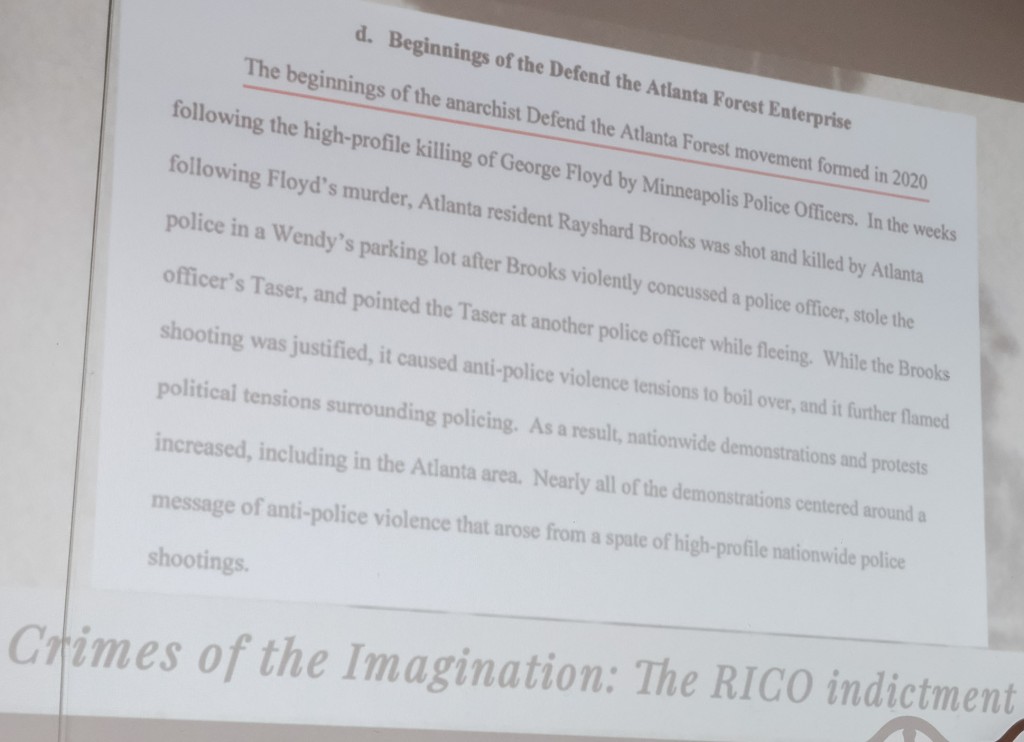
Other reasons for the various municipalities chosen for the tour included involvement of communities that have faced historic oppression, activist ties in some locations and simply places with strong interest in hosting the tour. The spokesperson also stressed the importance of offensive anti-repression measures among aligned organizers in cities around the U.S., including keeping momentum and attention growing for the 61 defendants indicted under Georgia’s RICO Act on charges of a conspiracy related to the Stop Cop City movement. That state narrative of conspiracy is a particular concept the group wants to reframe in countering state narratives, particularly in light of Trump administration crackdowns on pro-Palestine protesters in recent months, making this work all the more important in the group’s minds.

The group stressed that this movement will last well beyond any legal decisions on Cop City—which had its soft opening in December and is scheduled to have its grand opening this month—to continue supporting all defendants facing charges related to the Stop Cop City movement, including through prison time if any should be forced to endure that.
The spokesperson said feedback from early stops in the tour—such as Washington, D.C., and Eugene, Oregon—has been positive, leaving people inspired to continue similar fights in their communities.
RICO defendant and suspended Emory student highlight local panel

No paywall. No corporate sponsors. No corporate ownership.
Help keep it that way by becoming a monthly donor today.
Free news isn’t cheap to make.
As the kickoff event shifted from the presentation to the panel discussion, suspended Emory University medicine and sociology student Umaymah Mohammad and RICO defendant Savannah Patterson of the Atlanta Solidarity Funddiscussed their challenges resulting from activism. Mohammad detailed repression felt from consistent surveillance as a decade-long pro-Palestine organizer, including being followed, surveilled and doxxed at Emory; Patterson spoke about being among 200 defendants arrested in 2017 on felony counts of property destruction, as well as the May 2023 raid on the Atlanta Solidarity Fund house.
“I think Cop City has been a way to pull out the intersectionality of our struggle,” Mohammad said. “It’s a struggle for Palestinian liberation. We know the Georgia International Law Enforcement Exchange program exists here at Georgia State, where they send [Atlanta police] to train under a military whose entire function is to maintain an [Israeli] apartheid state. Even seeing the ICE stops on the highways look like a military occupation.”
Despite the personal cost of likely never having a career in the U.S., Mohammad wanted the takeaway from her story to be pride in standing up to genocide, worth it to her even if expelled from Emory. She noticed the bravery she inspired in fellow students at a campus few had spoken out at, building community and continuing to push with many opportunities to step up in this movement.
Patterson concurred, despite how scary blanket charges, the raid and a life on limbo felt to them.
“I’m proud of us, that we’re still able to offer crucial support for people,” Patterson said of the Atlanta Solidarity Fund’s continued legal help to movement defendants. “I’ve had to move a lot slower in my life these days, and people close to me have really supported me doing that. Not being able to participate in organizing as much as I used to has been really hard, but I still have been participating a lot, and seeing the people I’ve impacted in the ways that I’m able to offer right now really warms my spirit. I just remind myself I’m not alone.”
The panelists concluded by agreeing on one of the biggest universal lessons from their activism: Continue to speak up, as your silence will not protect you.