Consultants paid with city funds promoted Dickens’ NRI without disclosing financial ties, records show
As the Atlanta City Council weighs the Neighborhood Reinvestment Initiative legislation, records show the city paid consultants who promoted it at meetings and in city media without identifying their roles. At least $100,000 came out of the city’s Affordable Housing Trust Fund.
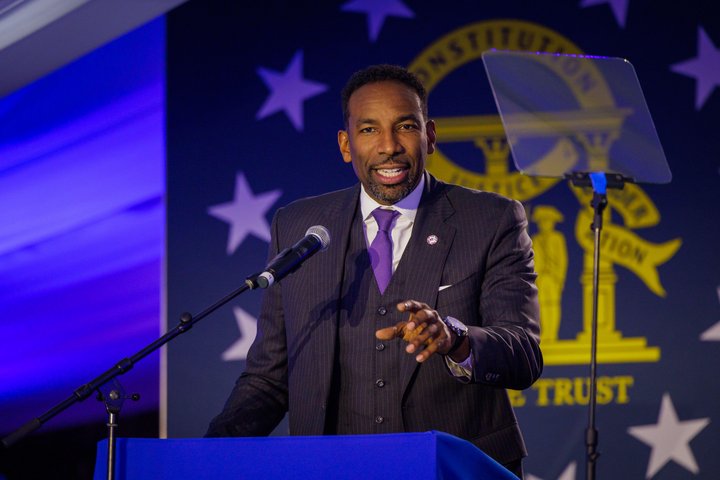
Atlanta Mayor Andre Dickens’ administration has spent more than $370,000 on marketing and communications consultants for his Neighborhood Reinvestment Initiative, including at least $100,000 from the city’s Affordable Housing Trust Fund, an account intended to support affordable housing initiatives.
Records indicate that several consultants who were paid with city funds to support the initiative also publicly advocated for it—speaking at meetings, appearing in city videos and posting on social media—without disclosing their financial ties to the city.
“While there are no ordinances that require such disclosure, we do not have an issue if they do,” said Michael Smith, deputy communications director for the mayor’s office.
The consulting work began as the administration sought support for the multibillion-dollar proposal now under consideration before the Atlanta City Council.
“We’re seeing some trends here. This is how the administration pushes their agenda,” Council Member Kelsea Bond told the Atlanta Community Press Collective. “It’s very troubling, and it lacks transparency.”
The Neighborhood Reinvestment Initiative (NRI) is Dickens’ $5.5 billion plan to address inequality in Atlanta by investing in historically underserved neighborhoods in the city’s south and west regions.
Dickens first introduced the plan in September 2025. To fund it, the administration called for extending the lifespans of the city’s eight tax allocation districts (TADs) through 2055. The city council declined to vote on the associated legislation during its lame duck session. The legislative package was reintroduced in the City Council on May 18, removing two TADs and extending the lifespan to 2056. According to Invest Atlanta’s CFO, Nino Chiappetta, the TADs would raise about $7.7 billion in funding during this period. Invest Atlanta is the economic development authority responsible for determining how TAD funds are spent.
As the legislation was first introduced, consultants began a coordinated communications effort around the NRI. They built toolkits and tracked and responded to social media posts critical of the NRI, spoke during public comment and appeared in videos published by the city supporting the initiative.
“The City engaged outside firms to support communications and public engagement related to this initiative. We often hire external consultants to assist with work on various city issues, and the NRI is no different,” Smith said.
In-depth investigations like this are vital to the health of democracy. A typical 800-word story costs about $700 to produce. This investigation was closer to $1,400.
It’s our hope that readers like you will help us raise back the cost of this story.
Will you chip in $30 to help cover the costs of this story?
Public funds and NRI communications
Documents obtained by ACPC through public records requests show that the consulting firms Incisive, SynergyGPS LLC, and the Accent Group were each given contracts that began in the same month the mayor introduced the NRI. Some of those contracts were extended in February with ending dates of June 30, 2026. Dickens has requested the City Council adopt his NRI legislation by June 15.
Each contract sets a $100,000 cap—the maximum amount any department can spend on a single project with a single vendor without requiring City Council approval. Records show that, through April—the last month for which city expenditures are publicly available—the city has paid $373,000 to consultants working on the NRI.
“The amount spent on communication and public engagement is a tiny fraction compared to the scale of what this administration seeks to do for the current and future residents of this city. Putting it another way, if $5.5 billion were $100,000 in your bank account, $370,000 would be about $6.73,” Smith said.
About half of the spending came from city trust funds, including the Affordable Housing Trust Fund, which has previously raised transparency concerns after an Atlanta Civic Circle investigation revealed that millions of dollars had been spent from the fund on consultants, bond payments and staff salaries.
“It’s very ironic that the money is coming out of the Housing Trust Fund,” Bond said. “Because housing advocates have been lobbying for years now to use that money correctly.”
Council Member Matt Westmoreland introduced legislation last year to tighten guardrails on spending from the trust fund, but the mayor lobbied for a weaker version with fewer protections, which the City Council ultimately adopted.
Some of the contracts were removed from the trust fund ledger after Westmoreland raised concerns about the expenditures in an email to Atlanta’s CFO, Mohamed Balla, on May 20. However, according to a ledger of trust fund expenditures for fiscal year 2026, obtained through a public records request, $100,000 in payments to SynergyGPS remain on the housing trust fund’s books.
“The expenditure was inadvertently coded to the wrong trust fund due to an accounting error. However, the Affordable Housing Trust Fund would have also been an appropriate funding source for this expenditure, given its direct support of the City’s affordable housing goals,” Smith said.
Bond did not share the same view.
“We should probably push for reforms around how the city uses public dollars to lobby in favor of upcoming City Council votes,” they said.
Called Agency
The city has paid Incisive $123,000 in the current fiscal year, with about half of those payments issued on behalf of the mayor’s office and the remainder for the city’s public access television division.
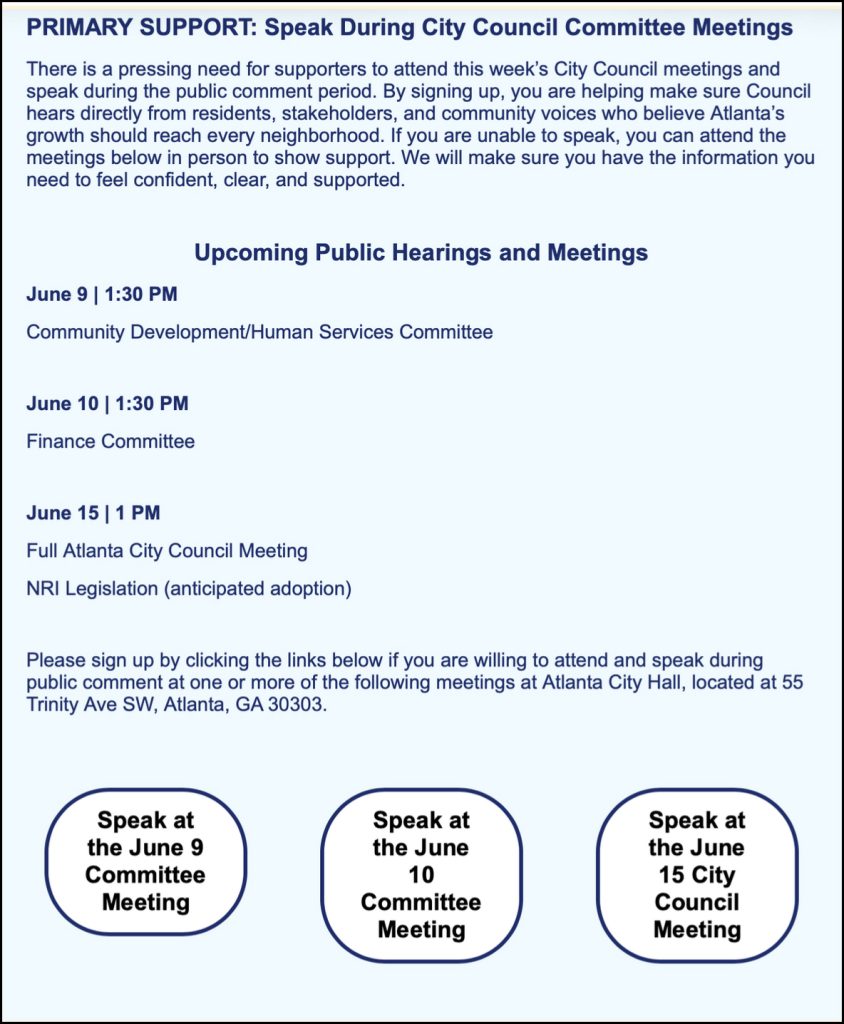
On May 15, representatives of Invest Atlanta emailed members of its TAD advisory committees. The email, reviewed by ACPC, encourages members to “Show Up to Committee Meetings” in support of the NRI and asks for “at least 10 people to speak” during public comments at City Council committee meetings.
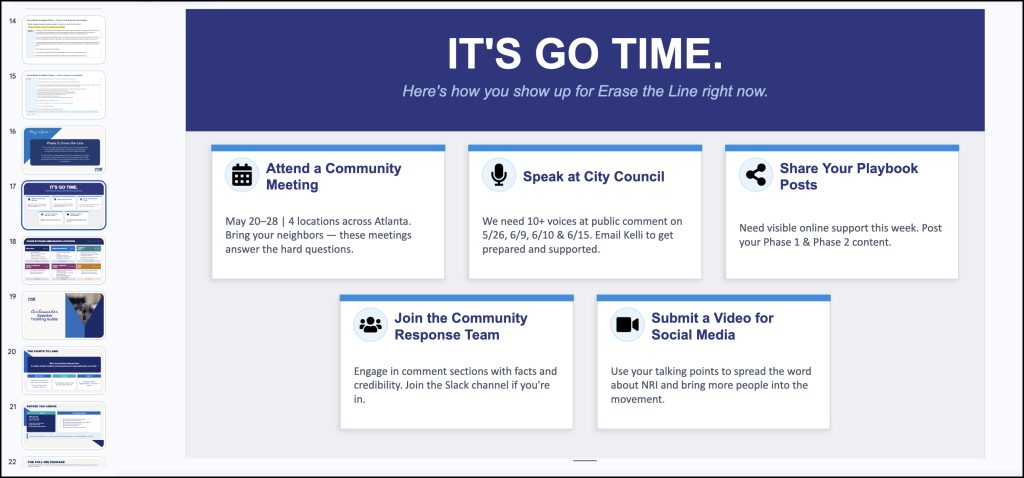
“If you’re interested,” the email says, “please email Kelli (kelli@calledagency.com), and we’ll make sure you’re prepared and supported every step of the way.”
Kelli Ramsey was employed at Incisive until May 2026, according to her LinkedIn page. She is the founder of Called Agency. On Oct. 7, 2025, Ramsey posted to her LinkedIn page that she was working with the city through Incisive.
The email sent by Invest Atlanta directs recipients to an “Erase the Line Ambassador Playbook” slide deck for the NRI. The playbook provides templates and sample language for social media posts. Ambassadors are encouraged to drive up engagement on the city’s April 28 post announcing the new NRI.
The playbook also includes suggestions for social media posts. It provides seven recommended social media video scripts and templates for Instagram and LinkedIn posts. Examples of Instagram and LinkedIn posts were included in the email forwarded by Invest Atlanta.
Ramsey spoke in support of the NRI during public comment at the Community Development/Human Services committee meeting on May 26. She did not identify herself as a consultant for the NRI.
On June 8, Ramsey sent out another mass email calling for recipients to attend the June 9 Community Development/Human Services Committee meeting, the June 10 Finance Executive Committee meeting and the June 15 full City Council meeting.
SynergyGPS
SynergyGPS is tasked with, among other things, updating a “TADs Campaign Calendar” and conducting community engagement and outreach activities.
The city has paid SynergyGPS $130,000, with $100,000 from the Affordable Housing Trust Fund and an additional $30,000 from a separate trust fund, though documents indicate the payments are for the same project.
Recent invoices directly tie expenditures to the NRI. The description of work submitted by the company notes, “additional team members have been added and on boarded for organizational and operational support. This is reflected in the community outreach partners that will create additional expense for events and engagement work with partners for our TAD outreach efforts. These expenses will continue to scale up in support of the scope of work.”
Synergy’s COO, David Mitchell, has appeared before the City Council on at least two occasions and the Atlanta Public Schools Board of Education at least once to speak in favor of the NRI during public comment. Mitchell did not mention his role as a consultant for the NRI. He also appeared without being identified as a paid consultant in the May 19 video posted by the city.
The Accent Group
The city has paid the Accent Group $120,000, with half of the payments assigned to the mayor’s office and half assigned to People TV. As with SynergyGPS, the invoices for payments out of both divisions reference the same contract.
Humberto García-Sjögrim and Caren Solomon Bhwarwani are listed as the principal contacts.
Both García-Sjögrim and Bhwarwani have been active in Instagram comment sections on posts about the NRI, defending the plan. This is not the pair’s first time working with the mayor’s office on city issues. In 2021, García-Sjögrim and Bhwarwani registered Neighbors for a United Atlanta with the Georgia Secretary of State. In 2023, Neighbors launched a “grassroots” campaign against the Buckhead succession movement. The organization went quiet after the succession movement failed, but its website and social media platforms were reactivated earlier this year in support of the NRI.
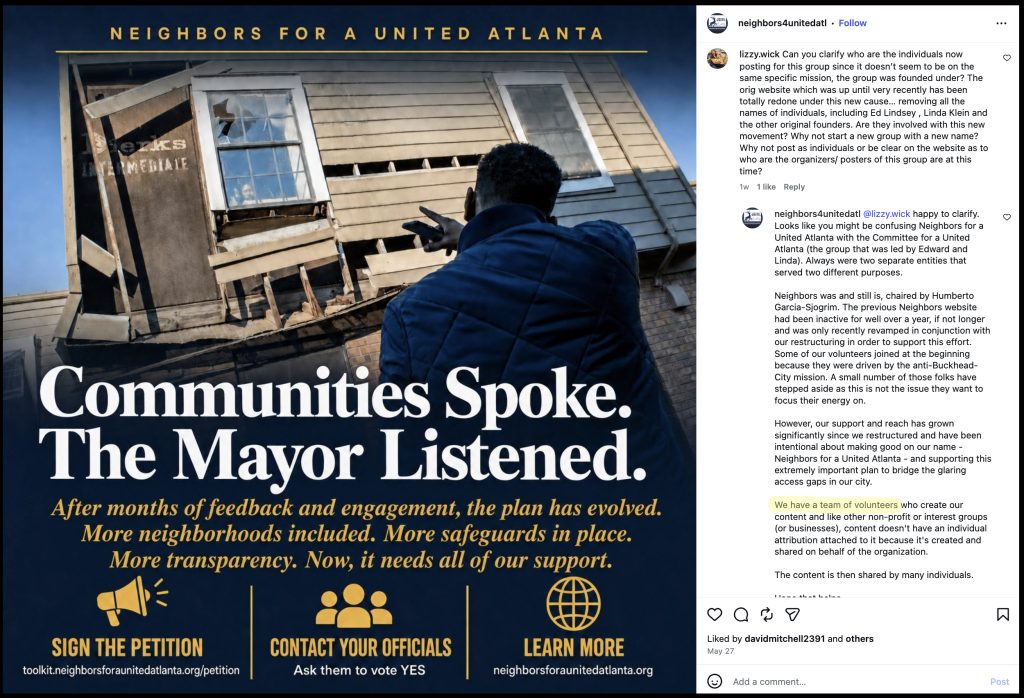
In response to a question on one of Neighbors’ Instagram posts asking about its reorganization in support of the NRI, Neighbors’ account said, “We have a team of volunteers who create our content.” The response also notes that García-Sjögrim still chairs the organization, but does not mention Accent Group’s consulting payments from the city.
The website now includes links to a different toolkit than Ramsey’s, with similar messaging. The site also includes a petition and an email template to urge Atlanta’s city council members to pass the NRI. As of the time of publication, the petition had 69 signatures.
García-Sjögrim appeared but was not identified in the city’s May 19 NRI video. Both he and Bhwarwani have commented on social media posts critical of the mayor’s plan.
Lobbying concerns
The records show a consistent pattern across multiple firms: consultants paid with public funds taking part in public-facing efforts tied to specific legislation still pending before the City Council, often without disclosing their financial ties to the city.
Smith said there are no city rules requiring consultants to disclose financial ties when advocating publicly and “consultants were not instructed on how to accomplish their scopes of work.”
None of the consultants identified in this story are registered as lobbyists with the Georgia State Ethics Commission—the agency responsible for regulating lobbyists.
Georgia law defines a lobbyist, in part, as someone who “is compensated specifically for undertaking to promote or oppose the passage of any ordinance or resolution by a public officer.”
Lobbyists in Georgia are required to register with the Ethics Commission. Registered lobbyists receive an official badge, which they must wear when lobbying government officials. In 2018, the City Council adopted legislation to allow city council members to have the city’s municipal clerk issue a written complaint to the Ethics Commission when they believe someone is violating state laws around lobbying.
No paywall. No corporate sponsors. No corporate ownership.
Help keep it that way by becoming a monthly donor today.
Free news isn't cheap to make.
Author

Related Articles
AI, Flock cameras and data centers dominate debates for Georgia’s statewide races
AI was a hot topic in every Atlanta Press Club debate, from Attorney General to Agriculture Commissioner
Approximately 500 participate in hunger strike at Folkston immigration detention center
Government recently awarded massive contract to expand GEO Group facility to 3,000 beds to become largest permanent ICE site in United States.

