Local orgs fear further criminalized homelessness in HB 295, advanced from Public Safety Committee
The 8-5 vote marked the third straight year the bill proceeded to the House floor, where it was withdrawn last year without a full-House vote.
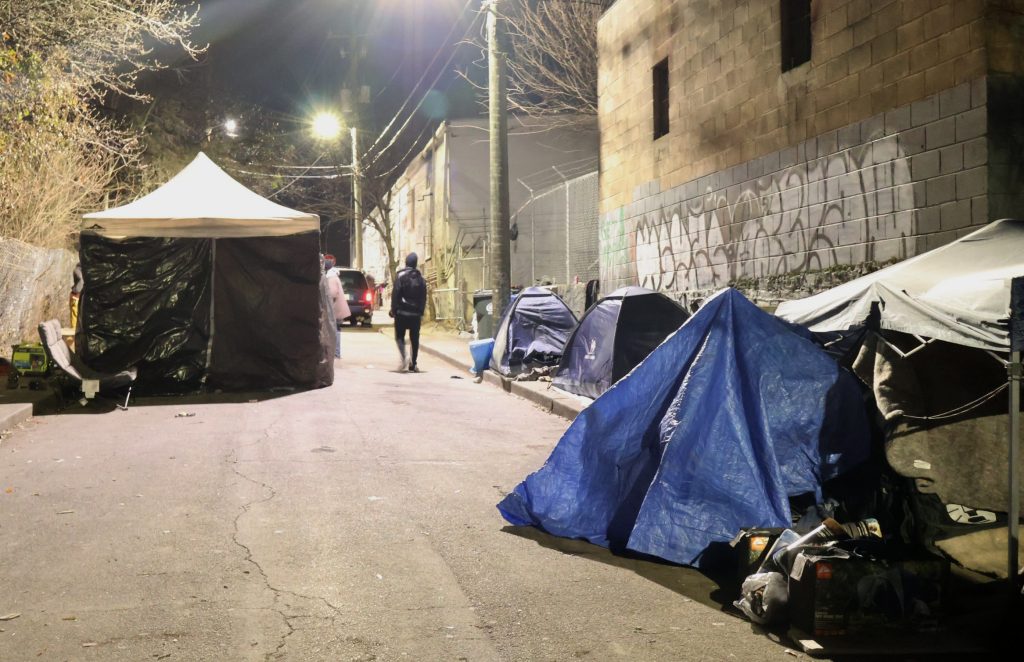
When Rep. Houston Gaines, R-Athens, introduced HB 295 to the House Public Safety & Homeland Security Committee on Wednesday, he called the bill commonsense legislation to ensure local governments enforce laws related to loitering, homelessness and illegal immigration, for the protection of property owners.
The bill would enable property owners to make claims for compensation from local governments if they incur expenses or loss of property value from nonenforcement of laws or maintaining a public nuisance. Community advocacy groups objected to the bill on behalf of vulnerable populations, particularly unhoused people. They stressed that Gov. Brian Kemp has emphasized affordable housing and support services as solutions—not tighter law enforcement—in accordance with scientific studies.
Lejla Prljaca, CEO of the Gwinnett Housing Corporation, said a Georgia State University study showed a gross undercount in the official data of more than 12,000 Georgians suffering from homelessness each night. She expressed concern about the breadth of what HB 295 considers a nuisance and the effects on struggling families.
“A lot of families—a lot of children—would actually be affected by this bill because of the lack of affordable housing,” Prljaca said. “I have interviewed families living in a car on private property, in parking lots of Walmart and Target. So these families would absolutely be affected by this. They would be criminalized. … When there’s a criminal record, it is much harder to get them housing privately or through a nonprofit.”
Committee member Terry Cummings, D-Mableton, joined the objectors and voted against the bill, reiterating her concern about the bill from last year. She fears that unhoused people would be arrested and jailed in greater numbers, rather than getting the mental health care many need. Gaines responded that he saw homelessness and mental health as separate issues from this bill making local governments enforce their laws. Committee member Jesse Petrea, R-Savannah, said the bill was, to him, more about complaints of aggressive panhandling from women constituents afraid to shop at night.
“We don’t want anybody with mental illness jailed just because they’re mentally ill,” Petrea said. “No one wants that. But we do want people to seek care and to get the care they need, and allowing this (panhandling) is not the answer.”
Kaitlin Ward, senior program associate at The Carter Center, spoke to the Center’s advocacy for social services as alternatives to incarceration.
“One in six people that are incarcerated today are for public nuisance issues, and about 40% of incarcerated individuals have been diagnosed with a mental health condition—almost double that of the general population,” Ward said. “Our jails are the No. 1 place in which people are receiving mental health care, which is not helpful. This bill today would encourage local governments to just use policing and to jail individuals instead of investing in alternative solutions and community response measures.”
Intown Cares program manager Tracy Woodard said her vast experience with calls from developers and owners to remove people from properties have three results:
- Police and Public Works clear a camp that will refill someday.
- Owners install private security and fencing, raising expenses.
- Governments pay social workers to aid unhoused people and help developers build truly affordable housing.
HouseATL executive director Natallie Keiser said all 500 members of HouseATL’s coalition opposed the bill, noting the arrests and incarceration are costly and exacerbate problems. People arrested lose belongings, identification and contact with outreach workers helping them find stability, she said.
“Mental and physical health issues may escalate due to the stress of being behind bars and losing medications,” Kaiser said. “We need for the state to support local governments and organizations who are investing in solutions that work, rather than pressuring them to incarcerate people who are homeless. The state already has a nationally respected initiative called the Georgia Housing Voucher Program, supported by your Department of Behavioral Health and Developmental Disabilities.”
She said that department and other programs need more funding and support, grateful though they are for Kemp’s request for $50 million toward the homelessness crisis.
Atlanta’s Policing Alternatives & Diversions Initiative (PAD) provides study-affirmed solutions and has recently been threatened by funding cuts. PAD Executive Director Moki Macías spoke to its impact as the first alternate response program in Georgia.
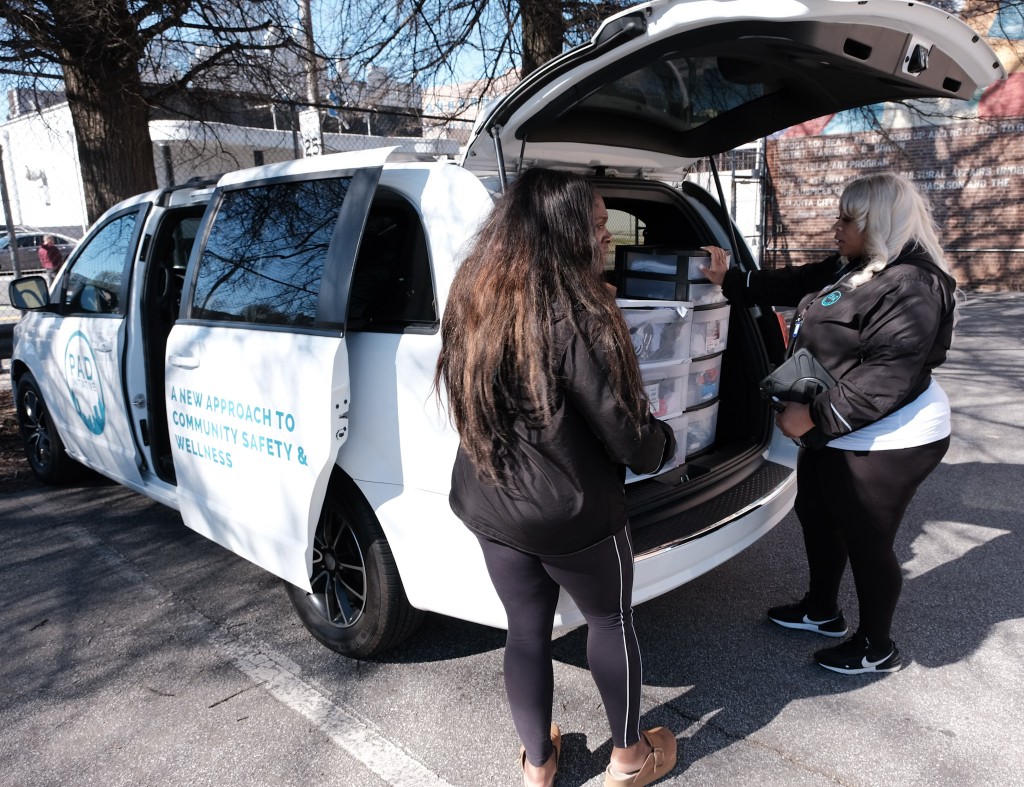
“We’ve launched a 24/7 Center for Diversion and Sobering, and just tomorrow we’ll celebrate the launch of Fulton County’s co-responder program,” she said. “These combined efforts are designed to more effectively address public disorder, brought on by unsheltered homelessness, insufficient mental health resources and the lack of public amenities like toilets. We know that arresting and jailing people for quality of life violations is a drain on resources and does nothing to address the underlying cause of the violation. Programs like ours and those we are part of are designed to do so. I’m concerned that an unintended consequence of HB 295 may be to dissuade local governments from enacting these evidence-based interventions that reduce the burden on law enforcement.”
Macías noted PAD had shared a suggested amendment to ensure initiatives like PAD are exempted. But the bill passed the committee by an 8-5 vote, with an amendment theoretically dissuading frivolous claims. It would next need to pass a full vote in the House to continue. The House did not vote on the bill last year, leading to its withdrawal for consideration this year.
No paywall. No corporate sponsors. No corporate ownership.
Help keep it that way by becoming a monthly donor today.
Free news isn't cheap to make.
Related Articles

Meet Sandbox: Atlanta’s fix-it hackerspace and progressive tech collective
Launched in early 2025, Sandbox offers its space in Little Five Points’ Hartz Building for member-run digital security trainings, community fix-it days, 3-D printing and much more.

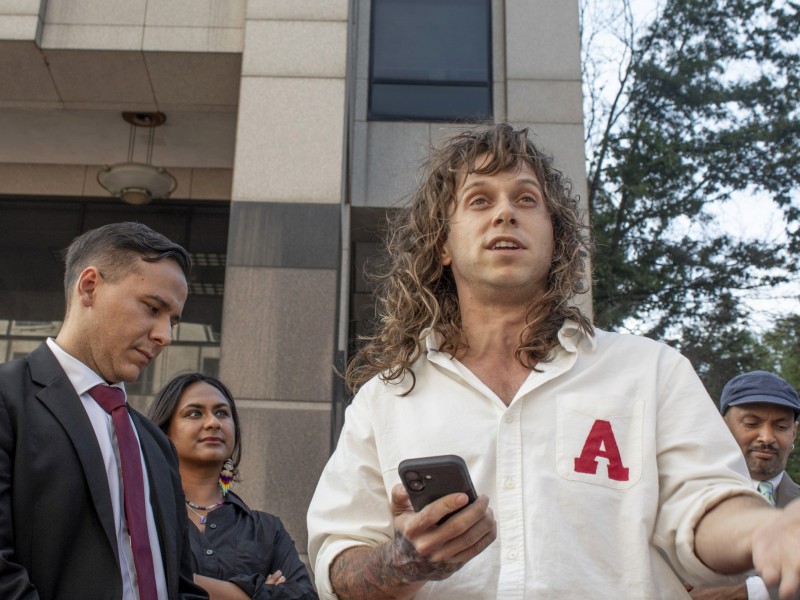
Georgia Court of Appeals will take up ‘Cop City’ RICO case
Attorney General Chris Carr appealed Fulton County Superior Court Judge Kevin A. Farmer’s dismissal of racketeering charges against 61 people. The Georgia Court of Appeals accepted the application on Wednesday, despite process challenges from the defense.