Anti-TAD organizers call TAD delay a battle won but expect fight in 2026
Mayor Andre Dickens’ controversial rush to extend eight tax allocation district funds through 2055 would divert as much as $5.5 billion from local government control to Invest Atlanta’s board, overseen by the mayor for his Neighborhood Reinvestment Initiative.
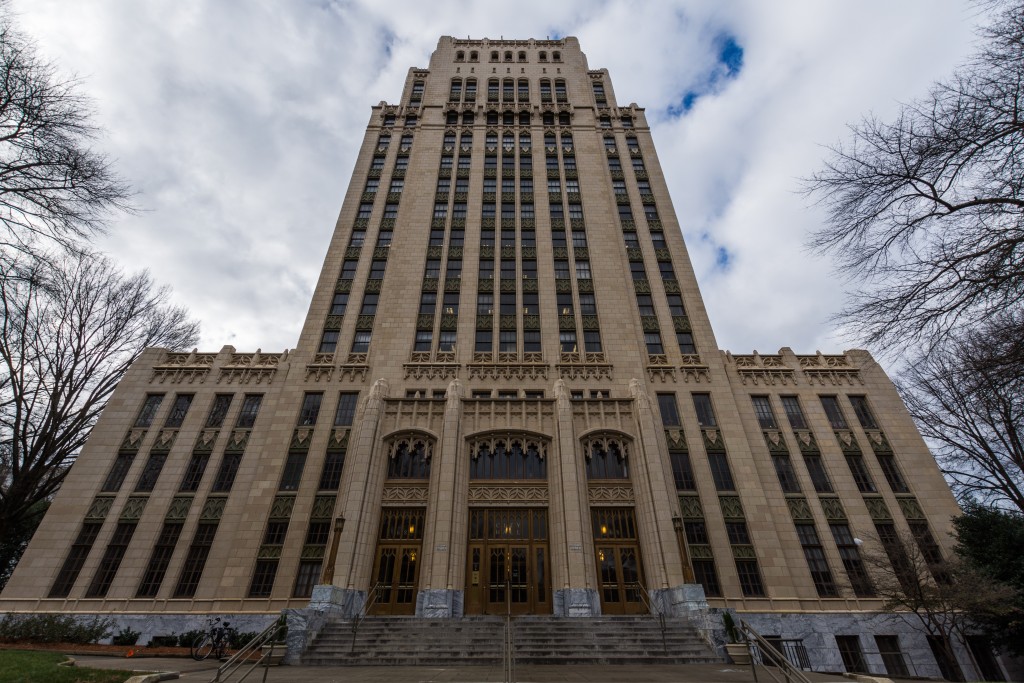
“I also see that several people are here to speak to the TADs,” District 1 Atlanta City Council Member and committee chair Jason Winston said after the first public comment of Tuesday’s Community Development/Human Services meeting. “If you didn’t get the gist of the chief of staff’s comment, Council will not be moving forward with any TAD legislation today or this year.”
Raucous applause overshadowed the remainder of Winston’s statement, including from 17 public commenters who later spoke on Atlanta’s tax allocation districts (TADs). All were opposed to the mayor’s office’s rush during this lame duck period to extend the eight TADs through 2055. The eight TADs already last through 2030 or beyond—as late as 2050—prompting concern from speakers as to why Mayor Andre Dickens’ office would need to extend the TADs well past his term limit.
TADs take property taxes from designated districts and reserve the money for redevelopment in the same district. Proponents say using this revenue for redevelopment—often by private corporations—leads to a net gain in tax revenue. Opponents say TADs pull funding away from necessary services, such as schools, roads and emergency services. Atlanta’s eight active TADs are:
- Westside (created in 1992)
- Perry/Bolton (2002)
- Eastside (2003)
- Beltline (2005)
- Campbellton Road (2006)
- Hollowell/MLK (2006)
- Metropolitan Parkway (2006)
- Stadium Neighborhoods (2006)
Chief of Staff Courtney English pre-empted public comments with a surprise turnaround announcement that the mayor’s office would wait until next year to address TADs. English did not deny the mayor’s office’s support for the TADs, which the office has previously revealed it would use more than $5 billion of to fund Dickens’ Neighborhood Reinvestment Initiative. Invest Atlanta, a nine-member board that the mayor chairs, would take control of TAD funds local governments would otherwise command—including City Council, Fulton County Board of Commissioners and the Atlanta Board of Education.
Community participation encouraged in TAD decision
“You’re taking one fifth of the city’s revenue—and maybe more, after 30 years—and you’re giving it to Invest Atlanta to decide what to do with it,” District 1 resident Paul Boster said, opposing TADs. “We elected you to make these decisions. We didn’t elect members of the Invest Atlanta board. So there’s a great undemocratic nature to what you’re actually doing.
“I don’t think you should give up the authority by giving all this revenue for a generation—we’re talking a generation of wealth going to Invest Atlanta. … Are we also doing this by executive order, rather than through NPUs and hearings and other opportunities for people to actually have a say?”
District 2 Council Member-Elect and Atlanta Democratic Socialists of America (DSA) Kelsea Bond declared the TAD delay a victory for everyday Atlantans applying public pressure to the council. An email-writing campaign against the TAD push, led by Atlanta DSA, garnered approximately 700 messages to the mayor and council by the committee meeting.
“Community participation is what democracy looks like, not shadowy boards of CEOs and corporate interests doling out money for for-profit developers that should be going toward our public schools,” Bond said.
Bond also listed housing, transit, groceries and hospitals among city needs the budget can meet, questioning the effectiveness of TADs as the vehicle for that.
“It’s financially and morally irresponsible and antidemocratic to write a blank check to Invest Atlanta, solely fueled by the pure hope that we will get these projects as promised,” Bond said to applause. “If we are in such dire need of funds, we need to press Fulton County to adequately assess luxury commercial properties. Each year our city misses out on hundreds of millions of dollars because the Fulton County Board of Assessors is afraid to tax the rich.”
Council members on the committee likewise encouraged public commenters to present their thoughts to other local governments, particularly Fulton County. District 4 Council Member Jason Dozier reminded everyone that the Fulton County Board of Commissioners’ next meeting is Wednesday, Dec. 3. He also stressed TAD Subcommittee and Invest Atlanta meetings discussing use of existing TAD funds are open to the public, occurring every second and third Thursday of the month respectively. Winston echoed the invitation as acting chair of Invest Atlanta and the TAD Subcommittee.
“Please help us show up in spaces where you’re not expected, to humanize these narratives,” District 5 Council Member Liliana Bakhtiari said. “I really would like to ask you all for the favor of holding Fulton County accountable when we take this up again next year. They are not at the table when it comes to mental health or health care, which is in their charter, not in ours, but we have carried the water for them on that.”
Council passes Michael Julian Bond’s funding evaluation resolution
Meanwhile, At-Large District 1 Council Member Michael Julian Bond proclaimed his support of TADs and explained his understanding of their history, stressing the oversight body—Invest Atlanta—was always meant to be beholden to City Council as its authority, not an equal as it is now.
“They are remarkable tools for community investment and redevelopment, but a TAD is like a hammer,” he said. “It can be a hammer in Jimmy Carter’s hands to build housing for people and be positive, or it can be Maxwell’s silver hammer.”
Michael Julian Bond went on to critique Atlanta Public Schools for longstanding issues in use of tax funds.
“Twenty-five years ago, against every actuarial projection of population, they went on an unprecedented building program,” he said. “So their financial issues and why they wound up where they are is longstanding. They didn’t get here overnight.”
Although the committee withheld the TAD-related ordinance, it unanimously passed a resolution from Michael Julian Bond to request the departments of Finance and City Planning and the Office of the Mayor conduct a study to evaluate funding mechanisms for designated redevelopment areas.
In explaining his resolution, he said of the public: “We just need to stop conflating issues between TADs, TIFs (tax increment financing) and other misinformed positions on why Fulton County has done things or why the school system has done things or how we might ‘hurt the school system’ or ‘hurt Fulton County’ by continuing some of our economic development practices.
He suggested a work session early in the new year to explain how such practices work and their history, stating that employees also don’t understand them properly.
“They are not as informed as they should be, and of course the public is not as informed as it should be,” he said.
Public voices concerns about TAD utilization
Matthew Nursey of the Housing Justice League (HJL) noted that TADs could work well along the line Michael Julian Bond explained but that HJL prefers other methods the city seemed to ignore, such as municipal bonds.
“Historically, the TADs here in Atlanta have left a lot of people out, and they’ve just been drivers for gentrification,” Nursey said, before describing what he called a better model for funding affordable housing. “Annual reports are great, but Housing Justice League believes that the city’s affordable housing trust fund should be fully democratized, placed into the hands of the people. We should have a forum and a way for folks to get involved in the process. We advocate for having a website dedicated solely to the housing trust fund so people can at any time go and look: how much funds are in it; what projects are underway; what has already been built—really be transparent.”
Other concerns the public raised regarding TADs included:
- conflicts of interest
- ramming them through before an audit slated for completion in the summer
- possible secretive back-room deals akin to those around Cop City as revolving-door corporate governance subverting democracy
- racking up debt
- mayoral overreach and excess power
“Don’t be afraid what the mayor’ll do, what the mayor said, because who put you into office?” resident Margie McLeod asked rhetorically. “And how long’s that TAD (money) been there? And you left them homeless people for two years, out in the street, dying? Guess how many children and women entered the shelter—or, well, foster care. We have money and you didn’t use it wisely. And then you want to have a corporate takeover when they are taking the money from the people?
“We got a new year, ‘26. We are going to fight for the people.”
No paywall. No corporate sponsors. No corporate ownership.
Help keep it that way by becoming a monthly donor today.
Free news isn't cheap to make.
Related Articles
Georgia Court of Appeals will take up ‘Cop City’ RICO case
Attorney General Chris Carr appealed Fulton County Superior Court Judge Kevin A. Farmer’s dismissal of racketeering charges against 61 people. The Georgia Court of Appeals accepted the application on Wednesday, despite process challenges from the defense.


Local orgs fear further criminalized homelessness in HB 295, advanced from Public Safety Committee
The 8-5 vote marked the third straight year the bill proceeded to the House floor, where it was withdrawn last year without a full-House vote.