Atlanta police searched license plate reader network for immigrants, records show
The Atlanta Police Department said that it “has not assisted any federal law enforcement agencies with immigration enforcement activities this year,” but records reveal that on at least 15 occasions, investigators scoured thousands of cameras to track migrants.
Correction: ACPC has updated this story. An earlier version included the statement that the Atlanta Police Department “had found no results when searching for the terms the ACPC had identified.” When initially contacting the department, ACPC inquired, “what would be the purpose of searches listing ‘ERO assist’ and ‘track alien’ as the reason.” The latter search term was incorrect. APD’s response to the query was, “A previous search for ‘ERO assist’ and ‘track alien’ was conducted in response to your media request which yielded 0 results.”
Users with Atlanta Police Department accounts used a network of thousands of Flock license plate readers to search for immigrants in March 2025, according to documents obtained via an open records request.
The Atlanta Police Department (APD) uses license plate recognition cameras made by Atlanta-based police technology company Flock Safety. In June, the Atlanta Community Press Collective (ACPC) requested a copy of APD’s Flock audit under the Georgia Open Records Act. APD provided the audit on Nov. 12, which shows searches of its network conducted between Jan. 1, 2025, and Nov. 7, 2025.
Records of the audit show that between March 20 and March 24, two individuals using APD credentials conducted 15 searches of the interconnected Flock network using the terms “locate alien” and “ERO assist,” the latter likely a reference to ICE’s Enforcement Removal Operations division.
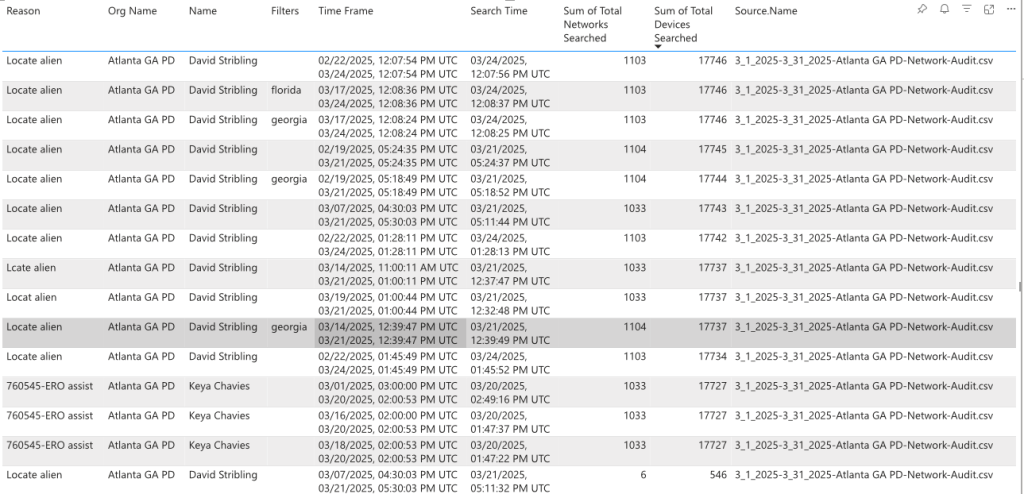
David Stribling, an APD Investigator, conducted 12 searches labeled some variation of “locate alien.” An APD spokesperson said Stribling was a detective at the time and “was assigned to an FBI task force that was working on trans-national fraud investigations.” Stribling has since retired from the department.
A second individual, Keya Chavies, conducted three searches labeled “760545 – ERO assist.” The APD spokesperson confirmed that Chavies did not work for the department. A LinkedIn profile for a Keya Chavies lists her as an Intelligence Specialist with the Bureau of Alcohol, Tobacco, Firearms and Explosives in Atlanta.
When ACPC asked APD about the immigration-related searches, the spokesperson for the department said it had “not assisted any federal law enforcement agencies with immigration enforcement activities this year.”
“Welcoming City” policy at odds with police practice
APD joins a growing list of local police agencies across the country that have participated in some form of immigration enforcement through Flock’s police surveillance technology apparatus.
No paywall. No corporate sponsors. No corporate ownership.
Help keep it that way by becoming a monthly donor today.
Free news isn’t cheap to make.
In addition to capturing license plate data, Flock cameras catalog vehicle makes and models and other unique identifying information like bumper stickers or body damage to create a “vehicle fingerprint.” The Flock cameras under one agency can be networked with other agencies across the country, allowing local police officers to conduct wide-sweeping vehicle searches. Departments can share their network data with a single outside agency or within a geographic radius, statewide or nationwide.
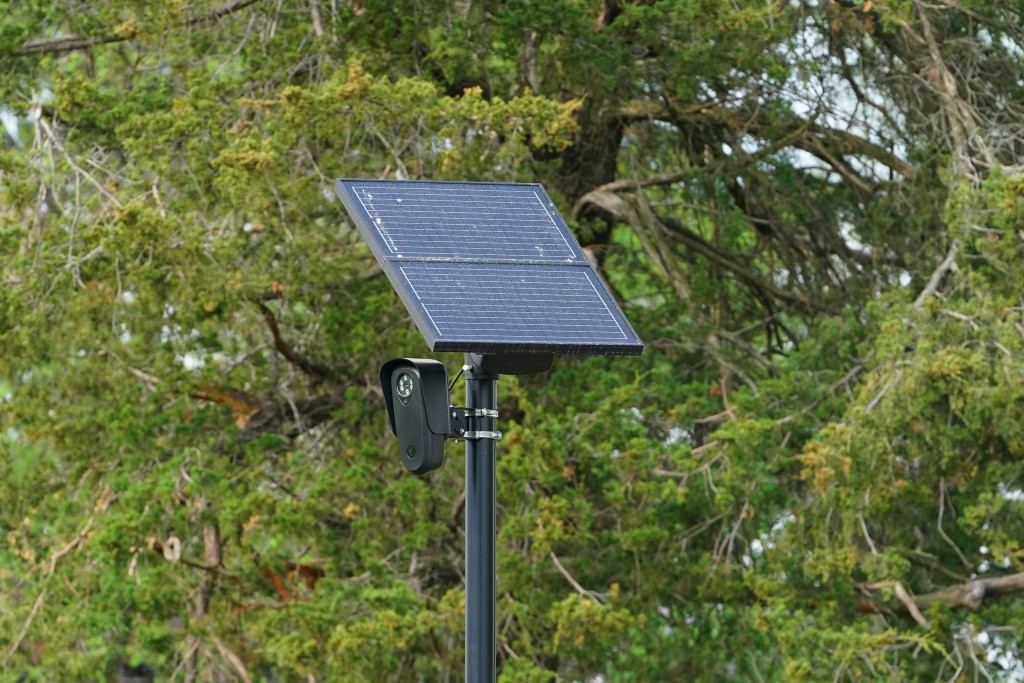
The scale of Flock surveillance is vast. The audit shows nearly 4,500 different agencies have conducted over 10.6 million searches that used APD’s Flock cameras since the beginning of 2025. APD conducted 323,292 searches over the same time frame.
Among the searches of APD’s network by external agencies were 3,254 by U.S. Border Patrol and 3,383 with keywords related to immigration enforcement.
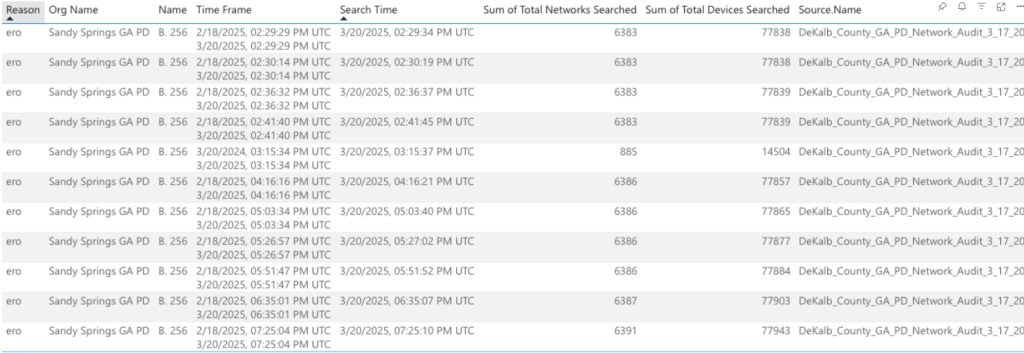
In May, ACPC reported on three metro Atlanta agencies conducting immigration-related searches. The following month, Appen Media reported the Sandy Springs Police Department had also engaged in immigration-related searches that listed “ERO” as the reason. The searches reported by Appen Media align with those conducted by APD.
The use of APD’s cameras by external agencies for immigration enforcement and APD’s own immigration-related searches clash with the city’s efforts to protect undocumented migrants.
In 2013, Atlanta joined the “Welcoming Cities and Counties” initiative, launching an effort to “foster a community of trust between Atlanta’s foreign-born population and the officers entrusted with protecting our streets.”
The city has restated its pro-immigration stance repeatedly.
In 2017, the City of Atlanta joined ten other cities and the Vera Institute of Justice in launching the SAFE Cities Network initiative to provide representation for migrants facing deportation. The following year, Mayor Keisha Lance Bottoms ended the city’s contract to house migrants detained by ICE in the Atlanta City Detention Center. In February 2025, the city council approved an ordinance to apply for $4 million in funding for case management services for noncitizens, and in June, the city accepted a $156,250 grant to provide migrant deportation defense in the Office of Public Defender.
Flock use faces national backlash
Flock has been under scrutiny since at least 2022, but has come under renewed criticism this year specifically for its role in facilitating surveillance of immigrants. In June, a 404 Media investigation revealed that local and federal agencies connected to the Flock network conducted 4,000 immigration-related searches between June 1, 2025, and May 5, 2025. At least eight cities have cancelled or paused their contracts with Flock this year.
In June, the Austin, Texas, City Council chose not to renew its contract with Flock over privacy concerns. The Denver City Council voted unanimously against an extension of its contract with Flock over concerns about how other agencies could access the city’s network, but last week, Mayor Mike Johnston unilaterally signed a smaller contract under the cost threshold that requires city council approval.
The Illinois Secretary of State’s Office conducted an audit of Illinois Flock data and found that federal agencies, including Customs and Border Protection, had direct access to search some Illinois-based networks in violation of state law. On Aug. 25, Flock announced that it was ending “limited pilots with U.S. Customs and Border Protection (CBP) and Homeland Security Investigations (HSI).”
That appears to be true; the final search by CPB that hit Atlanta’s network was Aug. 24.
However, that has not stopped other agencies from conducting searches on behalf of CPB. The Sheriff’s Department for Pierce County in southeastern Georgia conducted four searches that hit Atlanta’s network on Sept. 15. The reason for each of those searches was labeled in the audit as “Border Patrol Assist.”
Author

Related Articles

Melting ICE and other chilly topics for families: The People’s Puppet Show
A local organizer uses scenarios of colorful animal friends in conversation to help families break the ice on ICE every Saturday afternoon in Grant Park.