Residents of southwest Atlanta have long called for investment. Is Mayor Dickens’ $5.1 billion plan the answer?
The city has historically neglected southwest Atlanta, despite advocacy efforts. Now, Dickens’ $5 billion plan inspires both hope and doubt.
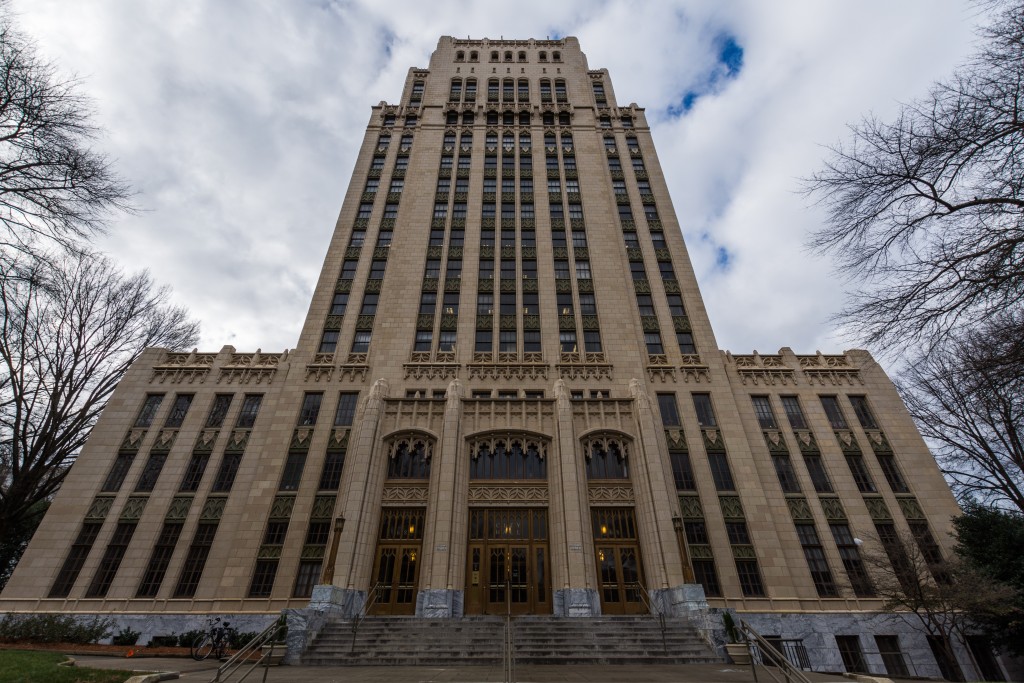
Southwest Atlanta is the epicenter of the highest concentration of poverty citywide. The average resident rents their home, makes under $40,000 annually and is considered “car-dependent” by nature of limited local resources. “If you were to draw a line from northwest Atlanta to southeast Atlanta,” says Courtney English, City of Atlanta’s chief of staff, “you would quickly see a picture of a tale of two cities where opportunity is concentrated on the northern half of the city and, because of years of disinvestment and malicious policies, southwest Atlanta has been starved of investment.”
Erin Robinson, a resident of various southwest Atlanta neighborhoods since 2017, said that she has been frustrated by aging infrastructure, inaccessibility to essential services and the lack of green spaces for her one-year-old. “It sometimes feels like you’re driving in the past,” she said. “It feels dated.” In response to this dynamic and cries of neglect by residents, Mayor Andre Dickens, English and the City of Atlanta have announced a $5.1 billion plan to invest into this area of the city.
Atlanta, like many cities during the 20th century, subjected its Black residents to rampant residential segregation and racist zoning ordinances, cutting them off from vital resources and opportunities for upward mobility. As a result, the average white household in Atlanta holds forty-six times the wealth of Black households. Through this venture, the City of Atlanta seeks to correct institutionalized underinvestment that has plagued southwest Atlanta over the last century.
Brian Goldstone, author of There Is No Place For Us, spent six years reporting on five Atlanta families experiencing homelessness despite working—sometimes multiple jobs. I asked Goldstone about what his research revealed about the barriers facing Atlanta families. “Families are being priced out, pushed out, and locked out of their own city. In Atlanta—a city that is no longer majority Black—a staggering 93 percent of families experiencing homelessness are Black. That number did not appear overnight.”
English, who is steering this initiative, named the legacy of redlining and equity gaps as systemic issues that can only be overcome through public policy and community-centered development like the proposal.
How will the revitalization be executed?
The plan centers around Thomasville Heights, English Avenue/Vince City, Grove Park/Bankhead, West Hollowell, East Campbellton, West Campbellton and Downtown Atlanta. The goal of the project is simple to define and complex to execute: make Atlanta—and these seven neighborhoods, in particular—”the best place to raise a child.”
English said he and his team scoured thirty years of nationwide urban and neighborhood planning documents to see what worked and what failed in order to illuminate the opportunities and potential pitfalls in developing their vision for the southwest parts of the city. The mayor’s office also spent nearly two years engaging with the region’s Neighborhood Planning Units (NPUs) and partner organizations like Westside Future Fund, Focused Community Strategies, the Grove Park Foundation and the West Hollowell Foundation to understand their hopes for their communities.
Affordable housing, transit expansion and addressing the damage done by past racist urban planning were identified as priorities, and culminated in the six key pillars guiding this initiative: housing, transit, food access, education, jobs and public space.
The plan will be funded primarily through extending the life of the city’s tax allocation districts (TADS), which dedicate property tax revenues toward reinvestment within the district.
The proposal’s budget breaks down to a $1.9 billion transit network expansion; $1.5 billion for trails and greenspaces; $1.3 billion in affordable housing projects, both single and multi-family; $170 million in support of local health centers, recreational spaces and grocery stores; $88 million for small businesses and other commercial development; and $81 million for public infrastructure.
I spoke with nearly a dozen residents, nonprofit leaders and researchers to gauge their impressions of the plan. Many were excited to see southwest Atlanta prioritized.
Robinson said that, when pregnant, she had to drive north in the city to access quality medical care. She laments that food options in southwest Atlanta are limited, spread out and barricaded. “I love to cook and garden, so not having access to quality produce is a pain point,” she said. “Hearing that healthcare clinics and grocery stores are part of this initiative really excited me.”
Community expresses gentrification concerns
Goldstone cautioned that projects framed around revitalization often accelerate displacement. “Affordability has to mean actually affordable to the families most at risk, not pegged to AMI metrics that immediately exclude them. There must be ironclad anti-displacement policies, real tenant protections and deeply affordable housing built first—not as a promise at the end of a development timeline.”
Typically, these sorts of protections are designed with and for target communities. While there is enthusiasm, not a single resident that I spoke with had heard of the reinvestment plan until I reached out requesting an interview.
“From what I can tell, very few people actually know about this $5 billion Neighborhood Reinvestment Plan, and that in itself says a lot about who’s been centered and who hasn’t in the city’s planning and public engagement process,” said Toni-Michelle Williams, executive director of Solutions Not Punishments Collaborative or SnapCo, a Black Trans and Queer-led organization reimagining public safety with the most vulnerable at the center. “The communities most directly impacted by displacement, under-investment and over-policing—particularly Black, trans and queer Atlantans—haven’t been meaningfully included in shaping the vision for South and West Atlanta.”
Many residents expressed concern that, much like the Beltline, the reinvestment plan would lead to further dispossession and gentrification despite its projected intentions. “As a young mother, I would love more parks nearby,” Robinson said, “but before we can get to these nice-to-haves, people need a roof over their heads and reliable housing. It’s dire over here.”
Williams agreed and called into question how the project fits into recent critical divestments. “While I support investment in trails and parks, those dollars could go further if paired with deeper investments in community health infrastructure—especially around HIV care and prevention,” she said. “Fulton County has already lost significant federal funding in those areas, and without targeted local investment, we risk seeing HIV rates spike again, compounding harm, housing instability and inequity across the city.”
Community members were also curious about upcoming international sporting events like the 2026 FIFA World Cup, which almost always emphasize tourists and newer, monied residents over those who have been here for decades. They expressed suspicion about the timing of a neighborhood revitalization initiative that may be focused on raising revenue even if said development prices people out.
These concerns are compounded by the lack of a detailed timeline for the project. While Dickens unveiled the project as though it was ready to break ground, the current TADs are set to expire in five years. English named his hope that increased anticipation and community involvement would make TAD expansion more feasible and politically expedient. Legislation has already been introduced to extend TADs for another 25 years. English also stated that, should the extension not come through, the mayor’s office is still committed to doing as much as possible by prioritizing “low-hanging fruit” and leveraging existing resources. But without TAD extension revenue, he said, the full $5.1 billion proposal will be a lot more difficult to fund.
Dickens’ inconsistent track record inspires doubt
Skepticism is not a new hurdle for this administration. Beyond questions about the rollout and in addition to inherited baggage from previous administrations, Dickens is still recovering from distrust seeded during the Cop City debacle, where clergy, students, residents and activists alike were all confounded by the Mayor’s support of a deeply unpopular development project.
“It’s also hard to ignore how public safety dollars keep expanding—we know ‘Cop City’ is pulling resources that could instead strengthen initiatives like the Policing Alternatives & Diversion (PAD) Program, which has proven that safety is built through care, not criminalization,” said Williams.
The mayor has made similar announcements that haven’t been followed through, including a 2024 Administrative Order to expand MARTA through more infill stations. These projects take time, but the backorder is growing longer than the fulfillment list.
With an uphill climb up ahead, English seems confident in the city’s ability to rise to the occasion with the community. “This effort is being led by a mayor who was born and raised in Adamsville,” English reiterated. “That matters because he’s not just thinking about numbers but also about faces and legacy residents he’s known all his life and who he is trying to find ways to keep them in the city.” Then, speaking of himself, English shared that he, too, was born and raised in southwest Atlanta. “I taught seventh grade social studies in the same room that I took seventh grade social studies. I am deeply connected to this work.”
An estimated 1.8 million people will move to Atlanta in the next few decades. How will the City of Atlanta welcome those transplants without discarding legacy residents? “When people are displaced from their neighborhoods, they aren’t just losing shelter; they’re being severed from schools, social networks, childcare, medical care, transportation, and support systems,” said Goldstone. “So when a city announces a $5 billion revitalization plan, the question isn’t simply whether investment is good—of course communities deserve investment. The question is: investment for whom?”
No paywall. No corporate sponsors. No corporate ownership.
Help keep it that way by becoming a monthly donor today.
Free news isn't cheap to make.
Author

Related Articles
Georgia Court of Appeals will take up ‘Cop City’ RICO case
Attorney General Chris Carr appealed Fulton County Superior Court Judge Kevin A. Farmer’s dismissal of racketeering charges against 61 people. The Georgia Court of Appeals accepted the application on Wednesday, despite process challenges from the defense.
Local orgs fear further criminalized homelessness in HB 295, advanced from Public Safety Committee
The 8-5 vote marked the third straight year the bill proceeded to the House floor, where it was withdrawn last year without a full-House vote.