‘No Kings’? Agreed, but Atlanta organizers question protest’s efficacy
While many heralded the rally and march as crucial to upholding democracy, others critiqued it as insufficient to meet a moment requiring great change.
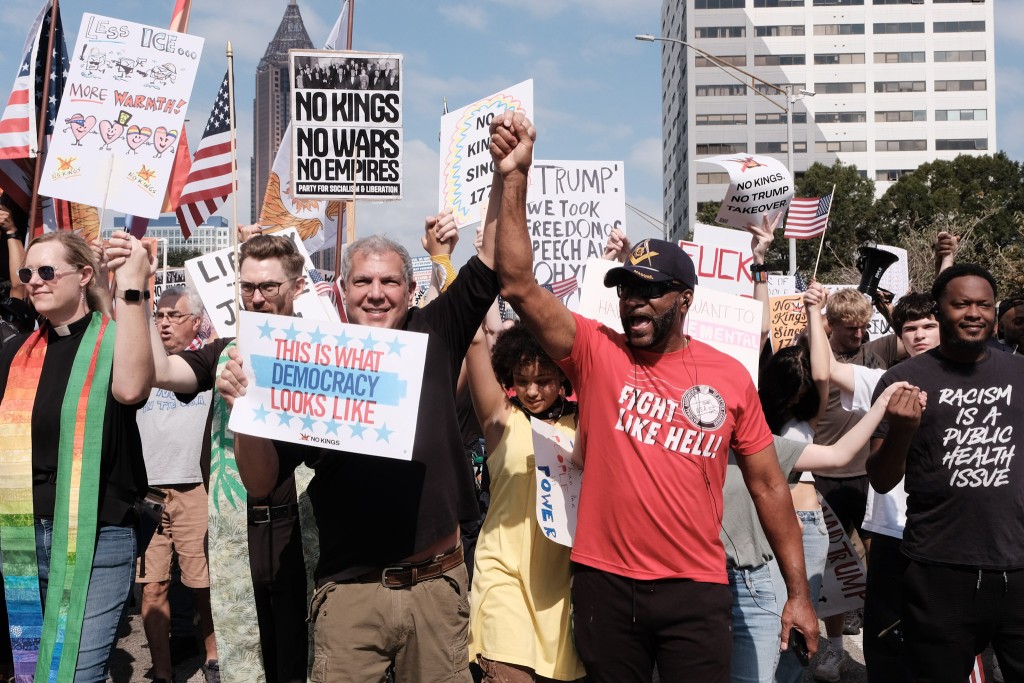
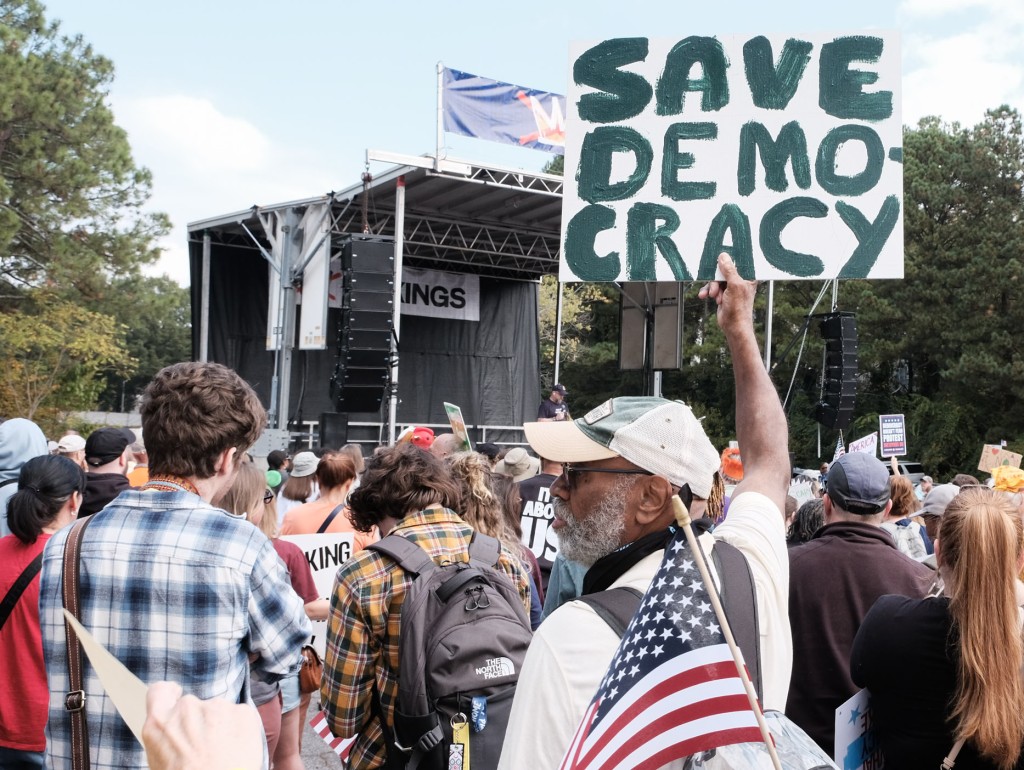
“Animal” was the clear and colorful core category for costumed Georgians at the No Kings 2 rally and march from Atlanta Civic Center to the Georgia State Capitol on Saturday, Oct. 18. They gathered for speeches and the 1 ½-mile trek as frogs, raccoons, bees, dinosaurs, Pokémon, unicorns and even axolotls, a nod to Portland protesters dressing as frogs to greet National Guard troops stationed in their city.
Rather than reflect the pall of a democracy in crisis, the crowd chanted for candidates and causes to fight or build on, sang upbeat songs of freedom and donned regalia as flashy as the abundant signs that hailed democracy and lampooned President Donald Trump.
Most featured speakers joined the crowd in applauding the vibrant expression of free speech and assembly—only under permit, which the Atlanta government did not grant for the march until two days beforehand. After event organizers from the 50501 coalition publicized intent to proceed with a peaceful march whether or not the government cooperated, the City of Atlanta declared on social media it had been working closely with the organizers to support a successful event.
But some community leaders questioned No Kings events’ effectiveness at opposing government crackdowns on constitutional freedoms, whether local governments such as Atlanta’s or the federal government.
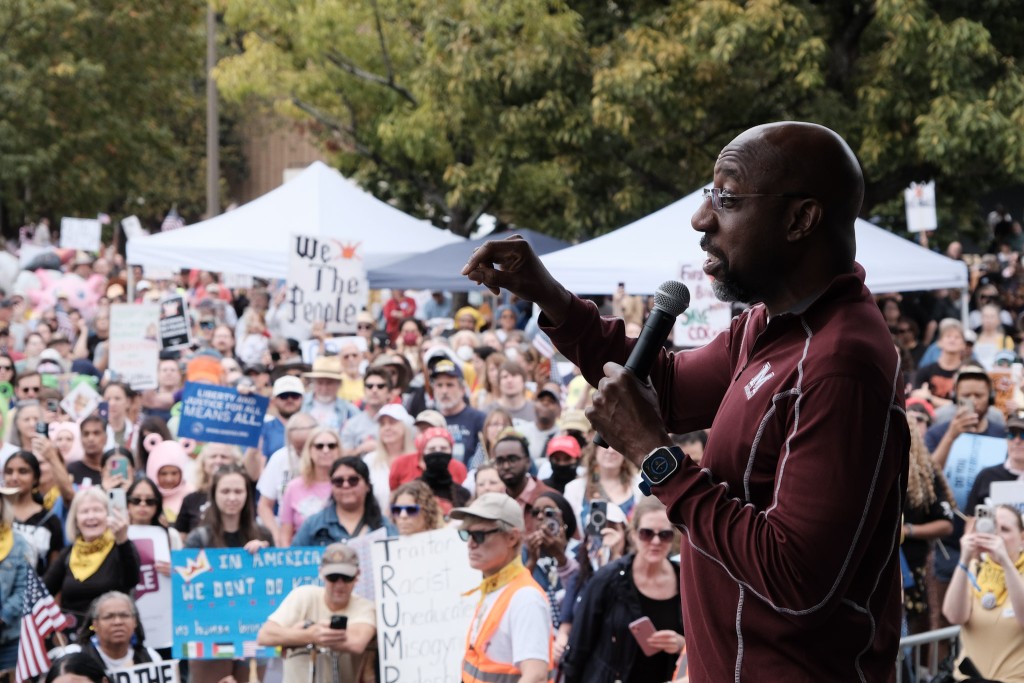
Atlanta-based U.S. Sen. Raphael Warnock drew the loudest, most sustained cheers from the crowd. He spoke at length about No Kings marches in 2,700 municipalities uniting Americans over party lines as a great reason for hope. He also quoted Martin Luther King Jr.—whose Ebenezer Baptist Church Warnock now pastors:
“We will have to repent in this generation, not only for the violent actions and vitriolic words of the bad people, but because of the appalling silence and indifference of the good people.”
A protester shouted “Now you do!” as Warnock briefly paused upon saying “repent,” referencing Warnock’s voting record in favor of military aid for Israel’s genocide against Gaza. Minutes later, Warnock said that a budget is a moral document showing who one thinks matters and who does not.
“It is so important that we make sure our voices are heard,” Warnock continued, immediately pivoting to address the heckling protester. “I’m coming to you, brother—I promise you, I’m coming for you.”
He said he was on the protester’s side and believed in the humanity of all people, listing Palestinians, Israelis, children on all sides, Ukrainian children and all races, ages, classes and sexualities as God’s children.
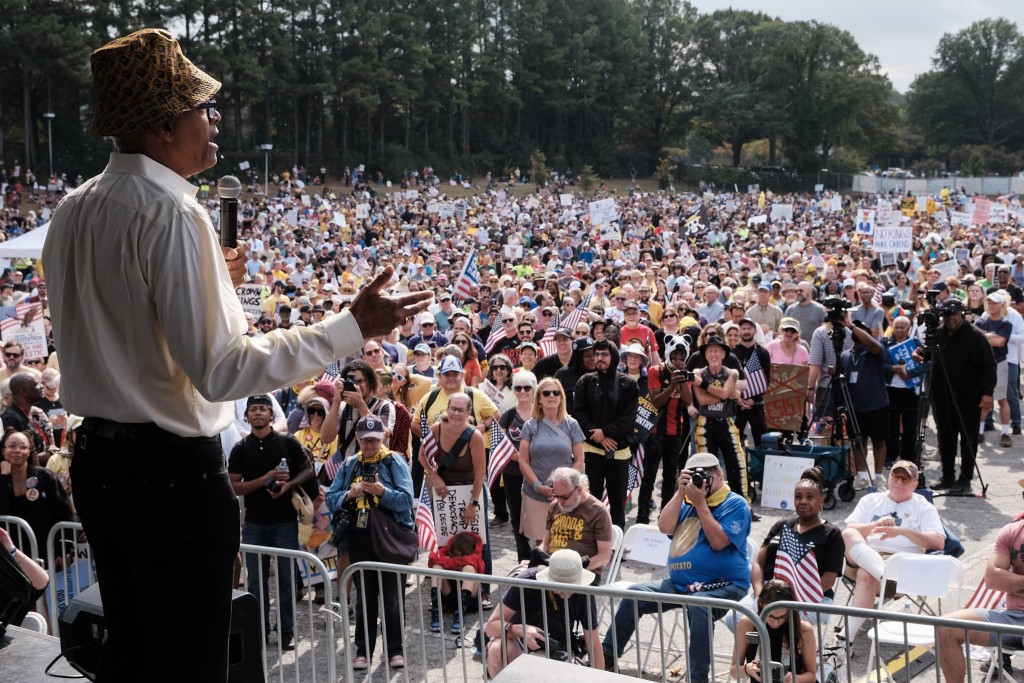
Although many speakers warned of the perils of authoritarianism while pontificating about better days through unity and making voices heard, U.S. Rep. Hank Johnson also spoke frankly about difficult times ahead.
“We got the military invading the streets, not just of Washington, D.C., but across the country,” he said. “No tanks rolling yet, but I can’t guarantee what won’t be happening four months from now. That’s why it’s so important that we’re all gathered here today.”
He too cited King, particularly the Beloved Community concept and fighting for it across party lines, welcoming all.
“Poverty is on the rise; racism is on the rise; and militarism is on the rise,” Johnson said, listing problems he accused the Trump administration of exacerbating. “Things will get worse before they get better. But as long as we the people are together in our Beloved Community setting, we will win.”
Community leaders spoke to how their organizations’ issues aligned with combatting authoritarianism, representing Indivisible, the Union of Southern Service Workers, Georgia Latino Alliance for Human Rights, Georgia Equality, Georgia Conservation Voters, the National Association of Educators, New Disabled South, the ACLU and more. Some spoke of more radical change required than merely gathering to collectively vent.
“My people are here to ask you to wake up,” said JaMelle Hill with Georgia Poor People’s Campaign. “This problem will not fix itself. We need all hands on deck. We are standing on the edge of a radical recarving of a democracy. And a revolution awaits.”
More overtly revolutionary speakers used their groups’ personal sound systems to address passersby during the rally and after the march.
Members of the Party for Socialism and Liberation shouted anticapitalist messages in both instances. They mostly tacked to messaging in line with the group’s banners, which read “No kings & no billionaires! We need a whole new system!” and “Defend democracy: It’s time for a general strike!” They departed after criticizing the march’s marshals for “doing the cops’ work for them” by instructing the crowd to disperse while police reopened the street.
A group of self-proclaimed anarchists then called for the tendrils of the crowd to remain in the streets and unite to oppose state oppression from the police. Speakers from this group called out Democrats, including former President Joe Biden and Atlanta Mayor Andre Dickens, for advancing the same causes the crowd ostensibly protested Trump for, citing ICE, the Palestinian genocide, Cop City and the killing of Cornelius Taylor.
“If you voted Democrat in 2020, 2024, it doesn’t matter—you still voted for genocide,” one speaker proclaimed. “What do we do to fix that? What do we need? Revolution! The people in there [the Capitol), they don’t give a f— about us.”
This group also receded as the crowd waned and dozens of police vehicles encroached from both directions of traffic.
Another group, the Atlanta People’s Campaign, took the opportunity at the rally to distribute zines with participants in its leftist organizing school.
“We thought it was an important opportunity to have our participants practice doing outreach conversations with a crowd of people who would be somewhat friendly to our values—maybe for their first or second protest ever,” said Campaign organizer Karl Kumodzi. “Have organizing conversations with them, and organize them into longer-term left work.”
Although Kumodzi noted most ralliers likely held different views, he underscored the people power necessary to transform society.
“That requires engaging with people from all walks of life and with all different interests, and figuring out how to mobilize and organize them into our political project,” he said. “It’s not about being right, it’s about winning. There’s too much at stake for us to not win.”
No paywall. No corporate sponsors. No corporate ownership.
Help keep it that way by becoming a monthly donor today.
Free news isn't cheap to make.
Related Articles
Georgia Court of Appeals will take up ‘Cop City’ RICO case
Attorney General Chris Carr appealed Fulton County Superior Court Judge Kevin A. Farmer’s dismissal of racketeering charges against 61 people. The Georgia Court of Appeals accepted the application on Wednesday, despite process challenges from the defense.
Local orgs fear further criminalized homelessness in HB 295, advanced from Public Safety Committee
The 8-5 vote marked the third straight year the bill proceeded to the House floor, where it was withdrawn last year without a full-House vote.