Emory protesters’ First Amendment rights violated, attorney says
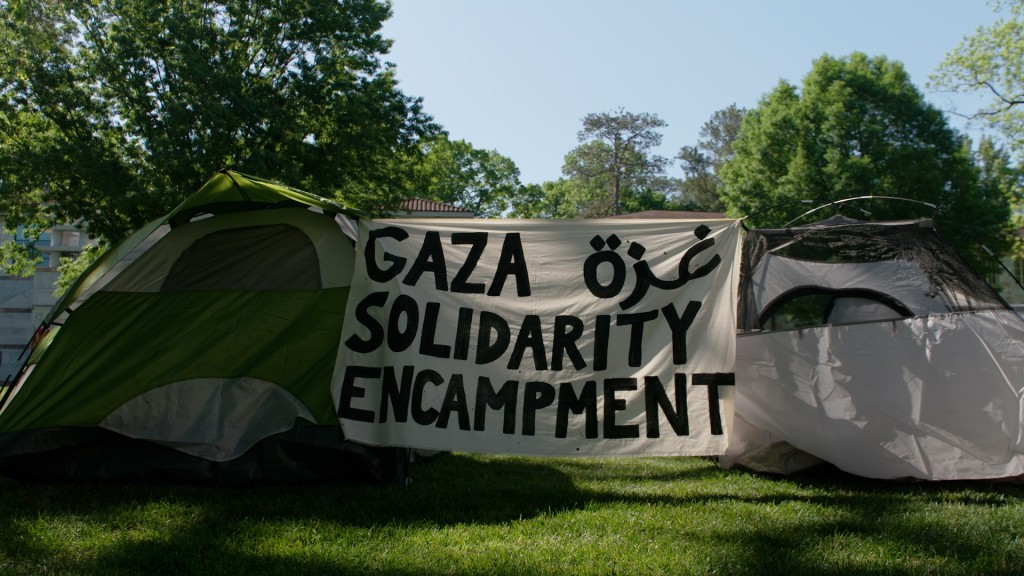
Nearly a year and a half after the brutal arrests at Emory University’s Palestinian encampment, four of the 28 people arrested still face criminal charges.
Two dozen of the people arrested that day have had their charges dismissed, received plea deals or entered into a court diversion program. Protesters like Alexander Carson and Erica Kadel, however, continue to appear in DeKalb County Superior Court.
Alexander Carson, a UPS Teamster who appeared in court Thursday, Sept. 25, recounted the events of the day of the encampment, saying Emory’s response was overly harsh.
“I’d probably been to hundreds of student protests before this in my life—a lot of them for Palestine,” Carson said. “I had never seen this level of immediate repression for a campus protest.”
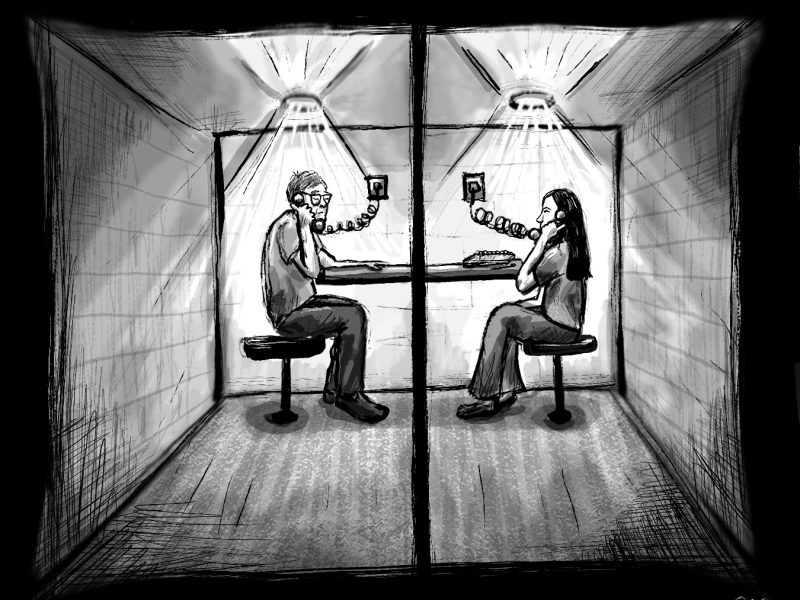
While held in jail following his arrest, Carson witnessed unidentified law enforcement officers reinforce the protest repression. “You’re not going to protest again after this, huh?” Carson heard an officer ask.
On the day of the encampment, Gregory Fenves, Emory’s former president, released a statement saying that a number of protestors were not “affiliated with Emory.” Carson and Kadel told ACPC that Emory had labeled them as outside agitators.
“I’m not surprised that my charges haven’t been dropped yet and that the others have been prioritized. I think there was more internal pressure within Emory to make the problem go away for their students and their faculty,” said Kadel.
Musa M. Ghanayem, an Atlanta-based Palestinian lawyer who represents Carson, says that protestors’ rights were violated.
“The state has violated the First Amendment of the Constitution. We have motions pending. There are specific statutes that allow for this and it is unprecedented,” said Ghanayem. “Everyone sees that this is just being done to placate Emory University. Right now, Emory’s embroiled in multiple different civil rights lawsuits based on the racist and discriminatory treatment of students.”
Ghanayem stressed that this case is not just about those arrested at Emory, but the entire U.S. population.
No paywall. No corporate sponsors. No corporate ownership.
Help keep it that way by becoming a monthly donor today.
Free news isn’t cheap to make.
“Your right to free speech is being attacked, not just Alexander [Carson]’s. My right to free speech is being attacked, not just Erica [Kadel]’s. Everybody who is reading this, whether you believe it or not, this is an attack on you,” Ghanayem said.
The movement for Palestine has seen massive amounts of repression across the United States. During the Palestinian solidarity encampments of 2024, law enforcement arrested over 3,200 protestors, according to The Appeal. Palestinian activists like Mahmoud Khalil have been detained for their involvement in the movement.
“I think part of it is to keep the chilling effect and to make people keep living in the shadow of the repression,” Carson said.
Erica Kadel, another of the Emory arrestees, said that the people in Atlanta need to pay attention to this case as it continues.
“We already know that there are communities within Atlanta who are more likely to be prosecuted based on their race, financial status or immigration status,” said Kadel. “Those communities that are most under threat are often the ones who the state is most willing to prosecute.”
Carson and Kadel encouraged supporters to come to court as the trial continues. They said the criminal legal system commits its biggest injustices when no one’s watching.
“Come to our trial.” Carson said, “Plan for it. Whenever the date is set, take off of work—it’s that important. Pack out the courtroom. Even if they throw people out, keep standing outside the courthouse until the trial is over.”
Author