
‘They want to kill me:’ Inside the Folkston ICE Processing Center expansion
Charlton County’s Folkston ICE Processing Center is set for a $47 million expansion, despite community pushback and reports of inhumane treatment.
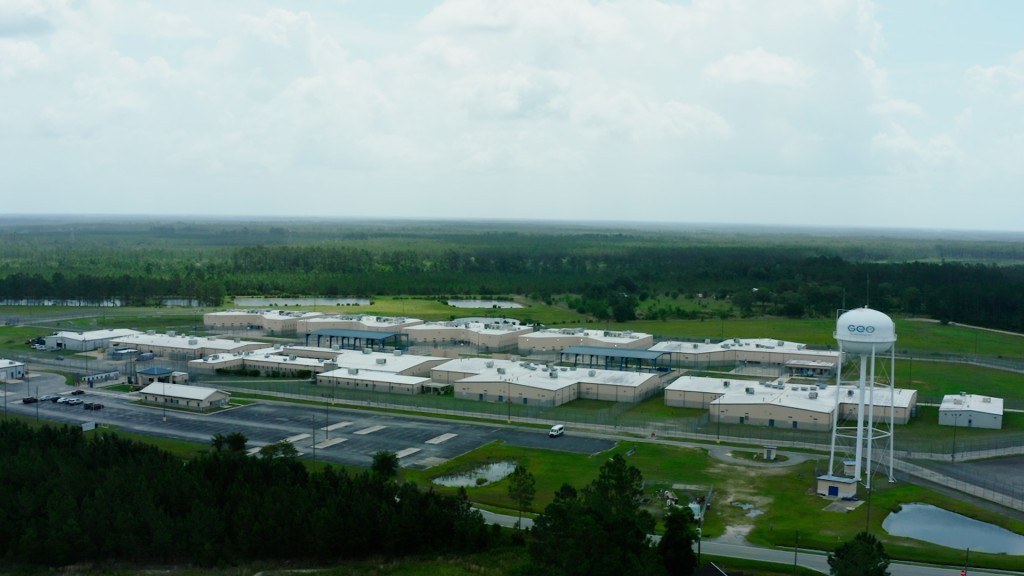
Every weekend, the Folkston ICE Processing Center (FIPC) in Charlton County, Georgia, briefly opens its doors for visitation. On Saturday, July 19, the families of people detained in FIPC waited in nearly 100-degree weather to see their loved ones. A mother struggled to keep her newborn baby cool, wetting her child’s head with a damp cloth.
Ten minutes into the second visitation window of the day, the front desk guard stopped taking visitor names, yelling she needed to catch up on paperwork. Families were left waiting outside longer than usual.
After walking inside, a guard accused a visiting teenage boy of a dress code violation, saying that shorts are only allowed for males under 12 years old. The teenager asked to borrow an extra pair of pants. “I’ll throw you in here and give you an inmate uniform if you want to borrow pants. Is that what you want?” the guard said.
The teenager was sent away while the rest of his family went inside for their visit.
Once the families finally arrived in the visitation room, they embraced their detained loved ones with tears running down their faces.
“This is a death sentence”
Andre Lindsay was in FIPC custody for nearly three years. He was born in Jamaica, but has lived in the United States since the age of six. Lindsay, a single parent since his wife passed, says he wants to be back home in South Carolina with his children, but the United States wants to deport him to Jamaica.
“I’ve spent my entire life in the United States,” Lindsay says. “I don’t know anything about Jamaica.”
Lindsay described leading a full life in the United States, which was suddenly ripped away when he was taken into custody and sent to FIPC. It was important to him to include in his story that, “Since I’ve come to the USA, I’ve been pledging allegiance to the United States.”
In Folkston, Lindsay said, he faced severe medical neglect. “They want to kill me,” he said.
No paywall. No corporate sponsors. No corporate ownership.
Help keep it that way by becoming a monthly donor today.
Free news isn’t cheap to make.
He described an incident where, upon returning to the detention center after a court proceeding, he slipped as he tried to get out of the transport van. Because his ankles were shackled and his wrists were handcuffed, he was unable to brace himself during the fall. His body twisted and his hip jammed up. Multiple doctors have ordered that he get hip replacement surgery, Lindsay says, but ICE has repeatedly denied him the procedure.
ICE continues to state that Lindsay arrived at FIPC with chronic hip pain, but Lindsay says that is a lie.
Two weeks ago, Lindsay was transferred to Krome Detention Center in Miami, Florida.
Lindsay was told by an ICE officer that he was transferred to Krome for medical treatment. However, Lindsay says his medical issues could have been taken care of in Georgia.
Before the transfer, Lindsay had a court hearing scheduled for Sept. 12. He is now unsure if and when that hearing will happen.
“Please help get me out. I need to see my children,” Lindsay said. “This is a death sentence.”
Inspectors find inhumane treatment inside Folkston
The Folkston ICE Processing Center is an immigration detention facility operated by the GEO Group, a private prison corporation that oversees 97 facilities around the world. While the facility currently has 1,118 beds, the GEO Group announced last month that it will be expanded to more than double its capacity—up to 2,986 beds—for $47 million. It is slated to become one of the largest Immigration and Customs Enforcement (ICE) detention centers in the United States.
This expansion comes in the midst of numerous complaints about FIPC’s inhumane conditions.
From 2022 to 2023, FIPC did not fully comply with environmental health and safety standards, according to the U.S. Department of Homeland Security Office of Inspector General. Inspectors found inoperable and unsanitary bathrooms with clogged toilets, mold, rust, and peeling paint. They observed that detained individuals were inappropriately handcuffed and had limited access to recreation and laundry facilities. Staff at Folkston also failed to maintain complete logs and documentation.
The most recent compliance inspection, conducted in late January under the current Trump administration, rated the facility’s compliance as “Good.” However, this report includes multiple blacked-out sections, and no longer includes photographs of the facility or suggestions for improvement.
Several immigrants’ rights organizations, like the American Immigration Council, Migrant Equity Southeast, and Asian Americans Advancing Justice-Atlanta, report that conditions inside FIPC remain inhumane.
“This place is worse than prison,” Lindsay said. “The shower floors are caved in, leaving standing water mixed with people’s feces, pubic hair, and spit. All of the food is expired. What they give us is always years old—like from 2022. The food is also inedible. All the chicken boxes the staff uses for our meals say ‘Not for human consumption.’”
Since President Donald Trump resumed office in January 2025, ICE has intensified its immigration enforcement. The administration has moved to revoke the citizenship of naturalized immigrants and even wrongfully detained American citizens. Andi Westcott, an organizer with the Democratic Socialists of America (DSA) Savannah chapter, says the GEO Group helped lay the groundwork for Trump’s brutal immigration policy.
“Companies like GEO Group donated millions of dollars so that they could reap the rewards. Anyone could go and look at the stock prices on November 5th—how they skyrocket,” Westcott said. “They were clearly planning on major expansions that they had coordinated well before the implementation of this administration and they’re following through on that.”
Folkston set to expand, despite local opposition
Savannah Pollock was born and raised in Folkston, Georgia. She opposes the expansion of the facility in her hometown and says corporations like the GEO Group prey on small rural towns.
“It’s not just us here, most of our little rural towns are placed in a position that they don’t want to be in. It’s easy for bigger companies like this to swoop in and play part villain and part hero by making us dependent on them by sprinkling in a little bit of jobs,” Pollock said. “It’s not out of nature for them. They get the most benefits out of it. They get tax incentives and free facilities. They get land that they can just use and keep out of the public’s eye.”
Charlton County is one of the poorest counties in Georgia, with a median household income of $48,534 and a 25.5% poverty rate. In 2013, the county closed down its only hospital, Charlton Memorial, causing job loss and leaving those in need of medical care over 30 miles away from the nearest hospital. Three years after the hospital closed, ICE contracted GEO Group to open Folkston. GEO went on to become the county’s largest private employer.
In a press release announcing the expansion in June, Georgia Republican Congressmember Buddy Carter stated that Charlton County would be paid $600,000 a year for water and sewage services to the facility. Additionally, according to Amendment #2, which was read at the Charlton County Board of Commissioners meeting on July 17, the county will also receive $260,000 for administrative costs. Local community members spoke out against the expansion during the meeting’s public comment period.
According to Charlton County Administrator Glenn Hull, the county only plays a limited administrative role in the expansion of the Folkston ICE Processing Center. The GEO Group operates the facility.
During the July 17 Charlton County Board of Commissioners meeting, Commissioner Joseph “Drew” Jones told activists that Charlton County is merely the middleman—ICE would continue the expansion with or without them.
Author

Related Articles


Georgia law students say “Hell no” to ICE recruiting at interscholastic career fair
Hundreds of students and dozens of organizations across Georgia’s five major law schools demand ICE be uninvited to the schools’ Public Sector Career Fair this Friday.
Dunwoody City Council votes to defer Flock contract over data use concerns
A viral video showing the ease of accessing live feeds from Flock cameras prompted deep questioning of the company’s data practices and contract changes.