
Opinion — Atlanta and Fulton County need to refocus on policing diversions
As Fulton County’s lease of Atlanta’s detention center ends, the city and county should commit to utilizing diversion services.

The Center for Diversion & Services, funded by the City of Atlanta and Fulton County, opened Jan. 20, 2025. Despite the lofty expectation of diverting over 10,000 people a year who would otherwise be booked on minor charges into Fulton’s jails, the center has been severely underutilized. On average, three people are diverted daily.
The Atlanta Police Department (APD) is responsible for arresting over 40% of those booked on divertible charges, and thus bears much of the blame. This underutilization has frustrated some Fulton officials who want to see their money well spent and recognize that the responsibility for addressing a dysfunctional county jail system falls on them.
Fulton County Jail has experienced persistent overcrowding for decades, resulting in horrifying neglect and preventable death. As of April, Fulton reported 1,724 people in custody at the main jail on Rice Street, with an additional 352 beds in use at the Atlanta City Detention Center (ACDC). ACDC is currently in the third of a four-year lease for up to 700 beds.
As the lease approaches its end and pressure mounts on Atlanta officials to repurpose ACDC as previously promised, Fulton needs to ensure all non-carceral alternatives, such as diversion, are maximized to sustainably lower the jail population. This goal is within reach, but requires buy-in from across the carceral continuum.
Incarceration creates a negative cycle
Fulton County has historically incarcerated individuals at a rate three times that of other urban counties. This punishment-first policy approach, coupled with systemic underinvestment in Black communities, has resulted in endemic racial disparities and a carceral system in a state of perpetual crisis.
Those incarcerated are more likely to suffer from substance use, mental illness, and housing insecurity. Many remain too poor to afford their bond. Over eighty percent of people diverted to date were unhoused at the time, epitomizing the connection between criminalization and unmet social needs.
With charges such as trespassing, public urination, or soliciting money, many who are booked are released within five days. However, it only takes one day for incarceration to irrevocably impact someone’s life. Across the country, roughly 40% of jail deaths take place in the first week. Even short stints of incarceration result in worsened mental health, housing insecurity and increase the risk of overdose death.
Jails are not social service providers, as can be seen in their persistent refusal to treat substance use disorders. Medical neglect and trauma are often compounded, and individuals return in worse circumstances than they entered.
The collateral consequences that result from a criminal conviction further limit opportunities for housing, employment and governmental benefits. As a result, formerly incarcerated individuals are continuously pushed to the margins.
With each arrest, an individual is thrust deeper into a labyrinthine criminal legal system that can be difficult to escape from. The cycle of carceral vulnerability and marginalization is thus perpetuated.
Policing Diversions stands as an opportunity and solution
Diversion exists in various forms. In Fulton County, pre-arrest diversion serves to meet immediate needs while also facilitating connections to long-term supportive resources. The new center is an acknowledgement that diversion can preempt many of the consequences of criminal legal system involvement, and that criminalized behavior does not exist in a vacuum but within the context of structural disadvantage.
Many criminalized for “quality of life” offenses have previously been met by cold bureaucracy, impatience and paternalism across Atlanta’s social service agencies and healthcare settings. In contrast to this institutional neglect, abuse and indifference, diversion leads with empathy, accessibility and stability. The process operates at the speed of trust and the opportunity for impact grows over time. This trauma-informed lens is crucial as a history of trauma is nearly ubiquitous among those criminalized, and is further exacerbated after incarceration.
In Seattle, Law Enforcement Assisted Diversion (LEAD) saved the city over $8,000 per participant per year and found that diverted individuals were 58% less likely to be re-arrested. A 2018 National Institute of Justice report showed that various diversion programs across the country lowered re-arrest rates and required less resources than incarceration. Similar findings have repeatedly shown that diversion is cost-saving and reduces crime better than punitive sanctions.
Criminalization entrenches the root causes of harm, is antithetical to healing and is a poor public safety strategy.
Atlanta City Detention Center should be home to diversion care, not punishment
Diversion offers a concrete step in reorienting our public policy away from punishment and towards care. It remains indefensible for any police agency to book a diversion-eligible individual into the county jail.
While diversion is an urgent necessity, it is inadequate alone. A reliance on policing to initiate diversion limits its impact and does not eliminate the risk of violence towards individuals in mental health crises, or who otherwise act in a way the police deem undesirable.
Diversion’s ability to effect change relies on supportive systems of community-based mental health, substance use treatment, housing, education, employment, and more. It takes the centering of prevention as policy priority to break the carceral cycle.
Unfortunately, this ideological shift has yet to arrive. Despite the Mayor’s claims that Atlanta wants out of the jailing business, he has yet to push his police department to fully use the diversion center and has not made plans to end the use of ACDC by Fulton County. Instead, the city’s recently finalized budget increased the Department of Corrections budget by 40%. APD’s budget also continues to rise and new recruits are being offered a $10,000 signing bonus, paid for by the Atlanta Police Foundation. Perhaps this foreshadows the policing-centric approach to “eliminate homelessness” before the World Cup next summer.
It is imperative we go beyond limited, police-led diversion to a wide embrace of diverse community responses. With emergency call data persistently showing around 5% of calls related to violence, police response makes little sense, introducing unnecessary risk to a variety of situations.
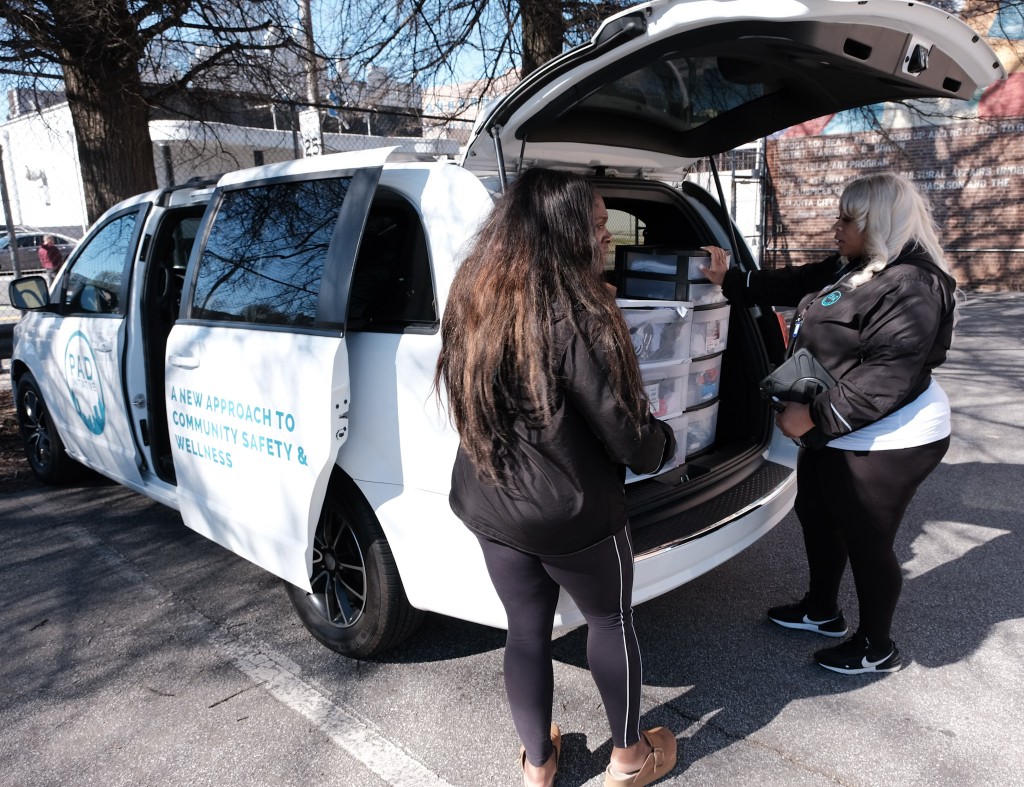
Alternative, non-police response has proven efficient and effective across the country. In Atlanta, the Policing Alternatives and Diversion Initiative (PAD) offers non-coercive, care-centered response. However, due to a budget that amounts to less than 1% Atlanta’s carceral investments, it is not available 24/7 and awareness of the service remains low.
Despite claims of justice and safety, we continue to punish many of the most vulnerable individuals for the crime of, in essence, being poor in public. Criminalization of this type amounts to perverse political manipulation, blaming individuals for their circumstances while not offering the support that could enable lasting change.
As French writer Anatole France put it over 100 years ago, “The law, in its majestic equality, equally forbids the rich as well as the poor to sleep under bridges, to beg in the streets, and to steal bread.”
If we embrace diversion, we’re saying, as a collective, that no one in Atlanta should be left behind. This approach, rooted in solidarity, would demand subsequent investments in care at the scale we have historically invested in punishment. Only then might we succeed in eliminating any perceived need for “quality of life” policing.
Robyn Hasan-Simpson and Mark Spencer, Md, are members of the Community over Cages Coalition
No paywall. No corporate sponsors. No corporate ownership.
Help keep it that way by becoming a monthly donor today.
Free news isn't cheap to make.
Authors

Related Articles


Opinion — Play the Game. Vote for Public Service Commissioners.
The most important race in the country is in your hands.