
Flock Safety’s license plate readers used for immigration enforcement by metro Atlanta police departments
Local police agencies’ data sharing policies created a national network of license plate readers, which local agencies have used to gather info on behalf of Immigration and Customs Enforcement.
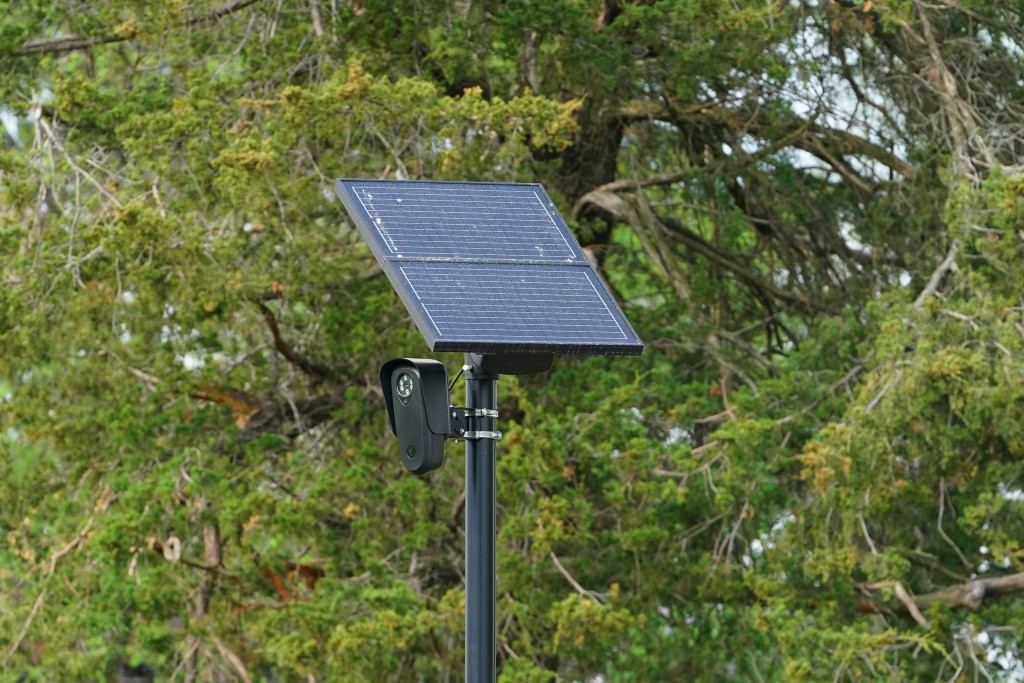
In the months since President Donald Trump’s second term began, five metro Atlanta police agencies have accessed data from Flock Safety’s nationwide network of automatic license plate readers (ALPR), using search terms related to Immigrations and Customs Enforcement (ICE), according to a Flock network audit of the Danville, Illinois, Police Department obtained through an open records request.
Flock Safety is an Atlanta-based police surveillance technology company whose ALPRs have been increasingly appearing outside businesses, schools and neighborhoods in at least 42 states. Flock cameras store the license plates of every passing vehicle and create a “vehicle fingerprint” by recording features like bike racks and bumper stickers.
Which metro Atlanta law enforcement agencies searched Flock Safety data on behalf of ICE?
Between Jan. 22, 2025, and March 7, 2025, metro agencies conducted at least 47 ALPR searches, citing that the reason for the search was for either ICE or Homeland Security Investigations (HSI), an ICE sub-agency. HSI’s mission is to investigate cross-border illegal activity, including that of the alleged transnational gangs at the core of the Trump administration’s immigration enforcement efforts. A 2019 report by the National Immigrant Justice Center found that HSI enabled mass deportations during President Trump’s first term. Earlier that year, an investigation by a local NBC affiliate in San Diego found that HSI engaged in surveillance of journalists and human rights workers working on immigration-related issues.

The Doraville Police Department conducted four Flock database searches on Jan. 31 with “ICE” cited as the reason, according to the Danville Flock network audit. The agency conducted these searches just days after ICE began arresting immigrants in Doraville and other metro Atlanta cities.
The Cartersville Police Department, located in the northwest metro area, conducted 39 Flock searches for HSI in the month leading up to the April 4 raid of an alleged human trafficking organization. In Cobb County, the Police Department and the Sheriff’s Office also conducted one and three searches for HSI, respectively.

The Covington Police Department conducted three searches in March 2025, listing “287” as the reason for the requests, likely shorthand for the 287(g) program. This program allows ICE to delegate immigration authority to state and local police agencies. ICE regularly publishes updates on the growth of the program. According to those updates, Georgia has 27 agencies operating in the 287(g) program, with 21 of those agencies having signed on since Trump’s inauguration. Four additional agencies have pending agreements. The Georgia Criminal Alien Track and Report Act, which was passed last year and is commonly referred to by its bill name, H.B. 1105, requires all sheriff’s offices in Georgia to apply for a 287(g) agreement.
The Covington Police Department does not have a 287(g) agreement, according to data published by ICE, nor do any of the Georgia agencies that provided ICE with Flock data.
No paywall. No corporate sponsors. No corporate ownership.
Help keep it that way by becoming a monthly donor today.
Free news isn’t cheap to make.
UPDATE: Appen Media reported in June that the Sandy Springs Police Department had conducted searches using the keyword “ero”.
Outside the metro area, at least three additional agencies conducted Flock database searches with ICE or HSI listed as the reason. The Banks County Sheriff’s Office has conducted at least 103 since Trump retook office—the most ICE/HSI related searches from Georgia agencies according to the available data. The Coffee County Sheriff’s Office conducted eight “ICE” searches in the same time frame, and the Franklin County Sheriff’s Office conducted four searches listing “ICE FUGOPS” as the reason. FUGOPS is likely short for “fugitive operations.”
UPDATE: ACPC obtained an additional Flock audit showing the Bolluch County Sheriff’s Office contducted five searches using the keyword “immigration” in May 2025.
Where did this data come from?
The data cited in this story came from an audit of the Danville Police Department in Illinois’ Flock network.
Independent researchers obtained the data through open records requests and provided it to the Atlanta Community Press Collective and other national and local news outlets. Flock’s system creates a record every time an agency runs a search of the database. Agencies can audit their systems to review those searches.
User agencies, like the Atlanta Police Department (APD), can network with Flock ALPRs from other law enforcement agencies nationwide.
Each agency can run a search through its local data or networked data. Networked searches can entail a search of thousands of law enforcement agencies’ data and tens of thousands of ALPRs.
Flock’s system default setting is to store data from ALPRs for 30 days on Amazon Web Services (AWS) cloud.
Every Flock database search requires the user to give a reason for the search.
Audit results were filtered by the “reason” field for keywords including “ICE,” “Immigration,” “HSI,” and “Homeland Security Investigations,” and “287.” The keywords were chosen for their association with immigration enforcement.
Since user agencies can select which networks they search, this dataset may not provide a complete picture of the total number of searches by an agency using these keywords. The data only shows the number of requests to the Danville Police Department in Illinois.
Does the City of Atlanta work with ICE?
According to the data available, APD has not conducted an ICE-related search since Trump’s second term began, though the Flock records show the department conducted two searches for “HSI” in 2024, with the most recent search in December.
APD’s policy expressly forbids officers from “ask[ing] to see a person’s ‘green card’ or other immigration documents.” State law under H.B. 1105, however, requires law enforcement officers to verify the “immigration status of any person who is being investigated for state violations, and who is unable to provide identification.”
The City of Atlanta ended its formal agreement with ICE in 2018 after Mayor Keisha Lance Bottoms issued an executive order to stop accepting ICE requests to detain people in the Atlanta City Detention Center.
Mayor Andre Dickens and the City Council have both pushed for programming in support of immigrant rights, including the rights of those who may be undocumented. The Mayor’s Office of International and Immigrant Affairs established a “Know Your Rights” page for immigrants who may interact with ICE. The Atlanta City Council passed legislation Monday to accept funding for an immigrant defense legal fellow in the Office of Public Defender.
Do Atlanta’s Flock Safety cameras pose a risk to immigrants?
Flock Safety created a “transparency portal,” which allows the public to review local agencies’ policies and general information like the number of vehicles that the Flock cameras in that jurisdiction have detected or the number of searches the local agency has performed. APD does not have this portal enabled.
Flock devices on APD’s network, however, may still pose a risk. If an agency networked with APD conducts a search on behalf of ICE, cameras on APD’s network will be included in the results.
That integration caused concern for the Denver City Council in April, when they considered plans to expand the city’s contract with Flock Safety. City Council members unanimously voted against the contract expansion last month, citing concerns that agencies in other jurisdictions could use data from Flock cameras in the city to track immigrants whose data is collected in Denver. Next 9News, a local NBC affiliate in Denver, reported that the City would lock down its Flock data by refusing to network the City’s cameras with other agencies, both locally and nationally.
Georgia law enforcement agencies’ searches of Flock data from Danville, Illinois for immigration purposes validate the concerns of the Denver City Council. In 2023, Illinois enacted legislation prohibiting the sharing of ALPR data for immigration enforcement. Despite this, the dataset showed Danville’s local Flock network was searched over 4,800 times by agencies between July 2024 and April 2025 for keywords related to immigration.
Author

Related Articles

A Rohingya man in New York died under mysterious circumstances— his relatives in Georgia are grappling with the loss
Federal immigration officers left Nurul Amin Shah Alam outside a closed coffee shop in harsh winter weather— days later he was found dead. He was getting ready to move to Georgia, says his niece in Stone Mountain.


Comments (1)
Comments are closed.