Stop Cop City RICO trials set to begin this summer, judge says
May 14 status hearing set plans to streamline the complex 61-person racketeering case under a new judge. Defense attorneys face tight deadlines ahead of trials anticipated to begin this summer.
After nearly two years of delay, trials will begin in the coming months for the 61 individuals charged under Georgia’s Racketeering Influenced and Corrupt Organizations (RICO) law as part of the state’s crackdown on the Stop Cop City Movement. During the May 14 status hearing, Fulton County Superior Court Judge Kevin M. Farmer said he expects all motions to be filed over the next two weeks and trials to begin as soon as June.
It has been nearly two years since a grand jury indicted 61 individuals, collectively known as the ‘ATL 61’, on RICO charges in August 2023 over protests over ‘Cop City,’ a police training center in Atlanta. Defendants’ lives have been disrupted by the lengthy delay. If found guilty, defendants could face up to 20 years in prison.
“This case will not die,” said Marlon Kautz, one of the defendants and spokesperson for the Atlanta Solidarity Fund. “There’s a political reason for that. As long as 61 people are facing decades in prison for RICO charges simply for being associated with a political movement, protest everywhere is chilled and intimidated.”
Kautz, Savannah Patterson, and Adele MacLean, collectively known as the Sol Fund 3, were arrested during a police raid in May 2023 and charged with money laundering. Prosecutors dropped the money laundering charges in September 2024, but the RICO charges remained.
During the May 14 status hearing, Judge Farmer laid out a game plan for navigating the complexities of holding trials for what he called “a 61-person elephant.” Farmer said he will try five defendants at a time, with the Georgia Attorney General’s Office determining which defendants will comprise each trial.
The Sol Fund 3, along with Sonali Gupta and Brooke Courtemanche, will be the first group to be tried over the summer.
Ayla King, who originally requested a speedy trial in 2023, will follow the first group. Attorney Surinder Chadha Jimenez, who represents King, said he expects the speedy trial to begin in August.
New judge on case must work through a backlog of motions
The original judge assigned to the case was Fulton County Superior Court Judge Kimberly Esmond Adams, but Adams was recently transferred to a different court. On the eve of Farmer’s first RICO hearing Wednesday, Adams issued a ruling denying demurrers—colloquially known as motions to dismiss—made on behalf of the five defendants scheduled to go to trial first. Attorney Don Samuels, who represents Kautz, said they received the denial Wednesday, “five minutes before walking into the courtroom.”
In the nearly two-year period that Adams was presiding over the case, defense attorneys filed over 250 motions, most of which had been adopted by multiple defendants. Xavier de Janon, defense attorney for Jamie Marsicano, said that the motions had largely gone unaddressed by Adams, creating a backlog.
No paywall. No corporate sponsors. No corporate ownership.
Help keep it that way by becoming a monthly donor today.
Free news isn’t cheap to make.
During the May 14 status hearing, Judge Farmer ordered that previously filed joint motions, which had been adopted by multiple defendants, must be refiled by each individual defendant. Each motion must now be “particularized” to the facts of each individual case. Refiling previously adopted motions is no easy task, the defense attorneys say.
Farmer said these motions and any other motions must be filed by May 30.
State submits more discovery as trial nears
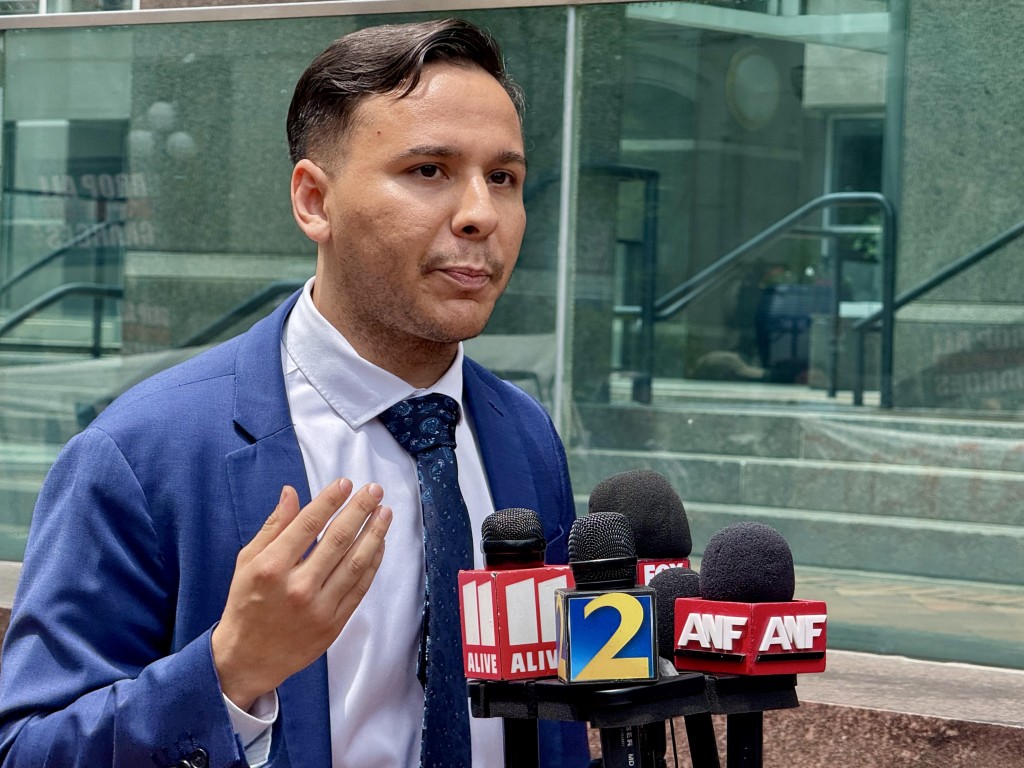
Deputy Attorney General John Fowler, lead prosecutor on the case, told the Court on Wednesday he brought 61 thumb drives with additional discovery, a surprise to defense attorneys. “We heard about a thumb drive today, for the first time ever,” de Janon said at a press conference following the hearing. “The state revealed that there’s more evidence in this case, 57 gigabytes of evidence.”
This discovery is in addition to the ten terabytes of discovery previously turned over to the defense, which attorneys said was uncategorized and included over 30 days’ worth of video footage and 27 days’ worth of audio recordings.
Assistant Attorney General Hallie Scott Dixon said the delayed discovery was due to the Dekalb County Police Department’s failure to turn over evidence regarding undercover agents.
Farmer chided the prosecution for its delay in turning over evidence. “If it’s the custody and control of the DeKalb Police Department, then it’s deemed to be in your custody and control. If they didn’t turn it over to you, you’re going to take the brunt of that.”
The late discovery production raised other concerns among defense attorneys.
“We not only have terabytes and terabytes of evidence already disclosed late,” de Janon said, “but now we have more evidence to review with a May 30 deadline.”
Defense attorneys also took issue with the timing of the new discovery, which came nearly a year after the May 17, 2024 deadline for discovery production that Adams set during a hearing last year. However, Adams did not put the order into writing, leaving Farmer to decide whether to allow the new discovery.
Farmer agreed with the concerns of defense attorneys, telling prosecutors, “[If/when] Stuff starts popping up two years old, people are going to call shenanigans on that.”
Some evidence may end up excluded from trials, Farmer warned, adding that he planned to set “hard deadlines” on discovery.
Defendants and court attendees subjected to heightened security
With 61 defendants, their attorneys, supporters and media, the hearing was well attended and moved to a larger courtroom.
Farmer ordered heightened security around the hearing.
The media, with the exception of pool cameras, watched the proceedings from an overflow room, reminiscent of an incident in November 2023, when Adams kicked out the media entirely to an overflow room.
Deputies instructed attendees in both the main courtroom and the overflow room to place their cell phones in pouches, which they then locked. Defense attorneys said their clients’ identification cards were taken in addition to their cell phones.
Amanda Clark-Palmer, who represents Timothy Bilodeau, said knowledge of the heightened security getting out to the public could prejudice a jury. She questioned the reasoning behind the additional security and requested the Court give notice to allow attorneys to argue against using those measures in the future.
Author