Working Families Party of Georgia launches ‘Wolf Packs’ to build progressive power
The group’s welcome gathering drew progressives and leftists from as far as Rome, Georgia, for a primer on how the party builds political power from volunteer constituents.
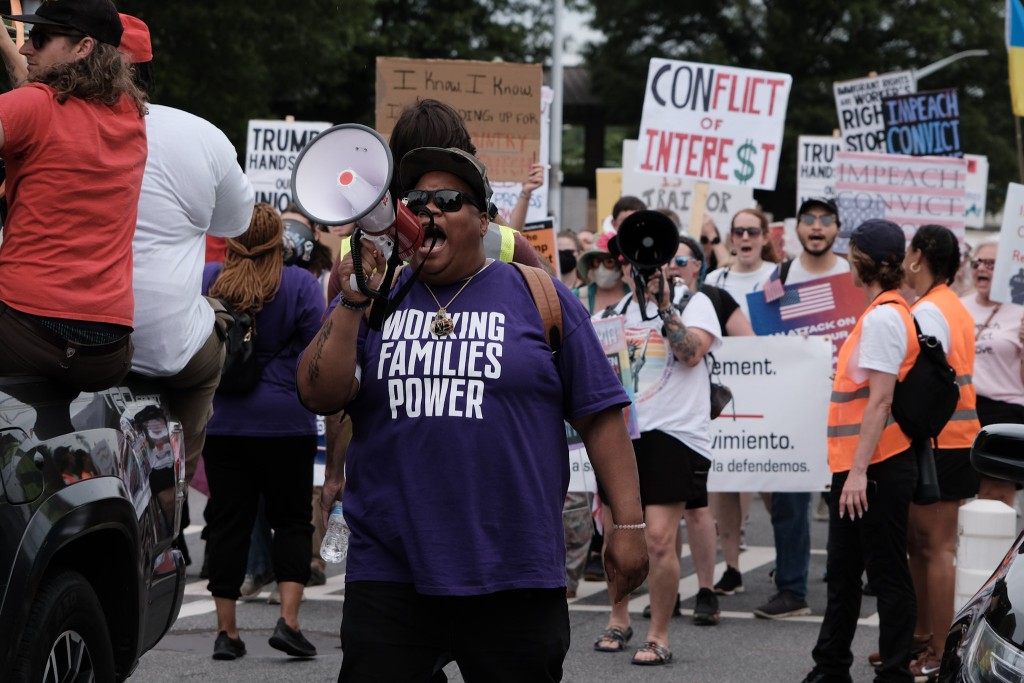
As numerous centrists and leftists in the U.S. have grown dissatisfied with Democrats’ responses to repressive and authoritarian measures from the Trump administration, many have been seeking a new political home for electoral politics. Locally, the same pattern has emerged. Mayor Andre Dickens and Atlanta City Council have repeatedly used tax dollars to fund the recently opened Atlanta Public Safety Training Center (known colloquially as Cop City) against the will of a majority of Atlantans. Similarly to the Trump administration, Dickens has cracked down on dissent with Gov. Brian Kemp’s blessing–leading many Georgians to find a more fitting political tribe.
A wolf pack to belong to, so to speak.
That’s what the Working Families Party (WFP), whose mascot is a wolf, calls each group of volunteer leaders. These leaders organize and recruit other impassioned progressives in their communities for political campaigns, whether issue-based or candidate-focused.
Growing the Wolf Pack
A core group of local WFP volunteer leaders hosted the party’s first Georgia Wolf Pack Welcome Gathering Saturday, May 10, at CreateATL in Atlanta’s West End neighborhood. They designed the meeting to expound on how they build local organizing groups and garner input from attendees on how they think that can best happen in Atlanta.
“It becomes your own personal Wolf Pack,” Atlanta Wolf Pack leader Hope Ogunsile said, explaining the importance of relational connections. “We go and find people that we believe have the same values as us, bring them over here, and say, ‘Hey, we got to get together, got to get to work.’”
Because WFP just started its Georgia Wolf Packs program, Ogunsile and her co-hosts were the lone members of the Atlanta Wolf Pack. In time, they anticipate growth throughout metro Atlanta, enabling flexible organizing at every level, from neighborhood to state.
“We want to stake a new center of gravity in our political life and drag everyone toward us,” said Michael Cortes, another Atlanta Wolf Pack leader. “Through our work, we’re going to start chipping away, start influencing the system so that we are creating that new space–and it’s going to look different everywhere. Not only on the electoral side of things, but building networks of power within our communities is just as important, if not more important.”
The group prioritized community input throughout the session, asking attendees what resonated with them, what didn’t, and to network in breakouts by exchanging political journeys and ideas.
“My dream party would look like a party of service, a party of democracy,” said Kyarah Barton of Oakland City.
Liz Peña, a longtime local now in East Point, said she attended because she wanted to help build a party for everyone, especially one that uplifts creatives, women and young people.
“I think young people have so much life–they’re ready to go,” Peña said. “They haven’t been beaten down yet, so I really appreciate recent college graduates, reminding me kind of how I felt at that age too. I went to Georgia State while Obama was being elected, so I was very much in the era of hoping things can change, and I bought into that. Times are obviously different, and I think the Democrats have done a really shitty job of progressing, so I was thinking about where I go (politically).”
Enacting political change
Scarlett Mayoralgo, WFP Middle Georgia organizer and Southeast compliance and ops coordinator, is one example of a young female leader Peña would like to see more of. Mayoralgo announced the Georgia chapter was progressing toward chartered status and endorsed Daniel Blackman for Public Service Commission in the June 17 election. She highlighted important issues of the Commission WFP wants to change, including:
- Halting eight years of price increases from Georgia Power–a monopoly, in her view.
- Undoing Republicans’ dominating the body in Georgia Power’s favor.
- Addressing Plant Scherer, the largest U.S. power plant emitter of greenhouse gases, located just north of Macon.
“This is the body that is supposed to regulate our utilities,” Mayoralgo said. “A lot of folks are not thinking about voting in June, which is why we started relational postcard programs.”
She said party research showed sending a personalized postcard to family and friends helped encourage voting, and invited allies to join weekly online postcard parties for Blackman each Monday in May. She also invited them to join WFP as members, with no dues obligation.
“We believe that paying money every month shouldn’t decide whether you’re a member,” Mayoralgo said. “We’re not reliant on Democratic infrastructure. It keeps a lot of people in the system that we know doesn’t work for us. We’re not just saying we’re different from the Democrats and we have different policies. We’re also building what you need underneath to win.”
What is the Working Families Party?
Founded in 1998 in New York, the Working Families Party defines itself as “a multiracial, feminist, working people’s political party of the American left that wins governing power to enact a structural reform agenda to save the planet and all the people on it.” The party website particularly calls out the wealthiest people on earth for rigging the U.S. political system in favor of the two major parties and notes WFP’s working-class policy successes.
In contrast with other third parties, WFP operates inside and outside the dominant two-party U.S. political system. WFP candidates both challenge Democrats in primaries and caucus with them, hoping to push the party left of its corporatist and centrist members. In other instances, WFP has run candidates as WFP on the ballot. These two strategies have resulted in WFP-endorsed politicians getting elected at every level. The Wolf Pack leaders contrasted these tactics with fully independent left-wing parties like the Green Party, which attendees agreed are better known for fleeting presidential campaigns than building sustained grassroots momentum with electoral and policy wins like WFP.
No paywall. No corporate sponsors. No corporate ownership.
Help keep it that way by becoming a monthly donor today.
Free news isn't cheap to make.
Related Articles

Local orgs fear further criminalized homelessness in HB 295, advanced from Public Safety Committee
The 8-5 vote marked the third straight year the bill proceeded to the House floor, where it was withdrawn last year without a full-House vote.