Why we protest: Voices of those fighting back during Trump’s first days in office
ACPC spoke to some of the hundreds of people who showed up in Gainesville, Georgia, in support of the immigrant community.
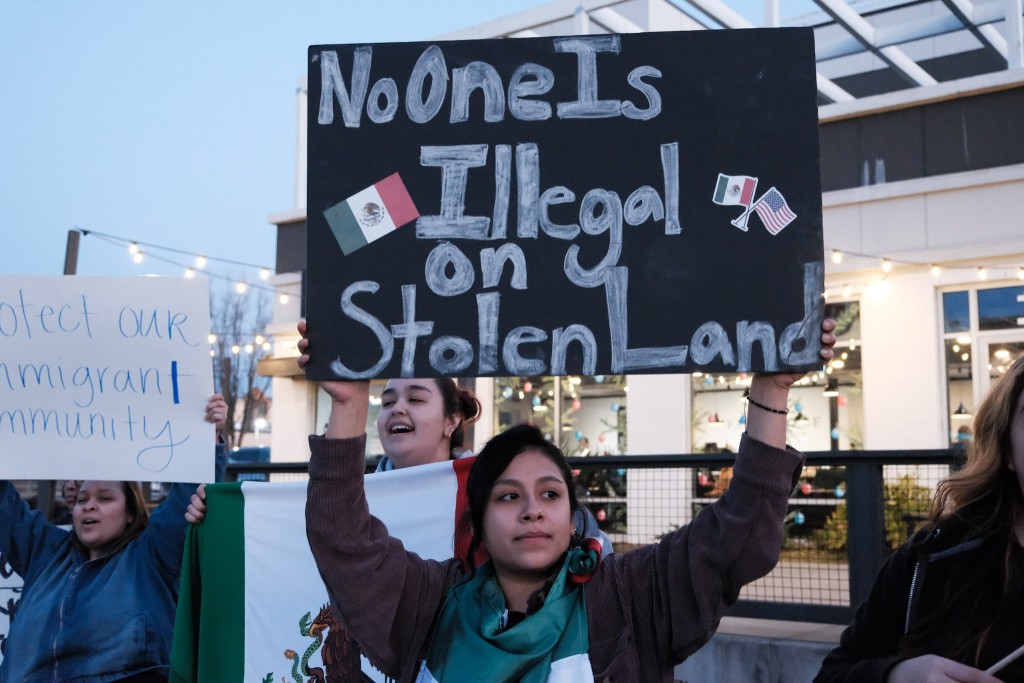
On Jan. 29, dozens of protestors with homemade signs lined a busy street in downtown Gainesville, Georgia, to protest the U.S. Immigration and Customs Enforcement (ICE) raids in immigrant communities that began across the country on Jan. 27, just days prior. As the sun set lower and the sky grew darker, the crowd grew from dozens to hundreds until there were people as far as the eye could see. Participants took to both the sidewalk and the street, driving their vehicles around the block, honking, flashing lights, flying flags and playing the music of their culture.
President Donald Trump’s anti-immigrant campaign promises came to swift fruition on his first day in office with the reinstatement of his “Remain in Mexico” policy and the suspension of asylum-seekers at the southern border. Other policies followed quickly, including authorizing local police officers to assist with immigration enforcement and increasing the use of civil search warrants in workplace raids.
When asked “Why are you here?” or “Why do you protest?” attendees said this demonstration was about much more than policy.
To them, this protest was about unity, community and standing in solidarity with immigrants across the nation.
Continuing the fight for immigrant rights
Kiaya Reddicks, a 27-year-old psychology major at the University of North Georgia, planned the event. “If ICE wants to come here, there is a community behind [immigrants], and they need to just know that we care,” Reddicks said.
Her father, a Jamaican immigrant, had a green card for a long time. But during the first Trump administration, he became a U.S. citizen because he was worried, she said. “When everybody walked up earlier, I was just filled with emotion and pride for my daughter for organizing this,” said Cindy Whelchel, Reddick’s mother.
Sue Perkins, 74 years old, protested throughout the ‘60s and ‘70s.
“In 2025, there should be no reason for any of this. We should have gotten past all this a long time ago,” Perkins said. “Who would have thought we would be doing it again decades later?”
Perkins has marched for various historical movements, from protests in favor of the Equal Rights Amendment to the fight against the Vietnam War. “It’s very similar. The energy is the same, the enthusiasm,” Perkins said. ”The people that don’t want their rights taken away; that doesn’t change over time.”
No paywall. No corporate sponsors. No corporate ownership.
Help keep it that way by becoming a monthly donor today.
Free news isn’t cheap to make.
Speaking out for those who can’t
A majority of the crowd were people in their teens and twenties. Many were there because their loved ones couldn’t be. Taking the place of undocumented parents, aunts, uncles, and cousins, they showed up for those who might be risking too much to attend.
“I know people personally who are here on DACA [Deferred Action for Childhood Arrivals] or they’re not here legally, and they can’t be here out of fear,” Nicole Juan said.
Juan Bernal qualified for DACA in high school. The program allowed immigrants who grew up in the U.S. to work and seek temporary protection from deportation. Now, he’s a U.S. citizen.
“Some of our folks didn’t come, because they are afraid with what’s going on: the deportations, the ICE, the raids,” Bernal said. “I’m seeing kids here that are here for their mom but they’re coming with a brother or auntie that are citizens. I’m glad that they’re here… We’re here, not only here in Atlanta but everywhere else.”
Sara, who wished to use a pseudonym to protect her privacy, says she’s here to fight for her people’s rights, particularly for her parents and aunt.
“They’ve been here. They pay taxes, just like everybody else,” Sara said. “And I don’t understand why they’re treated as less than human beings.”
For many, this was a celebration of their community and heritage. Yasmin Rojas brought her son with her for “baby’s first protest.”
“At first, he loved the noise; he thinks it’s a big party,” Rojas said. “And I told him that basically it is: we’re here for our people. He has to know he’s Mexican.”
Taking pride in culture and community
Heriberto Guteirez carried a Mexican flag and wore a serape, a shawl-like piece of traditional Mexican attire historically worn by vaqueros.
“If one person goes down, we all run to help each other. Not just my brothers and sisters from México,” Guteirez said. “Hondurans, Brazilians, Colombians, Panamanians, we’re here to support each other. We are not here alone.”
Guteriez rose his fist in the air for a chant that was heard throughout that night: “Long live México! Viva México! Viva America!”
Bernal said he was “shy at first” when coming to the protest. But eventually, he was rallying a large crowd, walking into the crosswalk during red lights and waving a large Mexican flag.
“I don’t tell them what to say, they already know what to say,” Bernal said. “I’m glad that they support me, not only México supports me, but I see Guatemala—all of their flags up there—Colombia.”
Rojas said she found out about the protest from a post on a Hall County Facebook page.
“I’m proud of Gainesville for doing this. I was so afraid that nobody was gonna show up. It was a spur-of-the-moment thing,” Rojas said. “It’s not held by any organization. It is literally just two or three young people, and that makes my heart happy.”
Seeing the turnout made Juan emotional. She was born and raised in Gainesville, whose population is roughly 30% Hispanic, and is the daughter of a Mexican immigrant. “Gainesville is to me home, and it’s home because there are so many of my people here,” she said. “We were just hoping to get our voices heard. We never expected so many people to come out.”
Author