Atlanta’s trans community demands safety on International Transgender Day of Visibility
This story has been updated to include additional reporting.
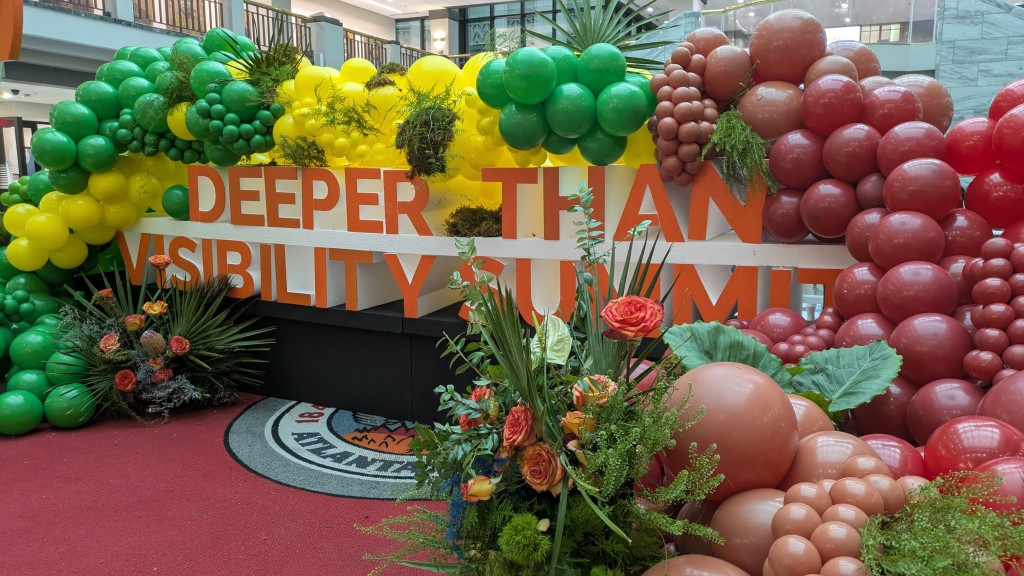
On Monday, March 31, community members gathered at Atlanta City Hall to commemorate International Transgender Day of Visibility (TDOV) via the “Deeper Than Visibility” Summit.
Organized by the Solutions Not Punishment Collaborative (SnapCo.), a Black, trans, queer led alternative policing organization, and the City of Atlanta’s Division of LGBTQ Affairs, the event invited attendees to go “deeper than visibility” by engaging in critical discussions on safety and empowerment within the community. People enjoyed a communal brunch and music by harpist Ahya Simone as they came together to build a stronger sense of community.
Omega Chuckii, an attendee at the summit said, “International Trans Day of Visibility is a day when trans individuals come out to celebrate the happiness and appreciation for who they are.”
Echoing that sentiment, Bentley Hudgins, panelist and Georgia State Director for the Human Rights Campaign, reminded the trans community that they are powerful. “Remember that you’re worth it, and remember that you’re supposed to be here. Protect your joy and your peace, and create moments of trans and queer love and joy and peace, because that is how we make it through this—because they cannot and will not defeat us as long as we keep loving each other,” Hudgins said.
The event featured a panel of organizers dedicated to the protection and advancement of trans rights. Many panelists emphasized the importance of unity across the LGBTQ+ community, especially in the face of Georgia’s recent anti-trans bills. They spoke about the need to educate community members on the legislation, contact and pressure elected representatives, and call attention to over-policing in Black queer communities.
Across the U.S. and in Atlanta, trans people of color are disproportionately affected by police brutality, according to SnapCo. The organization’s 2022 Deeper Than Visibility Report examined this issue. It studied the policing experiences of Atlanta’s marginalized communities and offered policy recommendations, which served as the foundation for the summit.

Push for more policing at odds with trans rights, advocates say
Panelist Dean Steed, SnapCo.’s communications director, shared his experience as a Black trans man within the Atlanta criminal legal system.
No paywall. No corporate sponsors. No corporate ownership.
Help keep it that way by becoming a monthly donor today.
Free news isn’t cheap to make.
In 2019, Steed was pulled over for a broken taillight. When the police searched his car, they found marijuana and charged him with a mandatory minimum sentence of ten years in prison.
After his arrest, Steed was placed in solitary confinement, a condition shared by 90% of incarcerated trans people, according to the Vera Institute, a non-profit think tank focused on criminal justice reform. Within the criminal legal system, solitary confinement is often referred to as “protective custody.” The United Nations classifies solitary confinement as a form of torture.
With support from his community, Steed was able to take a plea deal that reduced his sentence. He is now serving probation, but continues to face the pressure of the criminal legal system.
“I am subjected to random stops at my house by the police, random drug tests, and community service every month with the city of Atlanta,” Steed said. “And that’s just my story, but I know that there’s thousands of people with similar stories—especially right now, where we’re seeing Trump make policies targeting incarcerated trans people, forcing trans women into prisons with cisgender men, putting them in a more violent situation, and denying them gender-affirming care.”
Che Johnson-Long, a community organizer at Vision Change Win and SnapCo’s first organizing director, raised concerns about the rising number of state and federal bills targeting trans people, ongoing ICE raids, Mayor Andre Dickens’ efforts to block police reform in Atlanta and the controversial construction of the Atlanta Police Training Facility, known as Cop City. Critics say the 85-acre training ground will intensify police presence in Atlanta.
Johnson-Long told ACPC that the people of Atlanta have seen brutality against LGBTQ people at the hands of APD’s most aggressive units. Trans people, especially those of color, continue to face disproportionate targeting by law enforcement, according to the Prison Policy Initiative. Johnson-Long sees the city’s continued heavy investment in policing as at odds with furthering trans rights.
“I think that [Mayor Andre Dickens’] refusal to connect trans rights to policing is a message,” Johnson-Long said. “The amount of money that’s going into Cop City could very easily go into gender-affirming care health care in Atlanta and into services that keep trans folks housed, and so the city is very obviously making a choice to not invest in trans safety and instead to invest in trans targeting.”
Author

Related Articles
A Rohingya man in New York died under mysterious circumstances— his relatives in Georgia are grappling with the loss
Federal immigration officers left Nurul Amin Shah Alam outside a closed coffee shop in harsh winter weather— days later he was found dead. He was getting ready to move to Georgia, says his niece in Stone Mountain.