Anti-Confederate movement heats up in Stone Mountain

Controversy over a city cemetery in Stone Mountain is once again exposing a long and unresolved community struggle against neo-Confederate and far-right forces. On Feb. 5, several Confederate monuments in a Stone Mountain cemetery were tagged with blood-red paint in an alleged act of “vandalism,” according to a press release by city manager Shawn Edmondson.
The alleged vandalism occurred as Stone Mountain’s City Council has been considering a proposal by council member Theresa Crowe to relocate a Confederate historical marker from the cemetery to a more prominent location at the intersection of Silver Hill Road and East Ponce De Leon Avenue. The proposal has alarmed many in the 70% African American municipality of Stone Mountain. “There was no reason given,” says former City Councilmember Clint Monroe, “other than they want it in a more prominent place because they want to do Confederate tourism.”

Monuments to Hate
Debates over public history are often linked to struggles against racism and fascism, and the City of Stone Mountain rests in the shadow of one of the largest public history controversies in the United States. The granite mountain that looms over this suburban municipality displays the world’s largest high-relief carving on its north face, depicting three Confederate leaders who fought to preserve slavery during the U.S. Civil War. The Ku Klux Klan-affiliated Venable family once owned the mountain and operated a granite quarry there for many decades while also hosting cross-burnings on the mountain’s summit throughout the first half of the 20th century.
Racist symbology in the area, however, is not confined to the mountain or the state park. The City of Stone Mountain—once a headquarters of the Ku Klux Klan—still hosts a number of smaller Confederate monuments and streets named after known Klan leaders.

While racist monuments have made Stone Mountain famous, the city has also been home to a sizable Black community since the 1860s. As more Black families moved to the area in the 1980s and 1990s, many of the old white elite moved out. A small number have remained, and their lingering influence continues to vex the now-majority-Black community.
Through public-facing organizations like the Sons of Confederate Veterans (SCV), white nationalists have collaborated with local politicians to install and maintain Confederate monuments on city property—antagonizing many residents.
The city cemetery has become a focal point for this tension.
No paywall. No corporate sponsors. No corporate ownership.
Help keep it that way by becoming a monthly donor today.
Free news isn’t cheap to make.
Monroe has been vocal on the cemetery issue. While he objects to vandalism in general, he points out that there are no actual bodies buried under most of the cemetery’s Confederate monuments. False headstones, a large obelisk, and a 30-foot flagpole were all installed privately by the SCV—some as recently as 2012—in a section of the cemetery visible from the street but where no bodies are interred. “No graves would be desecrated by removing those headstones,” Monroe says.
Stone Mountain and the Far-Right
While the SCV describes its mission as “honoring history,” the organization maintains longstanding ties with more openly violent white supremacist groups. The SCV “Georgia Division” spokesperson, Martin O’Toole, is a self-identified “racist,” and is widely acknowledged as having been the publisher of a neo-Nazi newspaper called Völkischer Beobachter.
Many other SCV members hold overlapping memberships with League of the South and other racist extremist groups, The Guardian reported in 2022. The infamous Chester Doles of Lumpkin County is a member of both organizations, and “a former Klansman and member of the neo-Nazi National Alliance,” according to The Guardian. SCV and League of the South members participated in the deadly 2017 Unite the Right rally in Charlottesville, where anti-racist activist Heather Hayer was murdered.
Neo-Confederate groups are also among the most ardent supporters of President Donald Trump, who has gone out of his way to return the affection. While he once advocated removing Confederate flags from government buildings, Trump eventually pivoted to become an ardent defender of Confederate monuments.
There is a growing movement in Stone Mountain demanding that public funds not be spent to maintain Confederate and Klan monuments that have been installed by hate groups. Meanwhile, a local non-profit organization called Village Forward has been lobbying the City Council to support tourism in the cemetery. City Council member Theresa Crowe—who proposed moving the Confederate cemetery sign closer to the street—often attends Village Forward’s public events and voted against a resolution to remove the SCV’s Confederate flag and flagpole from the cemetery in 2023. The measure failed. The flag was later removed by parties unknown.

Community Outrage
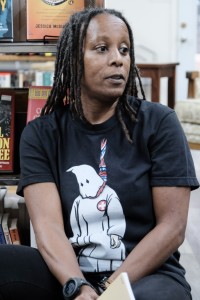
Erin Parks, a long-term resident of Stone Mountain and former teacher in DeKalb County Schools, laments that “we continue to live in a society that values dead racists over living humans.” She says it’s “appalling” that public money has been used to clean the graffiti or otherwise maintain the SCV’s racist monuments. “City funds,” she says, “should be used to care for living human beings, not to preserve the spectacle of the Confederacy.”
Meymoona Freeman, former member and co-founder of Stone Mountain Action Coalition, expressed a similar view. “Any time elected officials want to allocate time and resources from the city to support, extend, or focus attention on the Confederacy … that’s a problem.” She says, “It shows that their priorities are with the Confederacy and not with their citizens.”
Freeman notes that, like many “sundown towns” across the South, Stone Mountain seems to have in place a small and unofficial “white citizens council” that asserts outsized authority and influence over local politics and frustrates any efforts at change in the community.
“Stone Mountain,” Freeman says, “is like a modern-day plantation and maintains an oppressive social hierarchy.”
Proposal Walked Back
During the City Council meeting on Feb. 18, several residents offered public comment against Confederate tourism in the city cemetery and demanded the removal of Confederate monuments. Village Forward Chair Jelani Linder and Councilmember Teresa Crowe both responded that the public simply misunderstood Crowe’s proposal.
“It was never, ever the intent to move that sign to a more prominent location,” said Crowe. “That’s misinformation.” Seemingly embarrassed, she asked for the item to be tabled and removed from the agenda.
Linder made similar remarks while also invoking a peculiar image of “unity” that seemed to include neo-Confederate memorials. He praised Atlanta’s Oakland Cemetery as an example of city grounds where Confederate monuments could exist beside “other monuments” to “diversity and inclusiveness,” which he hopes the city will build in the future.
Linder neglected to mention that Oakland Cemetery removed Confederate monuments in 2021 due to vandalism and public opposition. The City of Decatur has also removed Confederate monuments. It remains to be seen whether Stone Mountain’s government will follow the examples of its neighbors.
Despite the ongoing struggle against far-right neo-Confederate interests, Erin Parks sees reason for optimism in Stone Mountain, both in the municipality and the state park: “On any given day, you can see a multitude of Black people running, laughing, and smiling in an area where the fathers of the Confederacy would have gagged to see us live. We are using a place that was built to terrorize us to better ourselves. That is encouraging to me. It gives me some hope.”

Comments (1)
Comments are closed.