
On second anniversary of slain forest defender Tortuguita’s killing, hundreds march on for collective liberation
FROM NOW UNTIL DECEMBER 31, NEWSMATCH WILL MATCH ANY NEW MONTHLY DONATION 12X OR DOUBLE ANY ONE TIME GIFT UP TO $1,000.
All donations to ACPC are tax-deductible and go directly to powering our newsroom.
Will you show your support for local news?
All donations to ACPC are tax-deductible and go directly to

Correction: This article to correct a caption to state that Cornelius Taylor was killed by City of Atlanta Department of Public Works employees during an encampment sweep.
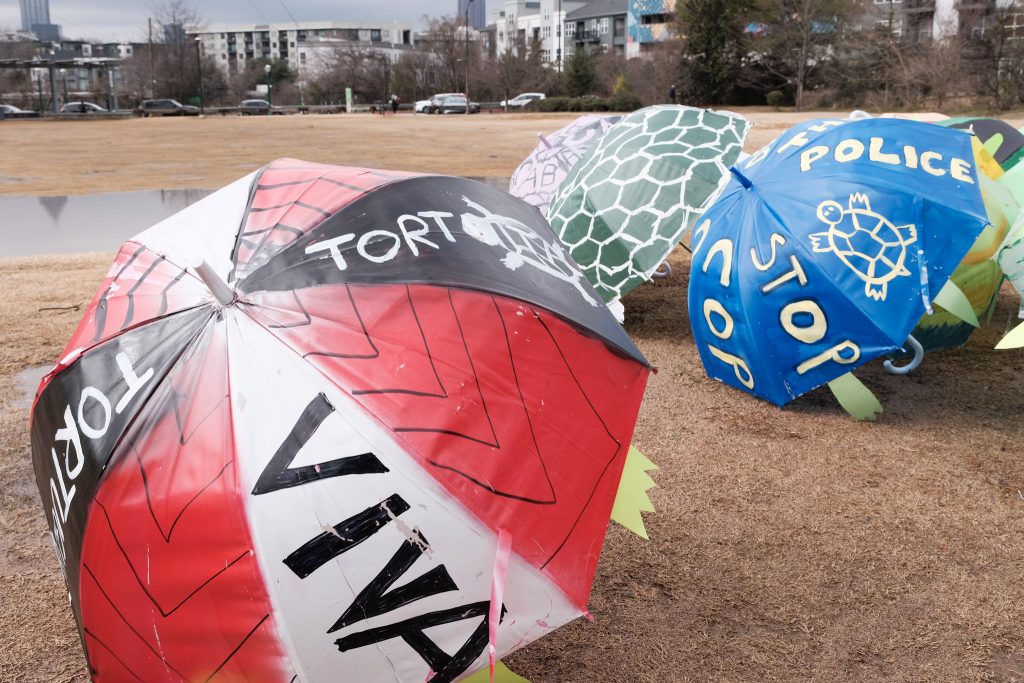
ATLANTA — On a date marked as a Day of Resistance, community members marched on Saturday with a colorful procession of umbrellas decorated as turtles, all to honor the Day of the Forest Defender—the second anniversary of the death of police-slain environmental activist Manuel Esteban Paez Terán, known as “Tortuguita.”
Upon the December soft opening of the Atlanta Public Safety Training Center or Cop City, which Tortuguita was protesting when they were killed by law enforcement, many wondered where the Stop Cop City movement would turn.
“This crowd behind us and with us continues to work to stop Cop City,” Community Movement Builders founder Kamau Franklin said. “We want to make sure that the larger Atlanta community—that the politicians, that the corporations—understand and know that this battle is not over.”
Hundreds of community members and at least 16 organizations marched along the Beltline on Saturday afternoon, from Old Fourth Ward Skatepark to the offices of BlackRock, which, as the world’s largest asset manager, has significant connections to corporations backing Cop City.
These connections’ harm of the environment, communities and public safety were exactly what Tortuguita opposed while occupying the Weelaunee Forest in January 2023, near where Cop City now stands.
“We’re here today to celebrate the legacy of Tortuguita,” said Geovani Serrano, community organizer of Georgia Latino Alliance for Human Rights. “We are supposed to be fighting to continue their legacy each and every day, for ancestors and the people taken away by law enforcement. We’re in a community that understands the criminalization of our bodies, that understands we need to invest more in our communities to protect the environment, to protect our communities.”
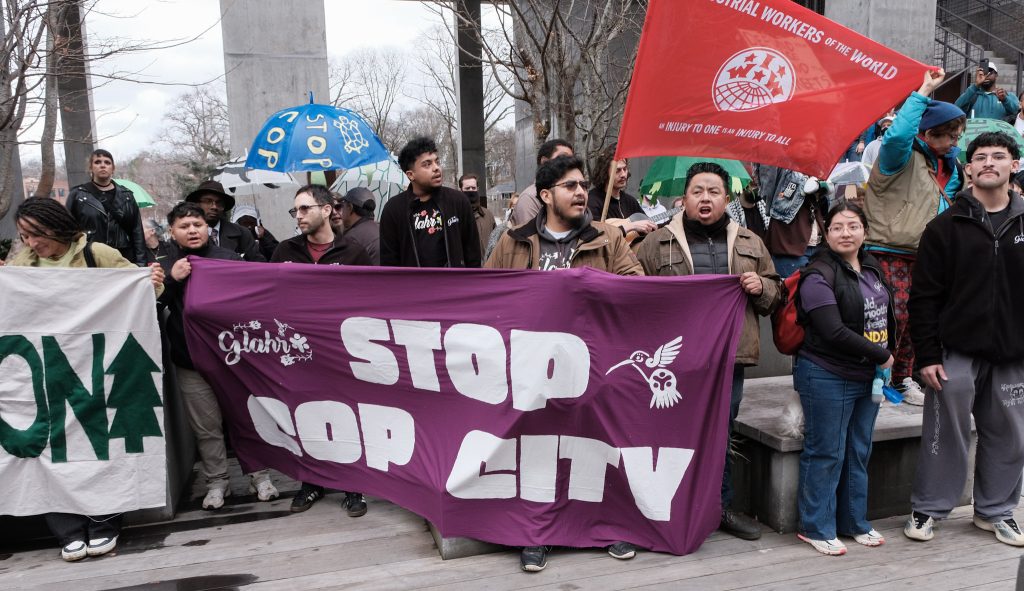
Sister Song Georgia coordinator Danielle Rodriguez echoed the criminalization of bodies as she addressed the intersection of abolition and reproductive justice, particularly the dire outcomes for Black women.
“I was one of the Black women protesting Cop City outside the mayor’s home, demanding that the voices of our community be heard,” Rodriguez said. “I stood there for Black mothers and parents seeking care, and for families who deserve investment in life, not policing. In Georgia, Black women are dying. … This is the devastating intersection of a criminal legal system that views our bodies as suspect and a health care system that was never built to save us.”
A series of speakers as varied as the polychrome parade of parasols likewise connected their issues to Cop City, police overreach and Atlanta’s enmeshed politicians and corporate interests. They often rose to national and international levels to address interconnected problems, aligning with Stop Cop City’s nationwide evolution into No Cop Nation. Black poets spoke of their experiences with police brutality and broader unjust economic and white supremacist systems. The Movement Mass Choir of Atlanta sang of inherited legacies of perseverance and maintaining hope and joy amid repression. Standing Rock Sioux Movement members explained how all people’s struggles are connected, from the modern militarized policing instigated against them to common Atlanta usage of a chant they created. And Tortuguita’s mother, Belkís Terán, promoted helping and healing as love in action.
In breakout groups, the crowd also had an opportunity to talk about wider issues like safety, community, harm and accountability. Each group member received a card with a question related to one of these topics, leading to exchanges of perspectives on what roles victims and perpetrators play in accountability, when people are likelier to forgive than avenge, and many different needs for safety.
Speakers outside BlackRock addressed what those might look like for homelessness and several prominent local victims of state violence, whose names appeared in the middle of trees on a set of signs.
“We are losing lives every day, whether Palestine or here,” said, Palestinian organizer Jawahir Kamil Sharwany. “We lost a life two days ago, Cornelius Taylor, to homelessness.” She and Housing Justice League organizer Matthew Nursey expounded on how greed from governments like Atlanta’s and corporations like BlackRock directly causes deaths like Cornelius’s and much more devastation, from longstanding global colonialism and imperialism to local street sweeps like the one that killed Taylor.

“Housing Justice League has its roots fighting corporations like BlackRock since the financial crisis back in the late 2000s,” Nursey said. “Corporate landlords have bought properties all throughout this city and put legacy residents out of where they’ve been living forever. Capitalism has failed us, and the ruling class — the people that make up BlackRock — they know this. And that’s why they use violence as their number one tool.”
The duo urged marchers to pack Tuesday’s 1 p.m. Atlanta City Council meeting to demand an end to street sweeps and justice for Taylor, among many calls for the public to get involved in the movement.
Terán said that since losing her child to police violence two years ago, resisting has not always been easy, but she encouraged attendees to find the will to fight. “We know that the system is very destructive. We know that the system wants to do only for money,” Terán said. “But no, we have to stand up, fight, and take a solution for the community.”


No paywall. No corporate sponsors. No corporate ownership.
Help keep it that way by becoming a monthly donor today.
Free news isn't cheap to make.
Related Articles

Justice for Cornelius Taylor Coalition continues community care activism with The People’s Table
Organizers fed and supplied more than 100 unsheltered Atlantans just outside City Hall, the Capitol and the Department of Public Safety in a show of how easily the three could serve them.
Public Service Commission meets scathing public backlash with stipulated agreement for Georgia Power expansion
While protesters preceded Wednesday’s Public Service Commission hearing with a press conference and in-chamber disruption, the Commission announced a stipulated agreement accepting Georgia Power’s full 10,000-megawatt expansion.
Mayor promotes new Constituent Service chief who was subject of an inspector general investigation
The Office of Inspector General found that in 2022, Vanessa Manley used her position in the city for personal gain, failed to disclose outside employment and submitted a false invoice.
