Students stage sit-in at Board of Regents meeting, call for Georgia universities to divest from Israel

Correction: This article has been updated to correct the spelling of Lydia El-Sayegh’s name.
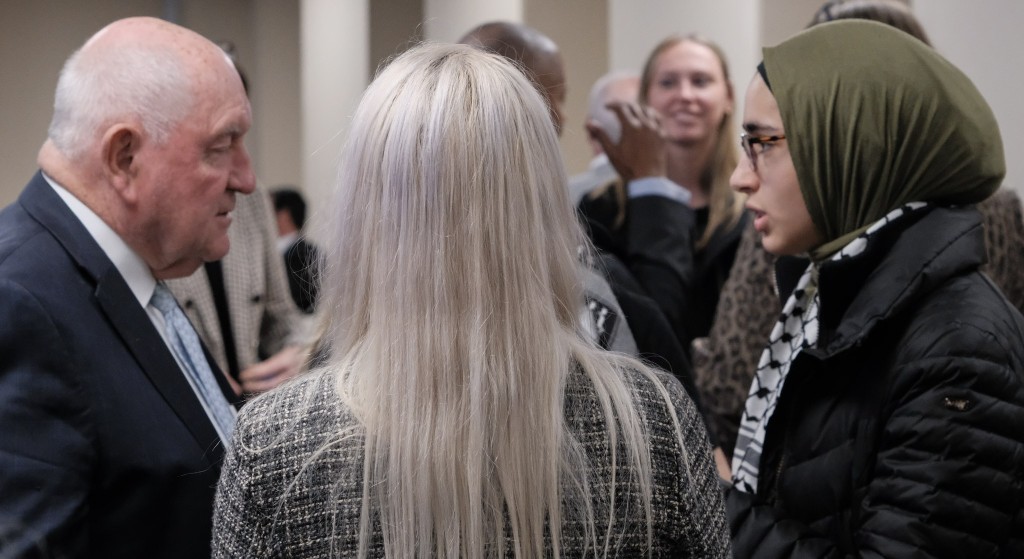
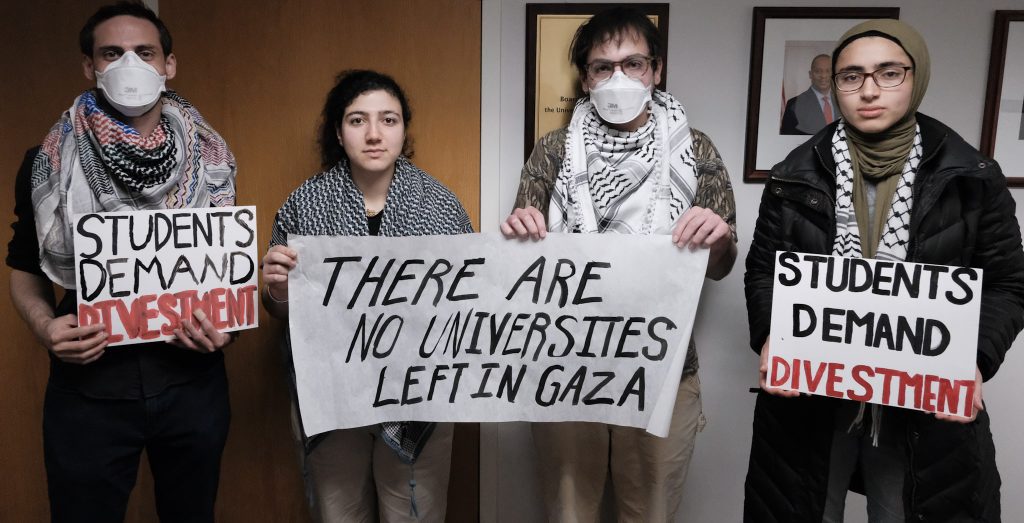
ATLANTA — People wearing keffiyehs around their necks and carrying signs reading “STUDENTS DEMAND DIVESTMENT” lined the halls leading to the University System of Georgia (USG) Board’s meeting room on Tuesday. These people, about 25 in total, included students, alumni and those standing in solidarity with them — from an educator to a state representative. Together, they advocated for local change that would impact the residents of Gaza in light of Israel’s ongoing genocide of Palestinians.
When the board meeting began, people filed into the room with some of the demonstrators distributing a one-page flyer about who they are, introducing themselves to board members and thanking them for the opportunity to be present. As the board began their regular business, students filled the front rows, silently holding signs throughout the entirety of the meeting, serving as a backdrop for the Regents’ every word.
Tuesday’s sit-in followed a letter sent to the USG in December by 12 student organizations across the state, requesting the opportunity to address the Board of Regents at the January meeting. The letter read, “As students, we are gravely concerned by the humanitarian crisis currently occurring in Gaza as well as any role that our institutions may be playing in the crisis via financial and research partnerships. We are hoping to discuss this topic and receive some transparency regarding USG investments.” The students never received a response.
“We’re here to demand that the USG fully divest from Israel and also that it compel all of its member institutions to divest, said Austin Kral, a computer science major at UGA. “That includes academic partnerships and research collaborations any universities might have.”
Georgia State University has come under fire for its Georgia International Law Enforcement Exchange program, also known as GILEE. The GILEE program is notorious for sending American law enforcement officers, including those with the Atlanta Police Department, to Israel to train with Israeli police. According to the Demilitarize Atlanta to Palestine Coalition, “The Israeli Occupation test out weapons and military tactics on Palestinians, then deadly exchange programs such as GILEE spread these tactics across the globe. … For over 30 years, GILEE has quietly advanced militarized policing, mass surveillance, and escalated warfare on marginalized populations in Atlanta and Palestine.”

For Palestine
Lydia El-Sayegh is a Georgia Tech alumna who participated in Tuesday’s demonstration. She participated in Tuesday’s demonstration for several reasons, the most personal being to show support for her family who are currently in Gaza, including her great aunt who is 91 years old. El-Sayegh described being on the phone just the other day with her grandmother in Gaza, who reported that a nearby school had been bombed.
“They don’t have proper nutrition, [my great aunt] has had kidney challenges, but no medical treatment. It’s been really awful,” El-Sayegh said.
No paywall. No corporate sponsors. No corporate ownership.
Help keep it that way by becoming a monthly donor today.
Free news isn’t cheap to make.
Renee Alnoubani is a student at Georgia Tech and president of the Muslim Students Association. As a Palestinian, she said violence against her people is something she’s been watching happen her entire life.
“There are no universities left in Gaza and that’s why we’re here,” she said. “When numerous human rights organizations and countries all over the world and governments have established that what’s going on isn’t apartheid, it’s genocide and they don’t do anything about it? It’s very strange to think about a public institution not fighting for the worst crime against humanity that can be committed in the world.”
As for next steps, Alnoubani said student organizers spoke with Chancellor Sonny Perdue and Chairman Dallas Smith, who asked them to send the Board more information.
“We’re going to try to work with [USG] the best we can because we understand that it is difficult to divest and we are more than willing to work with them because ultimately when that is achieved, it will save so many lives,” she said. “I call on them: it’s never too late to stand up for justice, to be good leaders.”
The Spring of Protests — and Arrests
Last year, students on college campuses across the country participated in protests against the attacks on Palestine. On the University of Georgia (UGA) campus, a protest on the North Quad lawn in April 2024 resulted in the arrest of 16 people, including nine UGA students. Kral was one of them. He and some of the other arrested students were suspended for an entire semester. Instead of graduating this past December as expected, he will now graduate in May.
Kral said that students at UGA were concerned about the university’s involvement with military defense contractors and weapons manufacturers. On Tuesday, he condemned defense contractor Lockheed Martin’s partnership with the UGA College of Engineering.
After Oct. 7, 2023, student organizers requested a meeting to discuss their concerns with the UGA administration for months, to no avail.
“They weren’t responsive at all, so we wanted to take up space and make sure they couldn’t ignore us anymore,” Kral said. “The university just escalated it in a really unnecessary way, because they didn’t want to have a conversation.” He called UGA’s actions “cowardly.”
When asked about demonstrators’ demands at Tuesday’s sit-in, a representative for USG told the Atlanta Community Press Collective via email, “The University System of Georgia encourages free expression and respectful civil discourse. We support the right to peaceably assemble and appreciate the students expressing their views as provided by the First Amendment.”
When it comes to the right to free speech and protest on campus, El-Sayegh said that students have historically shown they are the “moral compass” of the country, referencing the student protests during the Civil Rights movement and against the Vietnam War.
“Especially on university campuses, in a place where knowledge is produced, you need to be able to challenge and create dialogue, especially about global issues that affect human rights,” she said.
Gabriel Sanchez, a representative for State House District 42 who attended Tuesday’s demonstration, said for him, solidarity with Palestine is about shared humanity.
“Innocent civilians being murdered is a travesty, and so that’s why I’m here. It’s for morality, it’s for human decency and for human rights,” he said. “It’s important for us to always stand for oppressed people wherever they are. And right now, Palestine needs our help.”
Mutual Protection
Adam Brunell is an educator who heard about the protest through local Jewish groups that support Palestine.
“I know I’m wearing a yarmulke, but there are other Jewish supporters who unconditionally support the organizers’ demands,” Brunell said. “The Israeli apartheid system of cruelty and violence is so evil that anyone from any background can easily see [that].”
Beyond her family and being Palestinian, El-Sayegh is also motivated by her faith as a Christian — commenting on the inclusivity of various religious beliefs within the movement.
“My faith not only calls to stand up for the oppressed but also is in solidarity with [them]. I believe that Jesus died, executed by the state. He was homeless, he was a refugee. He experienced a lot of what Palestinians experience,” she said.
Kral said it’s “everyone’s moral obligation to try and stop a genocide.”
“If we allow it to happen there, it can happen anywhere,” he said. “We’re going to be here at the board meetings until we get divestment.”
Author

Related Articles
A Rohingya man in New York died under mysterious circumstances— his relatives in Georgia are grappling with the loss
Federal immigration officers left Nurul Amin Shah Alam outside a closed coffee shop in harsh winter weather— days later he was found dead. He was getting ready to move to Georgia, says his niece in Stone Mountain.