Stop Cop City for Public Health
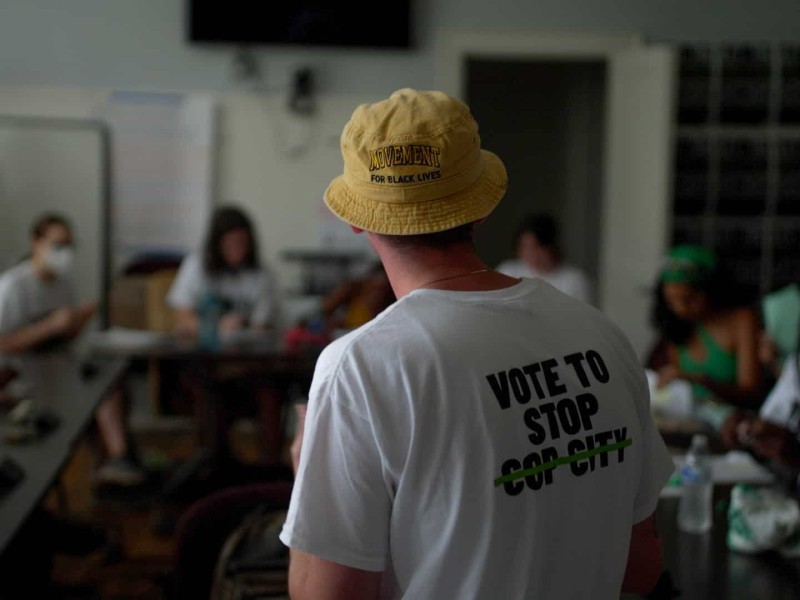
For public health workers, the Stop Cop City movement inspires nationwide organizing around abolition and planetary health. Public health workers joining the movement are connecting with each other through community organizing meetings, public demonstrations, labor unions, and professional associations like the American Public Health Association (APHA). The movement often begins with activists on the ground building relationships with public health workers who understand the influence of the carceral state on the health of the people and the planet.
Why would public health workers care about this? Policing, violence, and destruction of shade forests threaten public health. As Mark Spencer, an Atlanta physician and expert on policing, incarceration, and health equity, said, “This has always been about getting people to understand that further investment in policing does not make us safer. There’s something about police power that already permits them to be able to destroy this forest.”
To public health workers, the Stop Cop City movement and the abolition of policing and carceral systems are not matters of politics; they are matters of public health, environmental justice, racial justice, Indigenous sovereignty, and civil rights. Policing and carceral systems are costly, ineffective, and impact the social, mental, physical, and environmental health of the surrounding community. Further, they divert investments away from essential public health infrastructure that prevents harm and promotes mental, social, and environmental wellness. Health experts agree that investing in life-affirming institutions and the equitable distribution of social determinants like affordable housing, access to quality education and health care, community and social supports, good jobs, nutritious foods, and clean air and water will improve health outcomes for all of us.
Last year, Dr. Spencer and other public health activists in Atlanta noted that the annual meeting of APHA would be occurring at the Georgia World Congress Center. APHA is the largest professional organization of public health workers in the United States and typically has more than 13,000 attendees at its annual conference. The activists reached out to public health workers who were APHA members for support in organizing and raising awareness.
Public health nurses who were members of APHA got involved. They asked an outside advocacy group, the Alliance of Nurses for Healthy Environments, to start a petition to Mayor Andre Dickens to revoke the lease agreement with the Atlanta Police Foundation.
Human Impact Partners, a national public health non-profit, supported public health workers in drafting a late-breaking policy statement against Cop City at the same annual APHA meeting. When they heard about the nurses’ petition, they joined forces to persuade the APHA to take a stand to Stop Cop City.
The public health workers began organizing a Stop Cop City rally during the conference to demonstrate solidarity with the greater movement and bring more awareness to the issue. They submitted this late-breaking policy statement to APHA’s Joint Policy Committee, building off of previous APHA statements against police violence, environmental injustice, carceral systems, and structural racism. In short, public health workers argued that Cop City embodies these public health crises.
APHA’s Joint Policy Committee, which reviews proposed policy statements, rejected this policy statement before the start of the conference in mid-November, just as the Block Cop City nonviolent march from Gresham Park to the construction site was occurring. And despite initial encouragement from nursing leadership within APHA, support for the rally cooled as the conference date drew nearer, held back by the refusal of the Georgia Public Health Association to support calls to Stop Cop City.
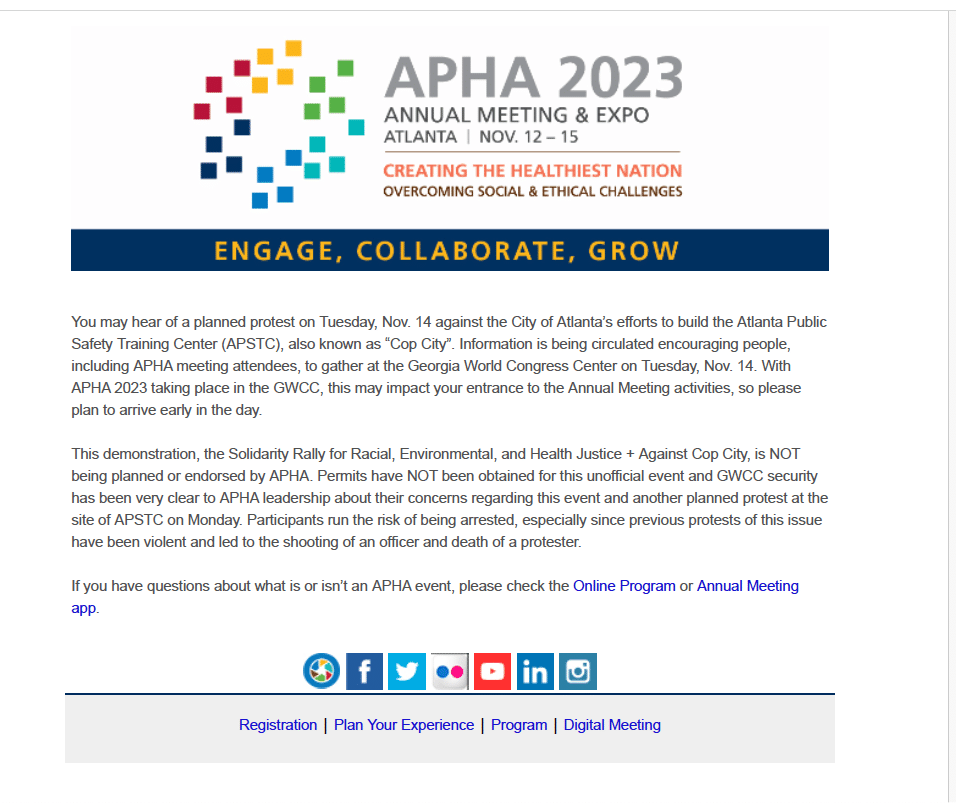
What was most disappointing and chilling was witnessing APHA leadership actively discourage its membership from attending the public health worker Stop Cop City rally. This included sending out a misleading message at the start of the meeting to attendees that used fear tactics to discourage participation, stating that “participants run the risk of being arrested, especially since previous protests of this issue have been violent and led to the shooting of an officer and death of a protester.”
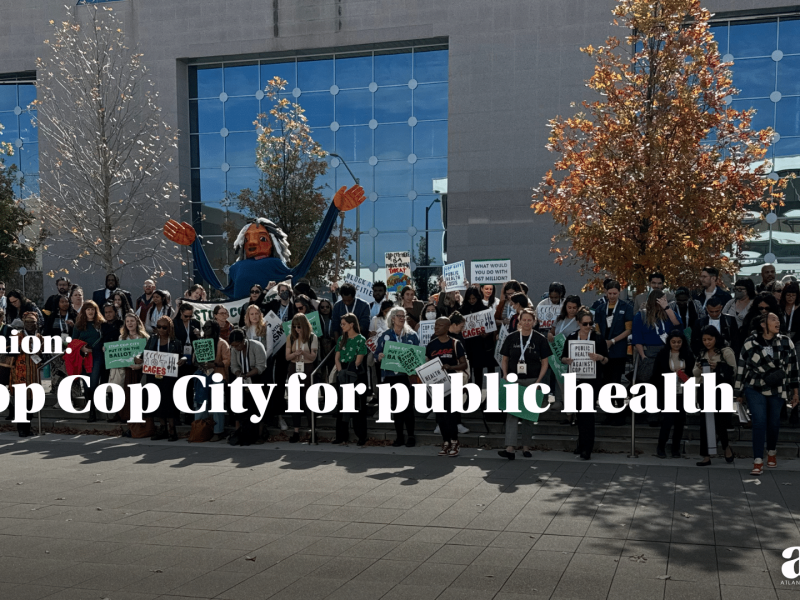
Despite these threats, more than 150 physicians, nurses, students, and other public health workers attended the peaceful Stop Cop City rally on Nov. 14. Police were present, primarily observing from the margins around and inside the convention center. The organizers considered this a successful movement-building event for public health workers from Atlanta and across the country.
No paywall. No corporate sponsors. No corporate ownership.
Help keep it that way by becoming a monthly donor today.
Free news isn’t cheap to make.
Katie Huffling, executive director of the Alliance of Nurses for Healthy Environments, addressed the crowd, saying, “Destroying 381 acres of forest – the ‘lungs of Atlanta’ – to build the largest militarized training center in the United States for urban warfare escalates public and planetary health threats at a time when we need to be looking for peaceful solutions to violence and strong climate action.”
Through organizing and attending this rally, public health workers are mobilizing to address the important connections between abolition, Indigenous sovereignty, climate justice, racial justice, and public and planetary health. New challenges are emerging that demand such a national movement, from Cop City projects in other cities, land-back and advancing the sovereignty of Indigenous Peoples, ecological restoration, and reparations to Black, Indigenous, and People of Color most impacted by environmental injustice and carceral system investments.
Public health workers are urging policymakers to challenge the inequitable distribution of the social determinants of health and to reallocate funds to affordable and dignified housing, public transportation, food security, climate adaptation, community safety, and mental health resources.
Join the call to action and add your name to the growing list of public health workers and allies declaring Cop City in Atlanta a public and planetary health crisis and demanding its stop.
Renae Badruzzaman, MPH is the Health Instead of Punishment Project Director for Human Impact Partners based in California. Alex Dudek, RN, MPH is a public health nurse and ANHE Fellow based in Wisconsin. Robin Evans-Agnew, RN, PhD is a public health nurse, associate professor, researcher, and ANHE member based in Washington State. Jessica LeClair, PhD, MPH, RN is a public health nurse, educator, researcher, and ANHE member based in Wisconsin. Renae, Alex, Robin, and Jessica were a small part of the group that organized the Stop Cop City rally at APHA.
Related Articles
Georgia Court of Appeals will take up ‘Cop City’ RICO case
Attorney General Chris Carr appealed Fulton County Superior Court Judge Kevin A. Farmer’s dismissal of racketeering charges against 61 people. The Georgia Court of Appeals accepted the application on Wednesday, despite process challenges from the defense.
What’s happening with the Cop City domestic terrorism, RICO charges?
In Fulton County, a judge dismissed the 61-person Cop City racketeering charge while also ruling that domestic terrorism charges could move forward. On the same day, an activist filed a motion to dismiss her domestic terrorism charge in DeKalb County.